
Reviewed · DMZ TOURS
DMZ Tour, 2nd Tunnel & UNESCO Suspension Bridge Tour from Seoul
The border feels close here. This full-day trip pairs the 2nd Tunnel with the Hantangang Sky Bridge, giving you both Cold War history and striking volcanic scenery. I like the clear variety, and I also like that lunch is left flexible, with guide Leo known for taking his group to a good local Korean restaurant. The main drawback is the long day, with roughly four to five hours spent on the road.
The tour costs $87 per person and includes an English-speaking guide, transportation, taxes, and entry fees for the paid sights. You should expect an early start, a moderate amount of walking, and a large group that can reach 80 people.
In This Review
- Key points to know before booking
- Why this DMZ day trip is different
- The 2nd Tunnel, a concrete reminder of invasion plans
- Cheorwon Peace Observatory and the view across the DMZ
- Korean Workers’ Party Headquarters and the marks of division
- Woljeongri Station and the stopped railway
- Hantangang Sky Bridge and volcanic cliffs
- Bidulginang Waterfalls, a short final stop
- The long road from Seoul and what the $87 covers
- Who will enjoy this tour most
- Booking flexibility and practical details
- Should you book the Cheorwon DMZ tour?
- FAQ
- Where does the tour begin and end?
- What time does the tour start?
- How long does the tour last?
- Is lunch included?
- What is included in the tour price?
- How much of the 2nd Tunnel can you visit?
- How physically demanding is the tour?
- Can I cancel for a full refund?
Key points to know before booking
- The 2nd Tunnel reaches 3.5 kilometers underground, though only about 500 meters is currently open for exploration.
- Cheorwon Peace Observatory provides views toward North Korean guard posts, as well as the surrounding border area.
- The Hantangang Sky Bridge is known from the drama Crash Landing on You, with views into a UNESCO Global Geopark.
- The route includes the Korean Workers’ Party Headquarters and Woljeongri Station, two stark reminders of the divided peninsula.
- This is a long excursion from Seoul, lasting about 11 to 13 hours including the return drive.
- Guide Leo receives especially warm praise, with his friendly manner and local restaurant suggestion adding a personal touch.
Why this DMZ day trip is different
Many DMZ trips from Seoul focus on the best-known sites near Paju. This one heads north to Cheorwon, a quieter area with a different feel and a stronger connection to the Korean War battlefront.
You are not simply looking at a border fence from a bus window. You walk into a tunnel built for military invasion, visit a former North Korean party headquarters, see a ruined railway station, and look toward North Korea from an observatory. Then the mood changes completely at Hantangang, where cliffs, basalt columns, waterfalls, and a suspension bridge take over.
I like that contrast. The tour connects political history with the physical setting that shaped it. You see why the region mattered militarily, then you see the river valleys and cliffs that made movement difficult and gave the area its unusual scenery.
The tradeoff is time. With a 7:00 am departure and a total duration of 11 to 13 hours, this is not a casual half-day outing. The long drive is part of the price of reaching Cheorwon, so you should book it because you want this particular combination of sites, not simply because you have one spare afternoon in Seoul.
More DMZ tours:
- Best DMZ Tour Korea from Seoul (Red Suspension Bridge Optional)
★ 5.0 · 41,422 reviews - DMZ Tour: 3rd Tunnel, Option(Suspension Bridge, Boat) from Seoul
★ 5.0 · 21,373 reviews - DMZ tour south Korea from Seoul (NK experience hall, defector)
★ 5.0 · 20,599 reviews
The 2nd Tunnel, a concrete reminder of invasion plans
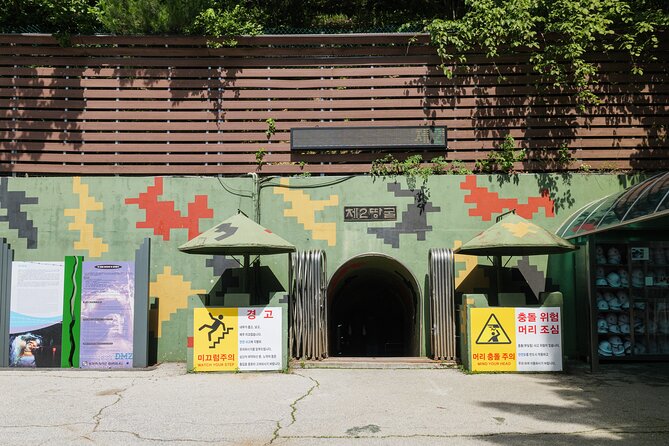
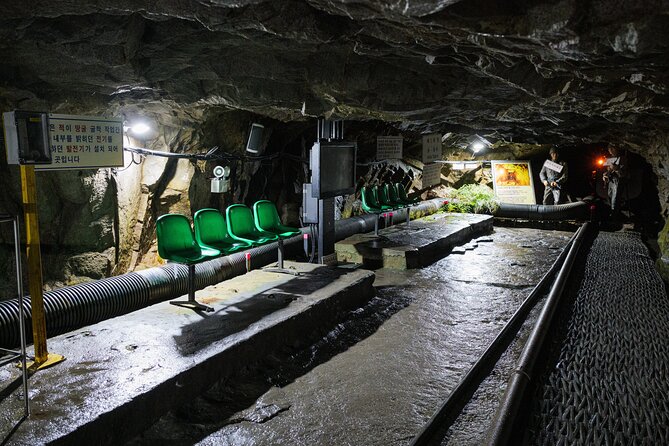
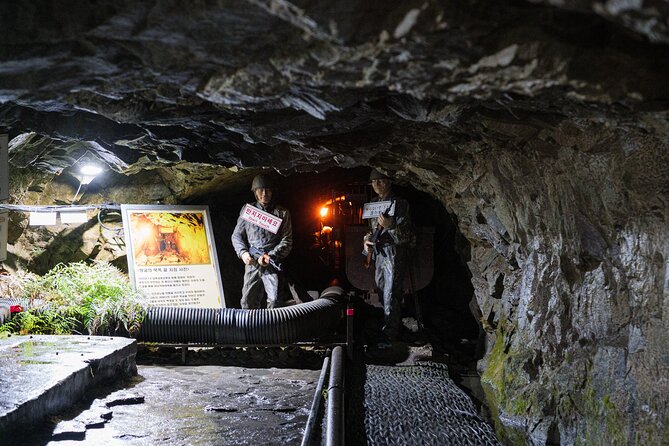
The 2nd Tunnel is the central stop, and it gives the tour its strongest historical weight. North Korean forces built it below ground to allow troops and equipment to move into South Korea without being seen.
The tunnel was discovered in March 1975. It measures about 3.5 kilometers in total and runs between roughly 50 and 160 meters below the surface. Its scale is sobering: the passage was large enough for armed troops, vehicles, artillery, and tanks. The supplied information estimates that about 30,000 troops could have moved through it in an hour.
Only a section is open today, with about 500 meters available to explore. That limitation matters. You are not walking the full length of the tunnel, but the accessible section is enough to show its low, functional design and the effort involved in cutting through the rock.
Allow about 90 minutes here. The stop is not just a quick photo break, and you should arrive ready for a physical visit. The tour asks for a moderate fitness level, which is a useful warning for anyone who has trouble with underground walking or extended time on foot.
I find the tunnel more affecting than a standard military museum because the evidence is still in the ground. The danger was not an abstract plan on a map. It was a passage built with a specific military purpose, reaching toward the South Korean side.
The tunnel can also feel more demanding than the photographs suggest. Wear comfortable shoes and keep your expectations practical. This is a working historical site, not a polished attraction designed for easy strolling.
Cheorwon Peace Observatory and the view across the DMZ
After the tunnel, the Cheorwon Peace Observatory gives you a chance to understand the area from above. The three-story building opened in 2007 and includes an exhibition hall on the first floor and an observatory on the second.
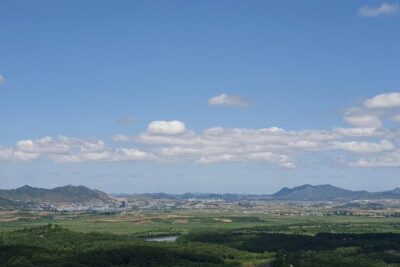
The main value here is perspective. From the viewing area, you can look toward the border zone, North Korean guard posts, and nearby points associated with the divided peninsula. The surrounding ecosystem and military geography become easier to read when you are no longer standing inside a narrow passage underground.
The word peace can feel heavy in this setting. The observatory is not simply a scenic lookout. It is a place where you are reminded that the border remains active and closely watched, even when the fields and hills appear calm.
Plan for about an hour. That gives you time for the exhibition and the view without making the stop feel rushed. Visibility will affect what you can see, and the tour requires good weather, so conditions matter more here than at an indoor museum.
You might find the observatory less dramatic than the tunnel if you prefer hands-on sites. Its appeal is slower and more visual. Bring patience, because the value comes from taking in the full setting rather than checking off one landmark.
Korean Workers’ Party Headquarters and the marks of division
The Korean Workers’ Party Headquarters is a short stop, usually about 30 minutes. The origins of the building are unclear, but records indicate that it was built in early 1946, before the formation of the Workers’ Party of North Korea, the predecessor of today’s Workers’ Party of Korea.
The building is remembered for its role during the period when this area was under North Korean control. Its damaged structure gives you a physical sense of how political division affected ordinary towns and infrastructure.
This is not a long museum visit. Admission is free, and the stop works best as a compact introduction to Cheorwon’s wartime past. Your guide’s explanation will matter here, since the building itself cannot tell the whole story.
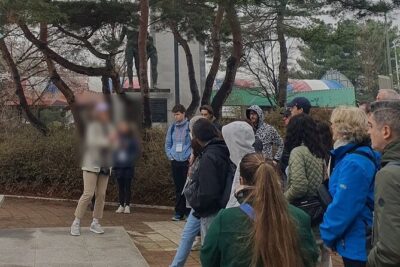
A good guide can keep this stop from becoming a quick look at old walls. Leo is particularly well regarded for being friendly, informative, and kind. If your group is led by him, his easy manner may help connect the site to the wider story without turning the visit into a lecture.
More suspension bridge walks:
- Seoul: DMZ Tour with Optional Suspension Bridge
★ 4.8 · 5,277 reviews - Signature DMZ Tour: Exclusive Defector Talk & Suspension Bridge
★ 5.0 · 4,459 reviews - Ultimate Korea DMZ Tour from Seoul (Gondola & Suspension Bridge)
★ 5.0 · 2,396 reviews - DMZ; NK Defector, 3rd Tunnel, Suspension Bridge,Hotel pickup
★ 4.9 · 2,055 reviews
Woljeongri Station and the stopped railway
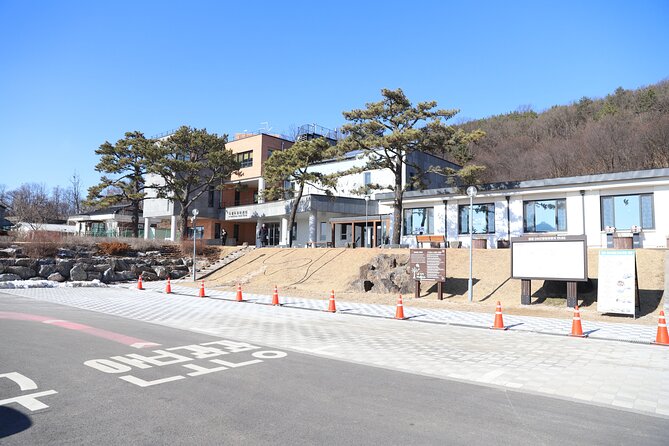
Woljeongri Station was the last railway stop before the DMZ. It is part of the Iron Triangle Battlefield area and is known for the remains of a train that once made regular journeys north.
The most memorable detail is the message that the iron horse wants to run again. The words point to a future in which rail travel could reconnect the peninsula, though the rusted remains make the present division impossible to ignore.
Allow about 30 minutes. This is another compact stop, but it adds something the tunnel and observatory do not. Railways usually suggest movement, trade, and connection. Here, the abandoned train represents a route cut short.
You may find this stop especially effective if you enjoy industrial history or old transport sites. It is less about a large collection of objects and more about one powerful remnant in an important location.
Hantangang Sky Bridge and volcanic cliffs
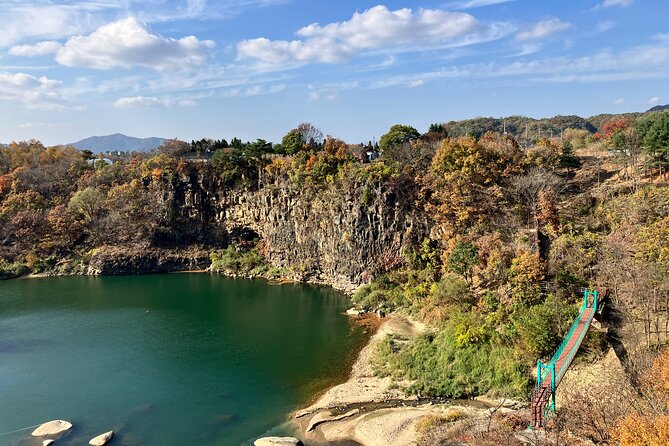
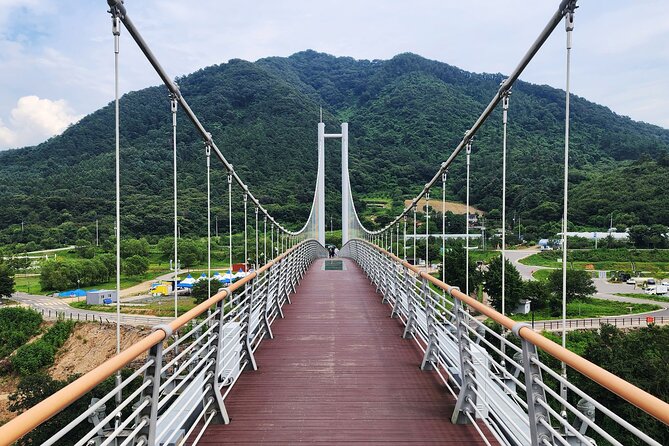
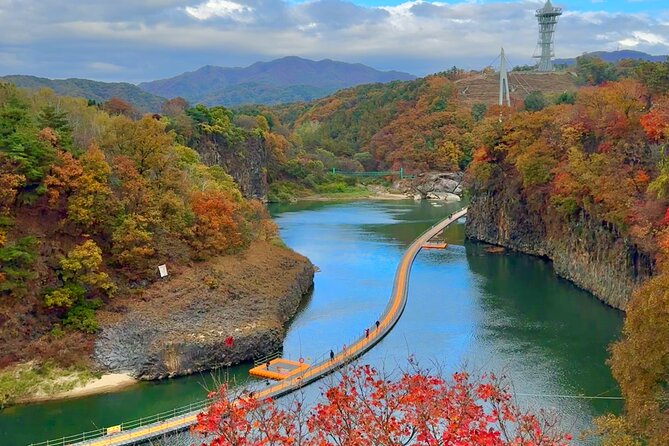
The tour’s final section shifts from military history to geology. At Hantangang, you visit the Sky Bridge, a suspension bridge known for appearing in the Korean drama Crash Landing on You.
The bridge crosses above the Hantangang Geopark, a UNESCO Global Geopark. The area was shaped by granite formed about 110 million years ago, later covered by basalt lava and worn down by erosion. That long process created the cliffs and unusual rock formations along the river.
The supplied route describes a cliffside path surrounded by columnar joints, with cliffs reaching about 30 to 40 meters high. The path is about 3.6 kilometers long and 1.5 meters wide, although the scheduled Hantangang visit is only about 30 minutes. In practical terms, you should expect a short visit to the bridge and viewpoints, not time to complete every possible walking route in the area.
This is where the day becomes visually lighter. After the serious mood of the DMZ, the river gorge gives you room to breathe and enjoy the setting. The contrast is one of the tour’s best features.
The bridge may not suit anyone uncomfortable with heights. The tour also requires moderate physical fitness, so good shoes are sensible. If you want a long nature walk, the fixed schedule may feel brief. If you want a scenic final stop without adding another major museum, the timing works well.
Bidulginang Waterfalls, a short final stop
Bidulginang Falls receives about 20 minutes, making it the briefest stop. Its name comes from the Korean word nang, meaning nest, linked to the hundreds of white doves once said to have nested in a cave behind the waterfall.
The waterfall adds another small natural feature to a day already filled with rock formations and river views. Do not expect a long hike or a relaxed picnic. This is a quick look before the return journey, but it helps round out the outdoor portion of the tour.
The short timing is both a strength and a weakness. You can see the falls without extending the day much further, but you may wish for more time if the setting appeals to you. The schedule is already full, so the stop gives you a taste rather than a full nature outing.
The long road from Seoul and what the $87 covers
At $87 per person, the tour offers fair value if you want several remote sites handled in one day. The price includes an English-speaking professional guide, an air-conditioned vehicle, hotel pickup, taxes, fees, handling charges, and admission to the included paid attractions.
Lunch is not included. One of the most useful details from the tour experience is that guide Leo took a group to a local restaurant, where they had what they described as their best Korean meal in South Korea. You should not assume lunch at that exact restaurant, but it is worth asking your guide for a local recommendation rather than settling automatically for a familiar chain.
The tour starts at 7:00 am at Myeong-dong Station and returns there. The information also lists hotel pickup, so confirm the exact pickup arrangement when you book. Either way, plan around a full day away from your hotel.
The round-trip vehicle time is about four to five hours. That is a large slice of the schedule, but it is unavoidable if you want to reach Cheorwon from Seoul and return the same day. An air-conditioned vehicle and a good guide make the drive easier, while a large group of up to 80 people can make the pace less personal.
There are no shopping stops. I consider that a real benefit. The day is focused on the DMZ, Cheorwon, and Hantangang rather than being padded with compulsory retail visits.
Group discounts are available, which may improve the value for families or larger parties. The tour also requires at least two people to operate, and poor weather can lead to a different date or a full refund.
Who will enjoy this tour most
I would choose this trip if you want a full historical and scenic day outside Seoul. It suits first-time visitors who want a structured introduction to the DMZ, especially if arranging transport to Cheorwon independently sounds difficult.
It is also a good fit if you are interested in military history, divided countries, railways, geology, or Korean television locations. Few day trips combine an underground military tunnel with a UNESCO geopark and a drama-famous bridge.
You should think twice if you dislike early starts, long bus journeys, or fixed schedules. The physical demands are moderate rather than extreme, but the tunnel, observatory, bridge area, and waterfalls mean you will spend part of the day walking.
The group size is another consideration. A maximum of 80 people is substantial. You may receive strong explanations and helpful local guidance, but you should not expect the quiet, flexible pace of a private tour. The praise for Leo suggests that the guide can make a major difference, so pay attention to the guide assigned to your date.
Booking flexibility and practical details
Confirmation is provided at booking. You can cancel for a full refund up to 24 hours before the start time. Changes or cancellations made inside that 24-hour window are not accepted for a refund.
Because the tour depends on good weather and a minimum number of participants, the operator may cancel it. In that case, you are offered another date or experience, or a full refund.
Travel insurance is not included. You should also remember that lunch is your responsibility, and the price does not cover personal expenses beyond the listed inclusions.
The tour is recommended by all published ratings and carries a five-star rating based on 48 reviews. That positive record is strongest around the guides, especially Leo, and the overall range of the day. It should not make you ignore the early departure and long road time, but it does suggest that the experience delivers what it promises.
Should you book the Cheorwon DMZ tour?
Book it if you want more than the usual Seoul city sights and prefer a day with real historical weight, unusual geology, and a guide to connect the pieces. The 2nd Tunnel and Cheorwon Peace Observatory are the core reasons to go, while the Sky Bridge and Bidulginang Falls keep the day from feeling like one long military history lesson.
Skip it if you want a short, gentle excursion or a deeply flexible private experience. At 11 to 13 hours, this is a serious day out, and four to five hours of driving will test your patience.
For the right person, $87 is a sensible price for transport, guiding, admission fees, and six distinct stops. Pack comfortable shoes, keep lunch flexible, and arrive ready for a long but memorable day at one of Korea’s most unusual borders.
FAQ
Where does the tour begin and end?
The stated meeting point is Myeong-dong Station in Seoul, and the tour ends there as well.
What time does the tour start?
The tour starts at 7:00 am.
How long does the tour last?
The full experience lasts approximately 11 to 13 hours, including about four to five hours of round-trip vehicle travel.
Is lunch included?
No. Lunch is not included in the tour price.
What is included in the tour price?
The price includes a professional English-speaking guide, hotel pickup, an air-conditioned vehicle, all listed taxes and fees, and admission charges for the included paid attractions.
How much of the 2nd Tunnel can you visit?
About 500 meters of the tunnel is currently available for exploration.
How physically demanding is the tour?
A moderate level of physical fitness is required. The schedule includes walking at the tunnel, observatory, bridge area, and waterfall stop.
Can I cancel for a full refund?
Yes. You can cancel at least 24 hours before the experience start time for a full refund. Cancellations or changes made less than 24 hours before the start are not accepted for a refund.
More UNESCO Sites in Seoul
- Day Trip to UNESCO: Suwon Fortress Adventure from Seoul
★ 5.0 · 56 reviews - Namhansanseong UNESCO Historical Sites and Korean Folk Village-Private Tour
★ 5.0 · 29 reviews - Andong Hahoe Village [UNESCO site] Premium Private Tour from Seoul
★ 5.0 · 24 reviews - From Seoul: 5-Day Tour of Korea with UNESCO Sites
★ 4.8 · 22 reviews
Just added in Seoul
- Seoul: Korean & English Language Exchange Global Party★ 5.0 · 28 reviews
- Your Personal Seoul Photographer!★ 4.1 · 15 reviews
- You’re Invited to Our Home in Seoul: The Only Cooking Class!★ 5.0 · 8 reviews
- From Seoul: Yongpyong Ski Day Tour with Transportation★ 4.9 · 40 reviews
- From Seoul: Hwacheon Ice Fishing and Lighting Festival Tour★ 4.5 · 4 reviews
- Unique Native Experience : Han River Picnic, Board game, BBQ★ 5.0 · 3 reviews
- Seoul: Gangneung BTS K-Pop & K-Drama Filming Locations Tour★ 4.6 · 14 reviews
- Seoul: Euljiro Gastroventure Tour★ 4.0 · 1 review
DMZ Tours, compared.
Best DMZ Tour Korea from Seoul (Red Suspension Bridge Optional)
Read our review →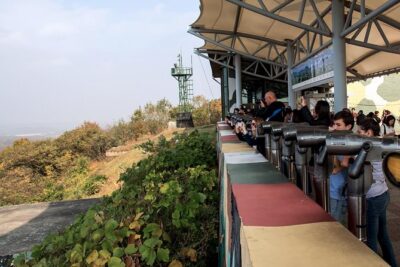
DMZ Tour: 3rd Tunnel, Option(Suspension Bridge, Boat) from Seoul
Read our review →DMZ tour south Korea from Seoul (NK experience hall, defector)
Read our review →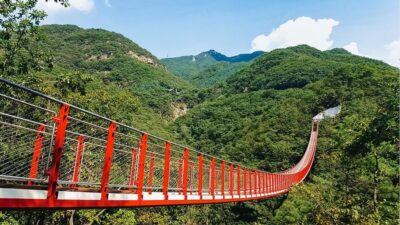
DMZ Insider Tour: 3rd Tunnel, NK Defector Meet & Red Bridge
Read our review →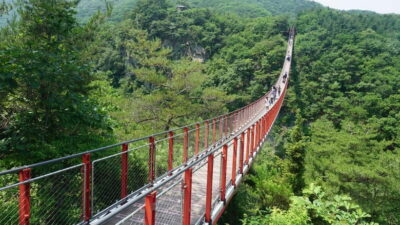
Signature DMZ Tour: Exclusive Defector Talk & Suspension Bridge
Read our review →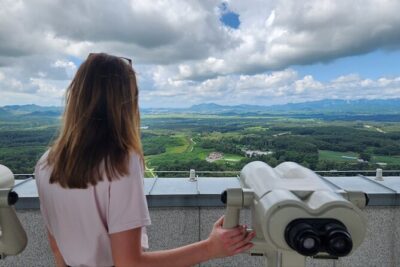
Thrilling Korean DMZ 3rd Tunnel Tour from Seoul + Red Bridge Rush
Read our review →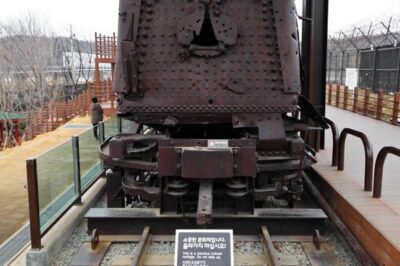
DMZ Past and Present: Korean Demilitarized Zone Tour from Seoul
Read our review →Browse the lists this tour appears in