
Reviewed · 3-DAY EXPERIENCES
3-Day Korea Western course by K-shuttle Tour from Seoul to Busan
Korea rewards travelers who leave Seoul. This three-day coach tour links royal tombs, old fortresses, traditional homes, memorials, gardens, and coastal-region sights on the way to Busan. I like the route for two clear reasons: it reaches places such as Gongju, Jeonju, Suncheon, and Jinju that are awkward to connect by public transport, and it takes care of hotels, transfers, breakfasts, and a guide in one booking.
The tradeoff is pace. You spend long stretches on the road and get only one to two hours at most stops. The first morning also begins with a potentially confusing bus meeting at 8am near Gwanghwamun, so you will want to arrive early and confirm the vehicle and guide before departure.
The tour costs $749 per person, including two nights in 4-star accommodation. That is not a bargain-basement outing, but it can be fair value if you want a guided route from Seoul to Busan without arranging several regional trains, buses, hotels, and entrance tickets yourself. The experience has earned a 4.3 rating from four published ratings, with particular praise for the guides, comfortable coach, hotel handling, and access to hard-to-reach places.
In This Review
- Key points before you book
- Why this route works from Seoul to Busan
- Day 1: Baekje tombs, riverside walls, and Jeonju roofs
- Songsan-ri Tombs and the resting place of King Muryeong
- Gongsanseong Fortress above the Geumgang River
- Jeonju Hanok Village and traditional food
- Day 2: Democracy, gardens, and Admiral Yi Sun-sin
- May 18th National Cemetery in Gwangju
- Suncheon Bay Garden
- Admiral Yi Sun-sin and the Imjin War
- Day 3: Jinjuseong Fortress and an early Busan arrival
- What the hotels, meals, and coach add to the price
- The guide can make or break the experience
- Who should choose this three-day course?
- Should you book the Korea Western course?
- FAQ
- Where does the tour depart from?
- Where does the tour end?
- What accommodation is included?
- Are meals included?
- How much luggage can I bring?
- What is the cancellation policy?
Key points before you book
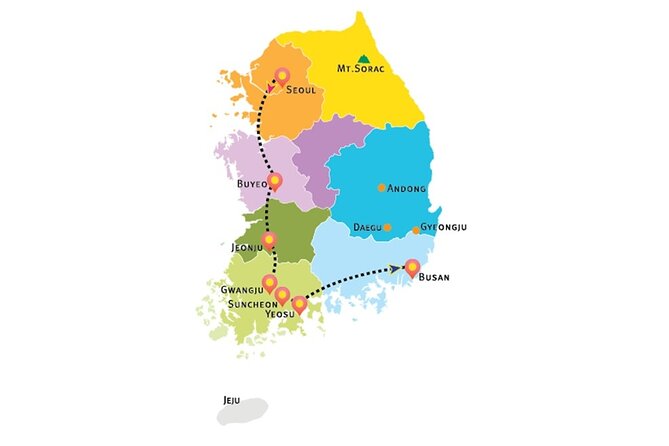
- You cover a wide section of western and southern Korea: The route links Seoul, Gongju, Jeonju, Gwangju, Suncheon, Jinju, and Busan in three days.
- Baekje history opens the trip: Songsan-ri Tombs and Gongsanseong Fortress give Day 1 a strong historical focus.
- The coach solves a real transport problem: Boseong, Jinju, and other regional stops are much easier with a vehicle and guide.
- Jeonju Hanok Village brings food and architecture: You get a short look at traditional homes, local dishes, and the city’s old quarter.
- Your Busan arrival is early: The coach reaches Busan Station at about 1pm on Day 3, leaving much of the afternoon free.
- The meeting point needs care: Departure is from the parking lot beside Dongwha Duty Free near Exit 6 of Gwanghwamun Subway Station.
Why this route works from Seoul to Busan
South Korea has an excellent rail network, but the best connections do not reach every historical site in a simple line. This route is useful because it moves west and south through areas that would otherwise require a patchwork of local buses, taxis, and overnight stays.
You start in central Seoul and finish at Busan Station, not at a hotel. That makes the trip especially handy if Busan is your next base or if you already have a train plan from the station. You will need to arrange your own hotel pickup in Seoul and your own onward transport after arrival in Busan.
The group can reach up to 40 people, so this is not a private tour. The upside is a lower planning burden and a professional guide. The downside is that boarding, meal stops, and head counts can take time. One published account described the first bus meeting as confusing, with the guide needing about 20 minutes to confirm the correct passenger. This is a practical warning, not a reason to reject the tour: bring your booking details, arrive well before 8am, and ask directly which coach is headed for the Korea Western course.
More Busan trips:
- 5-Day Korea Golden route by K-shuttle Tour from Seoul Including Busan, Yeosu
★ 4.5 · 37 reviews - Small Group 7D Korea package Tour with Seoul Gyeongju Busan Jeju
★ 4.5 · 13 reviews - 3-Days 2-Nights Gyeongju UNESCO Sites & Busan City [Private Tour from Seoul]
★ 4.5 · 11 reviews
Day 1: Baekje tombs, riverside walls, and Jeonju roofs
The first day begins at 8am at the parking lot beside the Dongwha Duty Free shop, near Exit 6 of Gwanghwamun Station. The location is close to public transport, but the meeting is at a parking area rather than inside the station. Give yourself extra time to find the right exit and vehicle.
Songsan-ri Tombs and the resting place of King Muryeong
Your first major stop is in Gongju, once a capital of the Baekje kingdom. The Songsan-ri Tombs contain royal burial mounds from the period when Gongju served as the capital, with seven tombs discovered so far out of the ten believed to be in the area.
The focus is the tomb of King Muryeong, Baekje’s 25th king, who ruled from 462 to 523, along with his queen. The tomb was found by accident during work to prevent flooding in nearby Tombs 5 and 6. Its brick construction and the national treasures found inside made it especially important for understanding Baekje culture.
You have about two hours here. That is enough for a measured visit, especially with a guide explaining what you are seeing. The stop is less about a dramatic view and more about seeing evidence of a sophisticated ancient kingdom in its original setting. If you prefer active sightseeing to museum-style history, this may feel slow. If you like archaeology and royal stories, it gives the route a strong start.
Gongsanseong Fortress above the Geumgang River
Next comes Gongsanseong Fortress, a Baekje-era mountain castle in Gongju. The trail follows the fortress walls and reaches Imnyugak Pavilion, described as the largest pavilion of its type within the fortress.
The reward here is the view toward the Geumgang River, along with the chance to walk part of the defensive walls. You get about an hour, so do not expect to complete every path. Wear shoes suitable for inclines and uneven trails. This is one of the stops where the coach matters: you can enjoy a short walk without working out a separate route between the tombs and fortress.
A few more options to weigh up in Seoul
- Best DMZ Tour Korea from Seoul (Red Suspension Bridge Optional)
★ 5.0 · 41,422 reviews - DMZ Tour: 3rd Tunnel, Option(Suspension Bridge, Boat) from Seoul
★ 5.0 · 21,373 reviews - DMZ tour south Korea from Seoul (NK experience hall, defector)
★ 5.0 · 20,599 reviews - Seoul: DMZ Tour with Optional Suspension Bridge
★ 4.8 · 5,277 reviews
Jeonju Hanok Village and traditional food
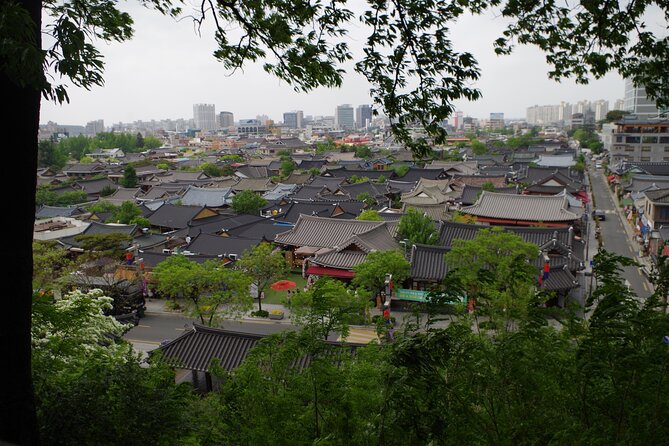
The day ends at Jeonju Hanok Village, where traditional Korean houses remain in the middle of a more modern city. The most noticeable feature is the shape of the roofs, whose edges lift slightly toward the sky. A Hanok Life Experience Hall offers a look at traditional domestic life.
You have roughly two hours here. That is enough to walk through part of the village and sample local food, but it is not enough for a full exploration of Jeonju. Bibimbap is the signature dish associated with the region, and the traditional setting makes this a useful place to try it.
This stop has a different feel from the morning’s tombs and fortress. It is more social, food-focused, and pedestrian-friendly. It can also be busy and tourist-oriented, so keep your expectations sensible. You are getting a brief introduction rather than an intimate village stay.
Day 2: Democracy, gardens, and Admiral Yi Sun-sin
Day 2 shifts from ancient kingdoms to modern Korean memory, horticulture, and military history. It is a varied day, though the schedule remains tight, with two hours assigned to each stop.
May 18th National Cemetery in Gwangju
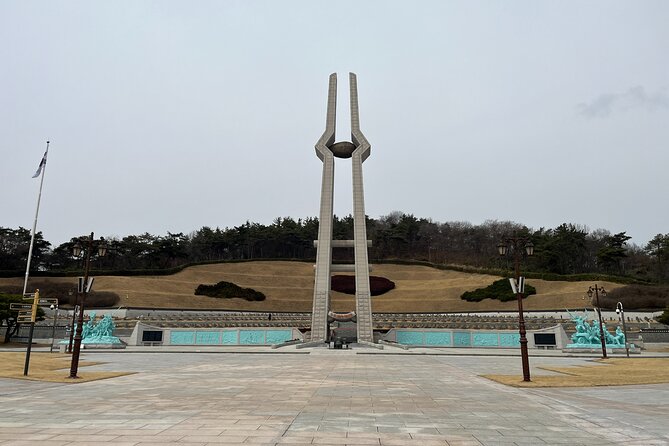
The May 18th National Cemetery lies in front of Mudeungsan Mountain and commemorates people killed during the democracy movement in May 1980. The victims were first buried under difficult conditions, with bodies moved by handcarts and garbage trucks. In 1997, the cemetery was exhumed and the victims were reburied at this memorial.
This is a serious stop. The site represents freedom and democracy in modern South Korea, and May 18 became a national day of remembrance. A two-hour visit gives your guide time to explain the event and gives you space to walk through the memorial grounds.
I would not treat this as a quick photo stop. The cemetery asks for quiet attention, and some people may find the subject emotionally heavy. That weight is also its value. It gives the trip a modern civic story that ancient palaces and fortresses cannot provide.
Suncheon Bay Garden
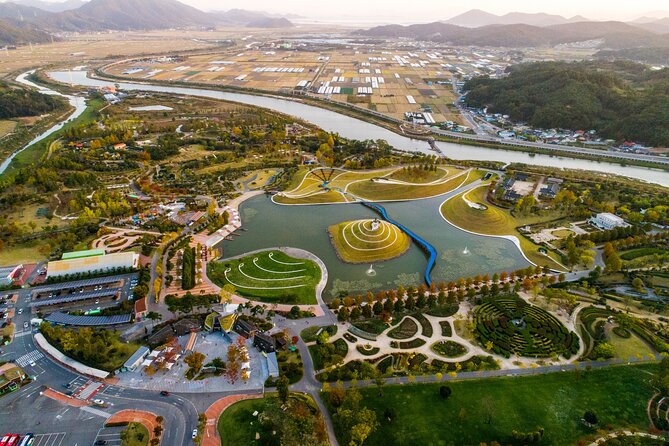
The mood changes at Suncheon Bay Garden, a conservation area covering about 1.12 square kilometers. It contains more than 505 species of trees and 113 species of flowers. Depending on the season, you may see tulips, royal azaleas, or canola flowers. The canola field is especially notable in May, when it creates a broad yellow display.
You have two hours to walk among the plantings and open areas. The garden is a good counterpoint to the cemetery, with space to slow down and enjoy the outdoors. It is also one of the most season-dependent stops. Spring flowers may be a major attraction at one departure date and less important at another.
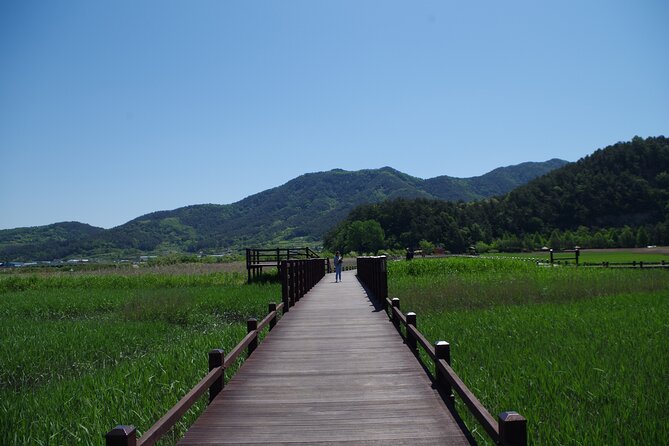
Do not assume this is a visit to the wider Suncheon Bay wetlands. The scheduled stop is Suncheon Bay Garden, so your time is focused on the designed conservation garden itself. The coach keeps the visit easy, but two hours will only cover part of the grounds.
Admiral Yi Sun-sin and the Imjin War
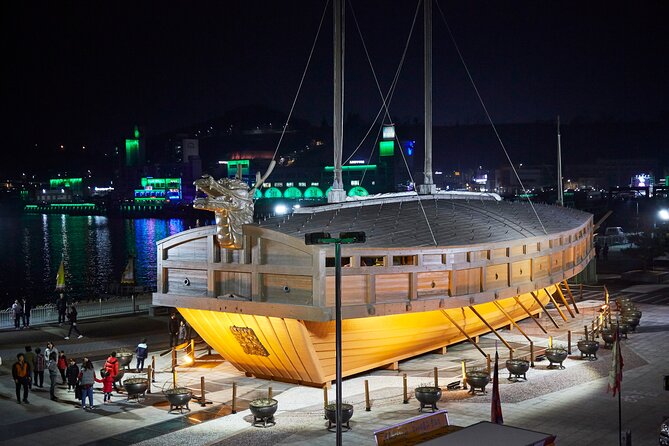
The third stop honors Admiral Yi Sun-sin, one of Korea’s most famous military leaders. During the Japanese invasion known as the Imjin Waeran War from 1592 to 1598, he used this site as a headquarters. Displays inside and outside focus on his role in defending Korea, and the hall was designated National Treasure No. 304 in 2011.
You receive another two-hour visit. That is generous for a focused memorial site, particularly if the guide explains the military setting and the objects on display. This stop works best if you have already learned a little about the invasion, but it remains approachable for first-time visitors.
The day includes a lot of information. Take notes if you want to remember names and dates, because the tour moves quickly from one subject to another.
Day 3: Jinjuseong Fortress and an early Busan arrival
The final morning brings you to Jinjuseong Fortress before the coach continues to Busan. The fortress was first called Geoyeolseong during the Three Kingdom Period, later Chokseokseong in the Goryeo Dynasty, and finally Jinjuseong during the Joseon Dynasty.
Its strongest historical link is the Japanese invasion of 1592. You have about one hour, which is enough for a concise walk and an introduction to the site, but not a long circuit of every wall and feature. The limited time suits the final day, since you still need to reach Busan.
Arrival at Busan Station is scheduled for around 1pm. This is one of the tour’s practical advantages. You can continue by train, meet an arriving companion, or begin a Busan stay that same afternoon. Since hotel drop-off is not included, plan your route from the station before the coach arrives.
What the hotels, meals, and coach add to the price
At $749, the package needs to provide more than sightseeing for the price to make sense. It includes two nights in 4-star accommodation, transfers, a professional guide, breakfasts, and some entrance fees. Lunch and dinner are not included, and hotel pickup and drop-off are also excluded.
The value is strongest for you if you would otherwise book separate regional transport and hotels. The route covers a lot of ground, and private taxis between these locations could quickly become expensive. The coach also lets you rest between stops instead of navigating Korean-language bus terminals.
The value is weaker if you already enjoy arranging intercity travel and prefer to spend several days in each town. Two hours in Jeonju, Suncheon, or Jinju gives you an overview, not a full visit. The package is buying access and convenience, not slow travel.
Room arrangements deserve attention. A double room normally means two separate twin beds. If you want one queen bed, request it in the special requirements field when booking. Three people can share one room with a pullout bed at no extra charge, but one person can instead book a single room with a single traveler surcharge.
The operator asks each person to bring only one piece of luggage because vehicle storage depends on group size. That rule matters on a three-day route with up to 40 people. Pack compactly and keep essentials in a small day bag.
The guide can make or break the experience
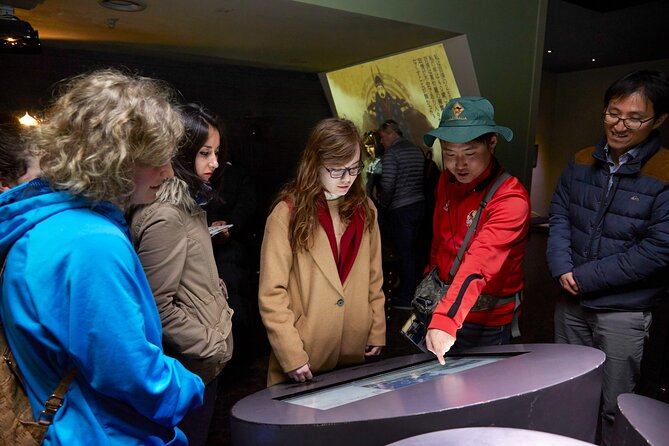
The strongest praise goes to the guiding. Justin was described as informative, while Mr. Kim, identified as MS, was praised for explaining Korean history and culture, suggesting evening food and activities, and helping with hotel check-in and onward travel.
Those details matter. This is not simply a ride between attractions. A good guide supplies the links between Baekje burial customs, the democracy memorial in Gwangju, Admiral Yi’s military role, and the final fortress at Jinju. The guide can also reduce friction at the hotels and help you understand what to do after the group separates.
The tour may use a multilingual guide, so language arrangements can vary. If you need detailed explanations in a particular language, confirm that before booking. The published experience also includes praise for the bus driver’s safe driving and for a comfortable coach, both important on a route with considerable road time.
Who should choose this three-day course?
I would recommend it to a first-time visitor who has already seen Seoul and wants a guided introduction to Korea beyond the capital. It suits you particularly well if you want to finish in Busan, dislike changing buses, or do not want to manage regional hotels and tickets in Korean.
It also works for history-minded visitors. The program moves from Baekje royal tombs to Joseon-era fortifications, the Imjin War, the May 1980 democracy movement, and Admiral Yi Sun-sin. That is a lot of context in three days.
You may want another plan if you need long visits, independent meals, or plenty of free time. The route is scheduled tightly, and the coach group can be large. Families should note that children must be accompanied by an adult. Children aged 3 to 5 receive the child price only when sharing a bed with an adult; a child using a separate bed pays the adult price.
A single person can book, but at least two people are required for the tour to operate. If too few people book, the operator may cancel after confirmation and offer an alternative or a full refund. Confirmation is sent within 48 hours, subject to availability, and passport name, number, expiry date, and country are required for every participant.
Should you book the Korea Western course?
Book this tour if access and ease matter more than independence. For $749, you receive a three-day route that would be complicated to reproduce by public transport, plus hotels, breakfasts, a guide, and a convenient Busan finish. The especially valuable parts are the remote regional stops, the historical explanations, and the help with hotel and onward travel.
Think twice if you dislike early starts, long coach rides, or short visits. The first meeting can be confusing, so arrive early and verify the bus. You can cancel for a full refund up to six full days before departure, with smaller refunds possible between two and six days, but late cancellations are not refunded.
For a compact first look at western and southern Korea, this is a useful bridge between Seoul and Busan. It will not give you every corner of the route. It will give you a well-organized taste of places many independent visitors skip.
FAQ
Where does the tour depart from?
The tour departs at 8am from the parking lot beside Dongwha Duty Free, near Exit 6 of Gwanghwamun Subway Station in Seoul.
Where does the tour end?
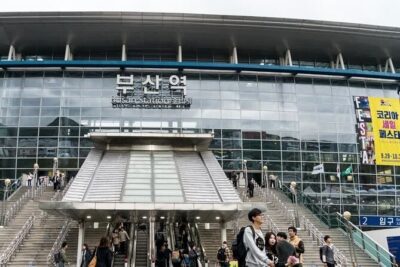
The coach drops you at Busan Train Station at about 1pm on Day 3. Hotel drop-off in Busan is not included.
What accommodation is included?
The package includes two nights in 4-star accommodation. A standard double room uses two separate twin beds unless you request one queen bed during checkout.
Are meals included?
Breakfast is included according to the itinerary. Lunch and dinner are not included.
How much luggage can I bring?
The operator asks each person to bring only one piece of luggage because storage space in the vehicle depends on group size.
What is the cancellation policy?
A full refund is available when you cancel at least six full days before the start time. A 50 percent refund applies when you cancel two to six full days before departure. Cancellations made less than two full days before departure are not refunded.
Just added in Seoul
- Seoul: Korean & English Language Exchange Global Party★ 5.0 · 28 reviews
- Your Personal Seoul Photographer!★ 4.1 · 15 reviews
- You’re Invited to Our Home in Seoul: The Only Cooking Class!★ 5.0 · 8 reviews
- From Seoul: Yongpyong Ski Day Tour with Transportation★ 4.9 · 40 reviews
- From Seoul: Hwacheon Ice Fishing and Lighting Festival Tour★ 4.5 · 4 reviews
- Seoul: Gangneung BTS K-Pop & K-Drama Filming Locations Tour★ 4.6 · 14 reviews
- Unique Native Experience : Han River Picnic, Board game, BBQ★ 5.0 · 3 reviews
- Seoul: Euljiro Gastroventure Tour★ 4.0 · 1 review
3-Day Experiences, compared.
Jeju English Private Taxi Tour(1day, 2days, 3days & 1 to 12pax)
Read our review →
3days Private Free Schedule Tour a lot of Experience Driver
Read our review →
All inclusive Jeju island English private taxi tour(1 to 3days)
Read our review →

3 Days Private jumbo taxi Tour in Jeju Island with Mr.Ko (Suhong)
Read our review →
3-Day Busan Hidden area and Local foodie Tour with Pick Up
Read our review →Browse the lists this tour appears in