
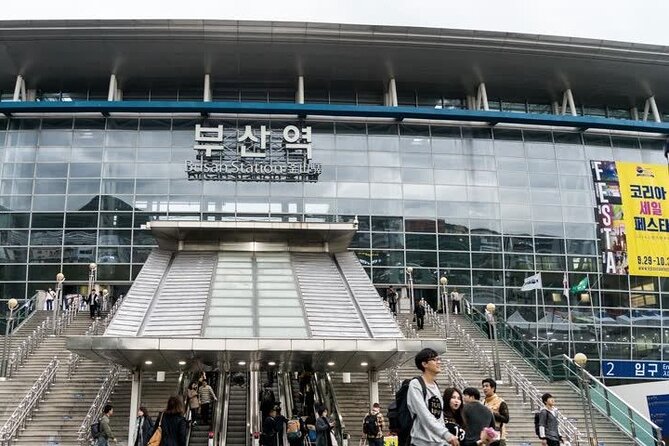
Reviewed · 3-DAY EXPERIENCES
3-Day Busan Hidden area and Local foodie Tour with Pick Up
Busan rewards a slower visit. This three-day private tour links coastal temples, fishing ports, markets, and beaches with Busan’s major sights, so you get more than a quick look at the city center. I like the private transport and the mix of food stops, Korean history, ocean views, and evening scenery. The main consideration is cost: at $800 per person, you are paying for comfort, guiding, and a full schedule rather than a budget city tour.
I also like that the route reaches places that are awkward to combine by public transport, including Daebyeon Port, Oryukdo, Taejongdae, Beomeosa, and the Hwangnyeongsan viewpoint. The one five-star review praised the English-speaking guide, friendly service, and strong grasp of Busan’s culture and history. Still, this is an ambitious three days, with some short photo stops and extra costs for meals and several admissions.
In This Review
- Key Points Before You Book
- What This Three-Day Busan Tour Does Well
- Day One: From Haedong Yonggungsa to Haeundae
- Dongbaekseom, Spaland, and the Modern Side of Busan
- Day Two: War Memory, Cliff Paths, and Old Busan
- Gamcheon, Gukje Market, and Jagalchi Seafood
- Day Three: Beomeosa, Tongdosa, and Eonyang Bulgogi
- Gijang Shopping and Busan After Dark
- Timing, Transport, and What You Pay Extra
- Who Should Book This Busan Experience?
- FAQ
- Is this a private tour?
- How long does the tour last?
- Is pickup available from Busan Airport?
- Are meals included?
- Are admission fees included?
- Is accommodation included?
- Is there a minimum group size?
- Can I request dietary accommodations?
- What is the cancellation policy?
Key Points Before You Book
- Private touring with airport and station pickup: Your group receives private transport, a driver-guide or separate guide and driver, plus gas, tolls, and parking.
- A strong seafood focus: Daebyeon Port, Gijang Market, Nampodong, and Jagalchi introduce you to anchovies, abalone porridge, king crab, raw fish, and other local foods.
- Busan’s coast gets full attention: Haedong Yonggungsa, Songjeong Beach, Haeundae, Oryukdo, Taejongdae, Huinnyeoul, Songdo, and Gwangalli all appear.
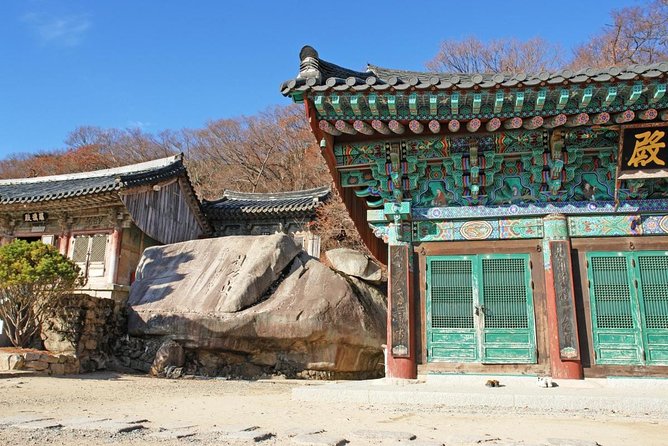
- Two very different temple visits: Beomeosa offers a mountain setting inside Busan, while Tongdosa brings a major Buddhist site outside the city.
- A useful history thread: The UN Memorial Cemetery, Gamcheon, the Modern History Museum, Gukje Market, and Yongdusan Park explain how war, trade, and migration shaped Busan.
- The third evening is scenic but long: Marine City, Hwangnyeongsan, and Gwangalli create a fine night tour, though the day already includes temples and shopping.
What This Three-Day Busan Tour Does Well
Busan is spread out. Beaches, ports, temples, markets, and mountain viewpoints sit across a large area, and moving between them can take time. This tour solves that problem with private transportation, making it easier to cover several districts without working out bus changes or carrying shopping bags on public transport.
The route also has a useful rhythm. You begin with the northeast coast, shift to southern and western Busan on the second day, then head toward temples and the Gijang shopping area before finishing with city lights. You see polished modern Busan, working waterfronts, older neighborhoods, and places tied to the Korean War.
The food angle is practical rather than formal. Meals are not included, but the route puts you near places where you can choose seafood, market snacks, abalone porridge, raw fish, or Eonyang-style bulgogi. Tell the operator about dietary needs when you book. That matters here because seafood appears often.
The price deserves a close look. At $800 per person, this is not a cheap sightseeing package. It includes private transport, fuel, tolls, parking, a guide and driver arrangement, airport or KTX station pickup or drop-off, and the night tour. It does not include hotels, meals, or admission fees paid on site. The value improves if you are sharing the vehicle with family or friends and want a guide who can explain the city as you go.
A five-star review specifically praised Frank Yi and the guiding team for friendly English service and a strong understanding of Busan culture, history, and attractions. That is the most important strength of this experience. A good guide can turn a market, memorial, or temple from a quick stop into a place you understand.
More Busan trips:
- Busan: Gyeongju Guided Day Trip to Three Kingdoms Capital
★ 4.8 · 1,925 reviews - Small Group Full Day Busan Tour (Max 6 Pax)
★ 5.0 · 1,464 reviews - From Busan: Gyeongju UNESCO World Heritage Guided Day Tour
★ 4.8 · 1,250 reviews
Day One: From Haedong Yonggungsa to Haeundae
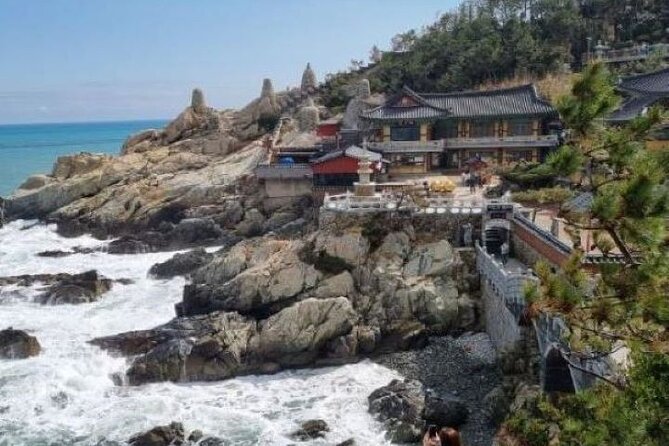
The first morning begins at Haedong Yonggungsa, one of Busan’s most striking religious sites. Unlike most Korean temples, which sit in the mountains, this one faces the sea on Busan’s northeast coast. It was first built in 1376 during the Goryeo dynasty.
Allow about an hour. You can see the Sea Water Goddess Buddha, the main sanctuary, Yongwangdang Shrine, a cave sanctuary, and a three-story pagoda decorated with four lions. New Year’s Day draws people who come to make wishes while watching the sunrise, and April is noted for especially attractive scenery.
The temple is free, but the coastal setting means stairs and uneven walking areas may be part of your visit. Wear shoes that can handle a short climb. Your guide can also explain why this temple feels different from the forest temples that appear later in the tour.
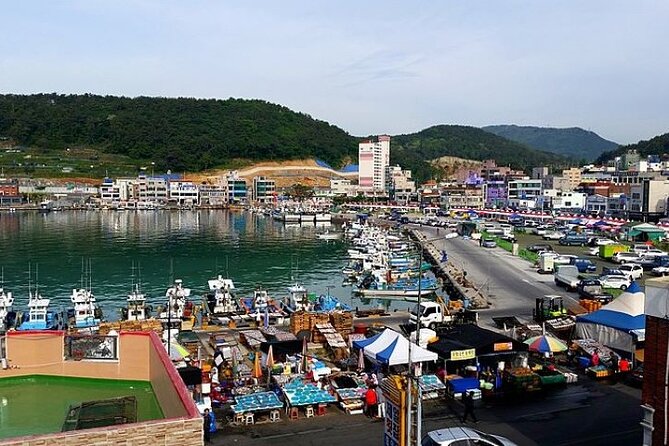
Next comes Daebyeon Port, a working fishing harbor selected as one of Korea’s 100 beautiful fishing villages. Gijang anchovies are the local specialty, and the port is associated with an anchovy festival. Anchovy Theme Square adds towers, sculptures, lighting, music, and fountains, but the more useful part for a food-focused tour is the chance to see seafood trade up close.
The visit lasts about 40 minutes. You might choose abalone porridge, live seafood, or dried seafood to take home, though food purchases are extra. This is one of the best places to ask your guide how Busan’s coastal economy connects with everyday meals.
At Gijang Market, seasonal products take center stage. Spring brings seaweed and anchovies, while cutlassfish is especially known around the two months before and after Chuseok. Live king crab is also available. The market is free to enter, but your appetite and wallet decide how much you spend.
The day then turns toward Busan’s better-known beaches. Dalmaji-gil Road is often called Busan’s Montmartre because of its sea views, pine and camellia trees, and hillside mood. The scheduled photo stop is only about 20 minutes, so treat it as a quick viewpoint rather than a long walk.
Songjeong Beach gets another 20-minute stop. Its shallow water makes it popular with families, and the beach is also used for pre-wedding photographs. At the north end, Jukdo Park leads toward Songjeonghang Port, where white and red lighthouses and the view from Songiljeong Pavilion make good photo subjects. Nearby restaurants specialize in hoe, sliced raw fish.
Haeundae Beach receives about 40 minutes. This is Busan’s most famous stretch of sand, around 1.5 kilometers long, with hotels, guesthouses, festivals, an aquarium, and access to Dongbaekseom. You will get a feel for the city’s resort side here, though the short stop is not designed for swimming or a leisurely beach afternoon.
Dongbaekseom, Spaland, and the Modern Side of Busan
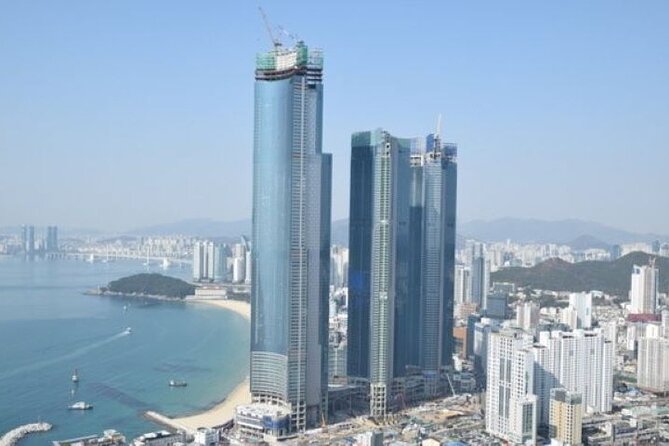
The one-hour visit to Dongbaekseom adds a change of pace. The island is covered with camellia and pine trees, and Nurimaru APEC House sits on the shore. The three-story building hosted the APEC summit and combines a modern conference center with traditional Korean pavilion ideas.
From the terrace, you can look toward Oryukdo, Gwangan Bridge, and Dalmaji Hill. This is a worthwhile stop for anyone who wants Busan’s natural setting and international identity in the same frame.
The final stop of Day One is Shinsegae Centum City Spaland. Shinsegae Centum City is listed in Guinness World Records as the world’s largest shopping complex, with designer labels, hundreds of brands, entertainment facilities, and a spa. The one-hour visit is best for browsing, a quick look at the architecture, or arranging a spa visit if time and admission allow.
Do not expect this stop to feel like a traditional market. It is polished, large, and modern. That contrast is useful, since the tour has just taken you through fishing ports and beaches.
Day Two: War Memory, Cliff Paths, and Old Busan
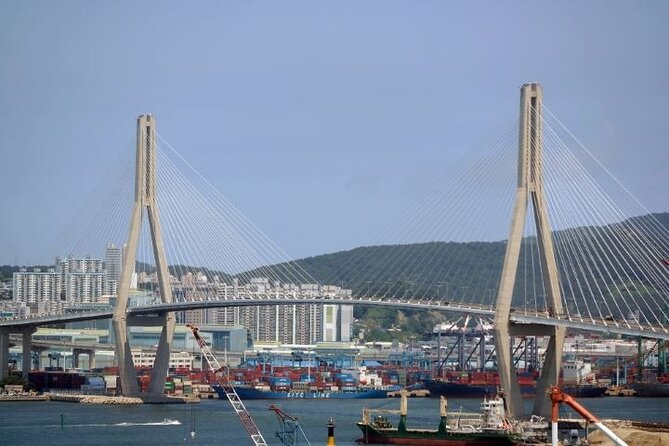
Day Two begins at Oryukdo Island, a group of rocky islets where the East Sea and South Sea meet. The formation was shaped by volcanic activity about 80 million years ago and is recognized as part of the Busan National Geopark. Depending on conditions and viewpoint, you may see five or six islands.
The stop lasts about 40 minutes. It is primarily about open water, rock formations, and photographs. If you prefer museums and city streets, this is a quieter start, but it gives the day a clear sense of place.
The UN Memorial Cemetery offers a very different experience. It honors UN soldiers from 16 countries and UN support personnel from five countries who died during the Korean War. It is the only cemetery of its kind in the world, with about 2,300 graves remaining after many bodies were returned to families.
The grounds cover 135,000 square meters and include a Memorial Service Hall, Memorabilia Hall, national monuments, and ponds. The 40-minute visit should be treated respectfully. This is not a casual photo stop. It provides essential context for why Busan became a refuge and a major wartime base.
At Taejongdae, the sea returns with cliffs, caves, and unusual rock formations shaped by erosion. You have about an hour, and admission is included here. Forested paths lead toward the observatory and Yeongdo Coastal Culture Space, while a train course can make the area easier to cover.
Because the coast is rugged, ask your guide about the most practical route for your group. The point is not to race across every path. It is to enjoy one of Busan’s most dramatic shorelines without spending the entire day walking.
Huinnyeoul Culture Village follows, with about 40 minutes in a cliffside neighborhood shaped by refugee history after the Korean War. The 14 lanes contain small cafés, workshops, independent bookstores, and ocean-facing corners. The village is often compared with Santorini, but its Korean story matters more than the comparison.
The area is hilly and the alleys are narrow. You may want to pause at Huinnyeol Jeomppang for ramen with an ocean view, but food is extra and the stop is short. This is a place where a guide’s explanation adds real value, since the painted walls and cafés are only part of the story.
Songdo Beach is Korea’s first beach, opened in 1913. After losing much of its popularity in the 1960s and 1970s, it was repaired and brought back into public use. The beach now has clear water, an overwater cable car, and the Sea Cloud Trail. The 40-minute stop gives you time for a look, but not necessarily a full cable-car outing.
More Food Tours in Busan:
- Busan Tailored Korean cooking class (Vegan OK)with market tour
★ 5.0 · 66 reviews - Busan history and market food tour with local chef
★ 5.0 · 58 reviews - Busan: Small-Group Traditional Korean Food Cooking Class
★ 4.9 · 58 reviews - Busan Local Food Cooking Class with Market Tour
★ 5.0 · 53 reviews
Gamcheon, Gukje Market, and Jagalchi Seafood
Gamcheon Culture Village is one of Busan’s most photographed neighborhoods. Small, brightly painted homes climb the hillside, with murals, sculptures, and narrow lanes. The Little Prince and his fox are among the familiar photo points.
The village grew during the Korean War, when Busan remained outside the main fighting and refugees gathered here. Its hillside layout was shaped so that one home would not block the view of another. That detail gives the dense settlement a social history beyond its colorful appearance.
You have an hour, and admission is included. Expect steep walking and many steps. If you have limited time, follow the guide’s suggested route rather than trying to cover every alley.
The Busan Modern History Museum continues the historical thread. The building was created in 1929 by Japan’s Oriental Development Company, later became the U.S. Cultural Center in Busan for five decades, and was eventually returned to Korea after sustained public demands. The museum addresses Japanese occupation and Busan’s difficult modern past.
The visit is only 30 minutes, so it will be a focused introduction rather than a full museum day. I consider it important because it helps connect the port, markets, and city growth with events that shaped modern Korea.
Yongdusan Park gives you a short uphill break in central Busan. The park sits on a 49-meter hill, while Busan Tower rises 120 meters above it. From the area, you can look toward Busan Port and the surrounding city.
Gukje Market began when refugees after the Korean War set up stalls to make a living by selling imported and smuggled goods. Today, its lanes sell machinery, kitchenware, clothing, and much more. The nearby Kkangtong Market and charity-store alley add to the area’s everyday feel.
The scheduled market stop is only 20 minutes, which is enough for orientation but not serious shopping. Nampodong Street adds a quick look at Busan’s theater district and street food. The nearby stalls are a good place to try local snacks, but you will need to manage your own purchases within the schedule.
The final stop, Jagalchi-ro and Jagalchi Market, receives about an hour. This is Korea’s largest seafood market, selling live and dried fish. Mackerel and sea squirts appear among the seafood, and much of the selling is done by women known locally as Jagalchi ajumma.
You can eat fresh raw fish at the market, but meals are not included. If seafood is not your preference, tell the operator in advance. This is one of the tour’s strongest food stops, but the sights and smells can be intense for anyone unused to live seafood markets.
Day Three: Beomeosa, Tongdosa, and Eonyang Bulgogi
Beomeosa Temple begins the third day in the foothills of Geumjeongsan Mountain. Founded in 678 during the Silla Kingdom, it is one of the three major temples in the Yeongnam region. Much of the original complex was destroyed during the Imjin War, then rebuilt in 1613.
The one-hour visit includes gates, pavilions, hermitages, the four-pillar pagoda, and Daeungjeon Hall, noted for its Joseon-era design. Beomeosa also operates a temple-stay program, though that is not part of this three-day tour. The mountain setting makes it a calm counterpoint to the markets and high-rise districts.
Tongdosa takes about two hours and is a major Buddhist site. It is one of Korea’s five temples associated with the Palace of the Jewel of Nirvana, where relics of the Buddha take the place of a statue. The temple was founded after Jajang brought Buddhist relics from China in 646.
This is a longer cultural stop, but admission is not included. Confirm the current entrance cost with the operator and bring suitable clothing for temple visits. Tongdosa is outside central Busan, so this portion contributes to the tour’s broad regional reach and also makes Day Three quite full.
Eonyang-eup provides the food highlight. Eonyang bulgogi uses thinly sliced beef, marinated with sugar, soy sauce, sesame oil, garlic, and pepper. The local preparation places strong emphasis on fresh beef, with the dish traditionally served within 24 hours of butchering.
Lunch is not included, but this is exactly the kind of meal that gives the day a local focus. Bulgogi is also approachable if you are new to Korean food because it is not spicy.
Gijang Shopping and Busan After Dark
The two-hour visit to Shinsegae Simon Premium Outlets in Gijang is aimed at shoppers. The center opened in 2013 and has more than 180 domestic and international brands. It sits close to the expressway, which makes it a practical stop when private transport is already in use.
Osiria Station and the surrounding tourism complex receive another two hours. The area includes Lotte Premium Outlet, the Busan National Science Museum, IKEA, and plans for a Lotte World Magic Forest theme park. Admission to the selected attraction is not included.
This section may feel less appealing if your priority is food, temples, or older Busan. For families or anyone hoping to shop, it can be useful. For everyone else, ask how much flexibility exists before booking, since four hours devoted to retail and the Osiria area is a substantial part of the final day.
The evening tour brings the experience back to the city. Marine City is lined with restaurants, cafés, and bars, and its high-rise lights create one of Busan’s best modern night scenes. The stop lasts about 30 minutes.
Hwangnyeongsan Mountain provides a higher viewpoint over Busan. The beacon-fire station once helped communicate with other signal stations, and the summit area now offers broad city views. The stop is also about 30 minutes, so your time depends on traffic and conditions.
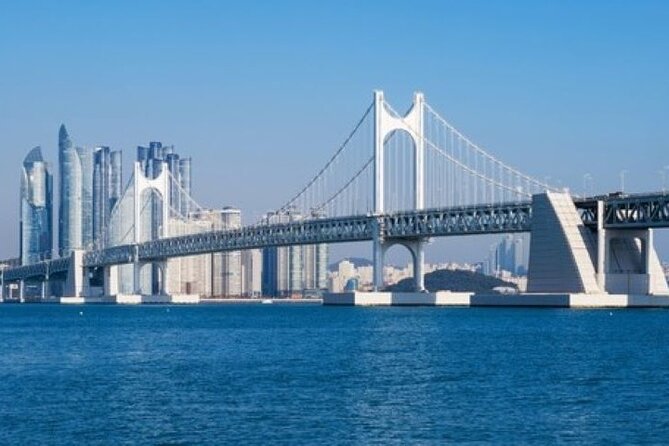
The final stop is Gwangalli Beach, facing the Gwangan Bridge. The bridge opened in 2002 and is lit at night, earning the nickname Diamond Bridge. The half-hour visit is enough to take in the lights and shoreline atmosphere, though it is not long enough for a full evening in the neighborhood.
Timing, Transport, and What You Pay Extra
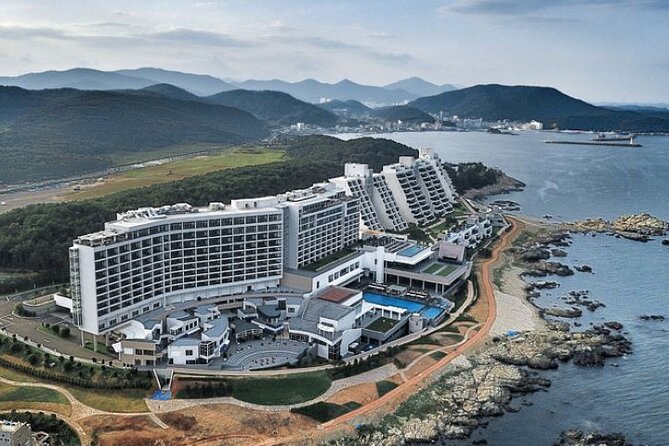
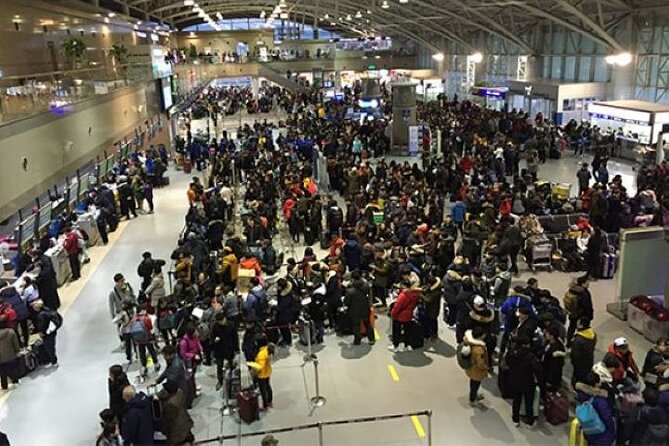
Private transport is the backbone of this experience. Pickup and drop-off are available at Busan Gimhae Airport or Busan KTX station, and the operator asks you to share the amount of luggage in advance. Meet at the requested time and location, usually near the exit gate, where the guide will look for your name.
The tour is for private groups, with a minimum of two people. There is a risk of cancellation if that minimum is not met, in which case an alternative or full refund is offered. Most people can participate, but the temples, villages, and coastal sites include walking, steps, and uneven ground.
At $800 per person, value depends heavily on group size and priorities. You get three days of private driving, a guide, parking, tolls, fuel, airport or station service, and the night tour. You still pay for hotels, meals, and certain admissions, including Tongdosa and the Osiria attraction.
The schedule is also more ambitious than relaxed. Several stops last only 20 or 30 minutes, and traffic can affect the actual time available. I would book this for coverage and convenience, not for long beach stays or slow market wandering.
Free cancellation is available up to 24 hours before the start time. Changes or cancellations inside that window are not refunded, and late changes are not accepted.
Who Should Book This Busan Experience?
I would choose this tour if you want Busan explained as a whole: fishing city, wartime refuge, Buddhist center, beach resort, shopping hub, and modern port. It is especially suited to families, first-time visitors, and small private groups that value door-to-door transport.
The strongest reasons to book are the wide range of places, the food-focused route, and the guiding service praised in the five-star review. Frank Yi and the guiding team received specific praise for friendly English communication and explanations of local culture and history.
I would hesitate if you want a low-cost trip, a loose schedule, or a deep focus on just one subject. Independent visitors can spend far less using the subway and local buses, though they will give up much of the comfort and coverage.
FAQ
Is this a private tour?
Yes. Only your group participates in the activity.
How long does the tour last?
The experience lasts approximately three days.
Is pickup available from Busan Airport?
Yes. Pickup or drop-off is available at Busan Gimhae Airport and Busan KTX bullet train station.
Are meals included?
No. Meals are paid for separately.
Are admission fees included?
Some admissions are included, but meals and several entrance fees are paid on the spot. Taejongdae and Gamcheon Culture Village are listed with admission included, while Tongdosa and the Osiria attraction are not included.
Is accommodation included?
No. Hotels and other accommodation are not included.
Is there a minimum group size?
Yes. At least two people are required. If the minimum is not met, an alternative or full refund is offered.
Can I request dietary accommodations?
Yes. You should provide any specific dietary requirements at the time of booking.
What is the cancellation policy?
You can cancel at least 24 hours before the start time for a full refund. Cancellations or changes made less than 24 hours in advance are not accepted for a refund.
Just added in Busan
- Small Group 7D Korea package Tour with Seoul Gyeongju Busan Jeju★ 4.5 · 13 reviews
- Private Transfer from Seoul to Busan(up to 12 passengers)★ 5.0 · 1 review
- Jinhae Cherry Blossom + Busan Sunrise from Seoul★ 4.5 · 5 reviews
- 7 days Flexible Tour for Major Cities(Seoul,Busan,Gyeongju etc)★ 5.0 · 5 reviews
- PREMIUM 5 Days Tour for Wonder of Korea(Mt. Seoraksan, Andong, Gyeongju, Busan)★ 5.0 · 1 review
- 5 Days Tour for Korea’s past and present(Mt.Seoraksan, Andong, Gyeongju, Busan)★ 5.0 · 1 review
- 7 Days Highlight Korea Tour(Seoul, Nami, DMZ, Andong, Gyeongju, Busan)★ 5.0 · 1 review
- 5-Day Korea Golden route by K-shuttle Tour from Seoul Including Busan, Yeosu★ 4.5 · 37 reviews
3-Day Experiences, compared.
Jeju English Private Taxi Tour(1day, 2days, 3days & 1 to 12pax)
Read our review →
3days Private Free Schedule Tour a lot of Experience Driver
Read our review →
All inclusive Jeju island English private taxi tour(1 to 3days)
Read our review →
3-Day Korea Western course by K-shuttle Tour from Seoul to Busan
Read our review →
3 Days Private jumbo taxi Tour in Jeju Island with Mr.Ko (Suhong)
Read our review →
Browse the lists this tour appears in