
Reviewed · PALACE TOURS
Seoul: 4-Hour Guided Tour to Palace, Bukchon, Jogyesa Temple
Seoul’s old soul is hiding in plain sight. This four-hour private tour links Gyeongbokgung Palace, the National Folk Museum, Bukchon Hanok Village, and Insadong while explaining how Confucian ideas shaped Korean buildings, rituals, and daily life. I like the strong focus on meaning, not just photo stops, and I also like the flexible meeting point, which can be arranged at your hotel.
The guide, Paul Koo, is especially praised for making Korean history easy to follow and for taking good photos at useful angles. The main consideration is cost: $152 covers a private group of up to two people, but palace admission, transport, food, and drinks are extra. The written itinerary also names Insadong, while the tour description discusses Jogyesa Temple and Bongeunsa, so you should confirm the exact route before booking.
In This Review
- Key points at a glance
- Why the architecture matters in Seoul
- Starting at Gwanghwamun Square
- Gyeongbokgung Palace: the main event
- The National Folk Museum and everyday Joseon life
- Bukchon Hanok Village and the old-new view
- Insadong, Jogyesa, and the route question
- What Paul Koo adds to the experience
- Is $152 good value for four hours?
- Who should book this private Seoul tour?
- Final verdict: a strong choice for cultural context
- FAQ
- How long is the tour?
- What is the starting point?
- Is the tour private?
- What language does the guide speak?
- Is palace admission included?
- Is transportation included?
- Does the tour include food and drinks?
- Is Jogyesa Temple definitely part of the itinerary?
Key points at a glance
- Gyeongbokgung takes up most of the tour: About 2 hours and 20 minutes are devoted to Seoul’s most important royal palace.
- Confucianism gives the visit a clear theme: Paul explains how Joseon values shaped palace design and traditional Korean life.
- The National Folk Museum adds ordinary people to the story: Exhibits cover work, family ceremonies, illness, aging, and death.
- Bukchon offers old Seoul beside modern Seoul: Traditional hanoks appear with city towers and N Seoul Tower in the background.
- This is a private tour for up to two people: The price makes more sense for a pair than for one person traveling alone.
- The route needs one quick confirmation: Jogyesa is part of the description, but the stated itinerary lists Insadong instead.
Why the architecture matters in Seoul
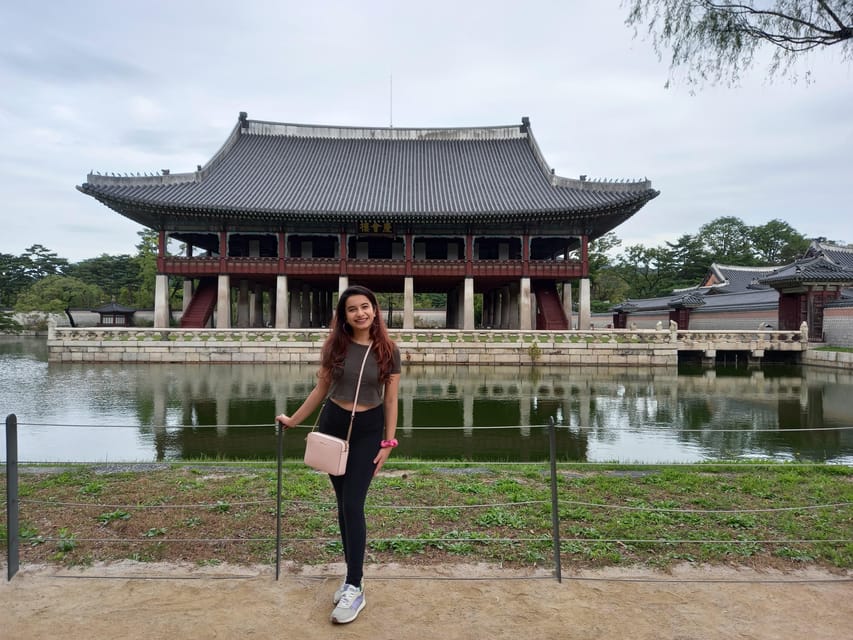
This tour is built around architecture, but it is not really an architecture lecture. The useful idea is that buildings reflect the values of the people who made them. In Joseon Korea, Confucianism shaped government, family life, education, ceremony, and the layout of royal buildings.
That context can change the way you look at Gyeongbokgung. Instead of seeing only grand gates and painted roofs, you begin to ask why the palace was arranged as it was, why certain spaces mattered, and how royal architecture represented the state.
I like this approach because Seoul’s historic sites can otherwise blur together. A guide who explains the ideas behind the buildings gives you a way to remember them after the tour ends. Paul Koo presents himself as a specialist in Korean Confucian culture, and the strongest praise for his guiding centers on clear explanations of history, culture, and religion.
This is particularly helpful if you are visiting Korea for the first time. You do not need prior knowledge of Confucianism. The goal is to give you enough background to understand why traditional Korean architecture looks and feels the way it does.
More Temple Visits in Seoul
- Seoul: Mt Seorak + Naksansa Temple or Nami Island Group Tour
★ 4.7 · 422 reviews - Best Things to Do – Half Day Seoul Trip (Seoul Palace & Temple)
★ 5.0 · 190 reviews - Mount Seorak and Naksansa Temple One Day Tour from Seoul
★ 4.5 · 167 reviews
Starting at Gwanghwamun Square
The stated starting point is Gwanghwamun Square, one of the most useful places to begin a visit to central Seoul. The meeting place and time can also be chosen after booking, and the guide can meet you at your hotel.
That flexibility matters if you are arriving after a long flight, traveling with an older companion, or trying to fit the tour between other plans. You will need to confirm the final meeting details in advance, since the activity specifically asks for advance reservation and guide confirmation.
Starting near Gwanghwamun also puts you close to Gyeongbokgung, the center of the day’s program. The tour is private, so you are not joining a large group with a fixed pace. For two people, that can make the experience feel more personal and allow you to ask questions without waiting for a dozen other voices to finish.
Transportation between stops is not included. The route is therefore easier to understand as a guided walking and city visit rather than a chauffeured sightseeing circuit. Ask how the group will move between locations before you set the rest of your day.
Gyeongbokgung Palace: the main event
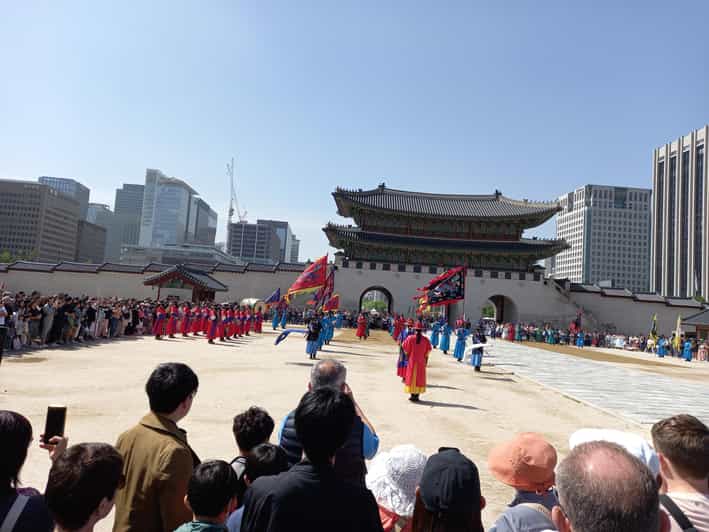
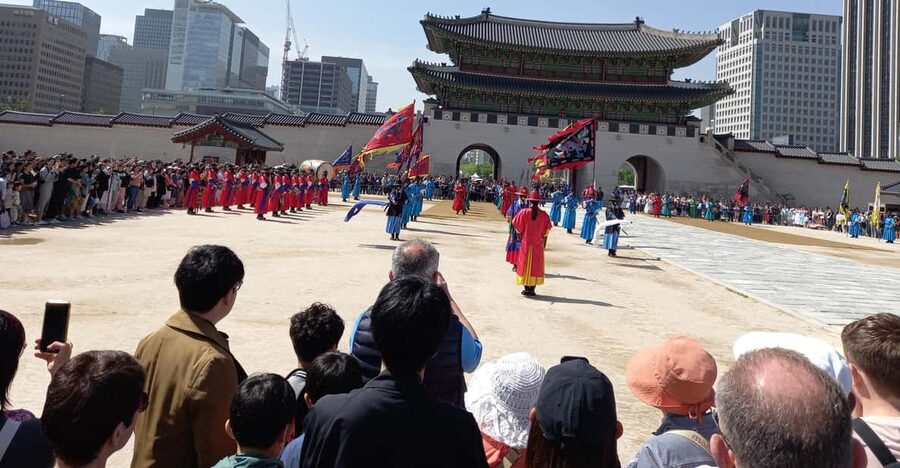
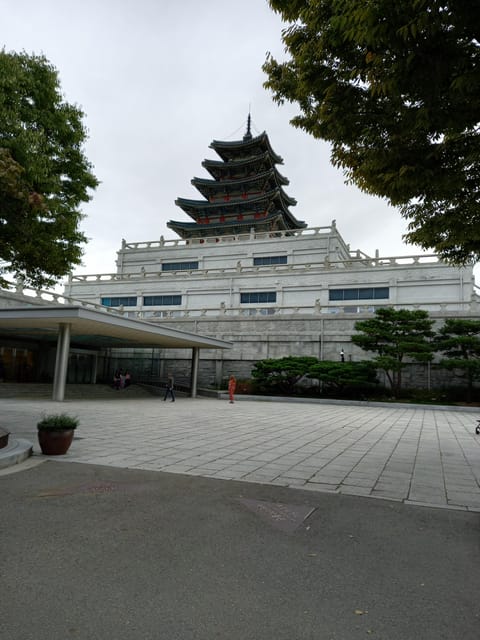
Gyeongbokgung receives about 2 hours and 20 minutes, making it the clear heart of the tour. Built in 1395 as the main palace of the Joseon Dynasty, it is described as Korea’s largest and most magnificent palace.
The most useful point here is its place in Joseon political and cultural life. This was not simply a royal residence. It was monumental architecture designed to express the order of the state, with Confucian principles at its center.
The tour description also points out that Gyeongbokgung is the only Seoul palace built on flat land according to an authentic Confucian palace structure. That gives the visit a strong architectural focus. You can expect Paul to connect the palace’s arrangement and visual form with Joseon ideals rather than treating each gate or courtyard as an isolated object.
Allow yourself to look up and around. Traditional Korean buildings are often remembered for their rooflines, painted details, courtyards, and sense of proportion. The guide’s job here is to explain what those features meant within the larger system.
The length of this stop is a benefit if you enjoy history. You will not be rushed through the palace in 30 minutes, and you have time to ask about the dynasty, Confucianism, and Korean traditional buildings. The drawback is that a long palace visit can feel heavy if you mainly want quick photographs. This is not a rapid checklist tour.
Admission to the palace is not included, so add that cost to the advertised $152. Since the fee covers the guide for four hours and a private group of up to two people, the value is strongest when two people share it. Solo visitors pay the same group price, though they receive the benefit of a private guide.
The National Folk Museum and everyday Joseon life
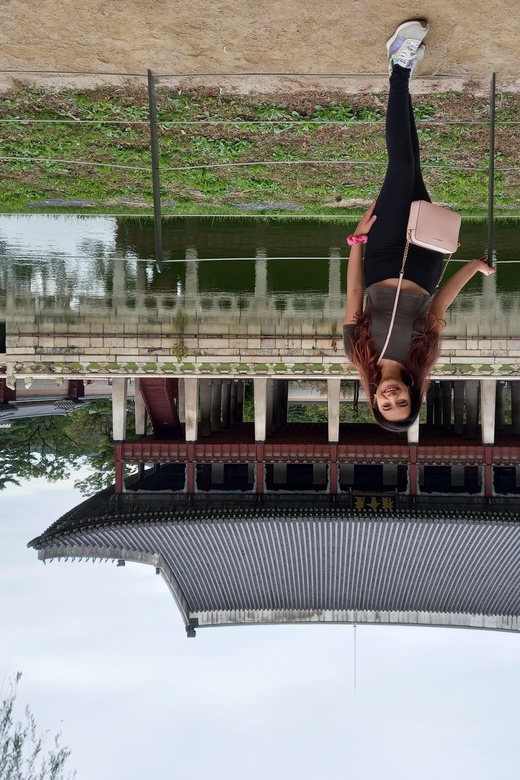
The National Folk Museum of Korea receives 30 minutes. That may sound brief, but it adds an important layer to the palace visit.
Gyeongbokgung tells you about royal power and national ideals. The Folk Museum shifts attention toward ordinary people. Its exhibitions cover seasonal activities, folk culture, and the stages of life from birth and childhood through marriage, aging, illness, treatment, and death.
That subject matter makes the museum a good counterpoint to the palace. You are not left with an image of Korea built only around kings and grand buildings. You also see how ceremonies and customs shaped daily life for families.
The museum presents ceremonial and commemorative rituals, including events connected with major moments in life. Paul’s Confucian culture focus should be especially useful here, since family duties and social relationships are central to understanding Joseon society.
Thirty minutes is enough for an introduction, but not enough for every exhibit. I would treat this as a guided orientation. If a particular display catches your attention, you may want to return later on your own, if your schedule permits. The attraction is included in the planned route, but museum admission is not listed among the tour inclusions, so confirm any entrance charge.
More Palace Tours in Seoul:
- Seoul: Gyeongbok Palace, Bukchon Village, and Gwangjang Tour
★ 4.9 · 2,321 reviews - Best Seoul City Tour (Gyeongbokgung Palace,Insadong,Namsan Tower)
★ 5.0 · 1,647 reviews - Small-Group Royal Palace and Seoul City Tour (hotel pick-up)
★ 5.0 · 1,474 reviews - Seoul City Sightseeing Tour Including Gyeongbokgung Palace, N Seoul Tower, and Namsangol Hanok Village
★ 5.0 · 1,423 reviews
Bukchon Hanok Village and the old-new view
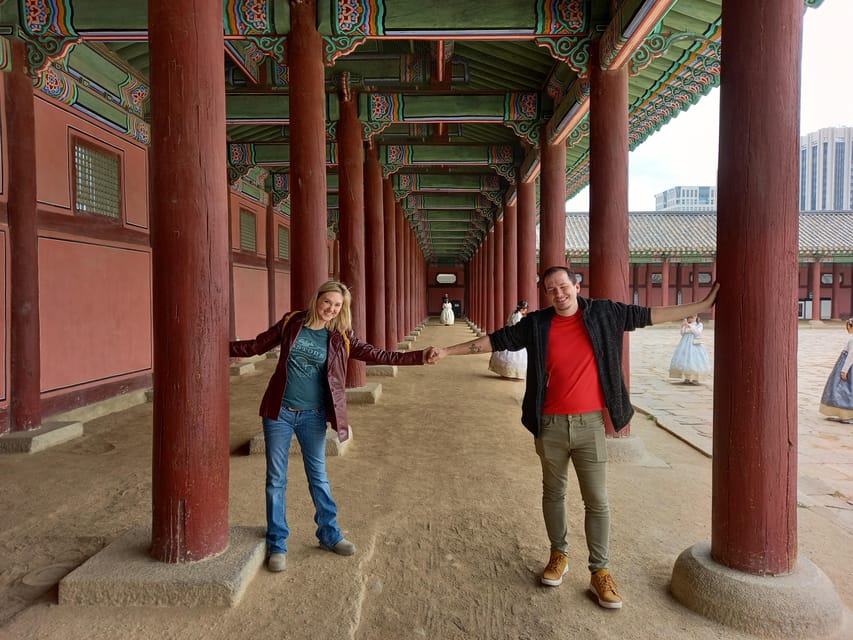
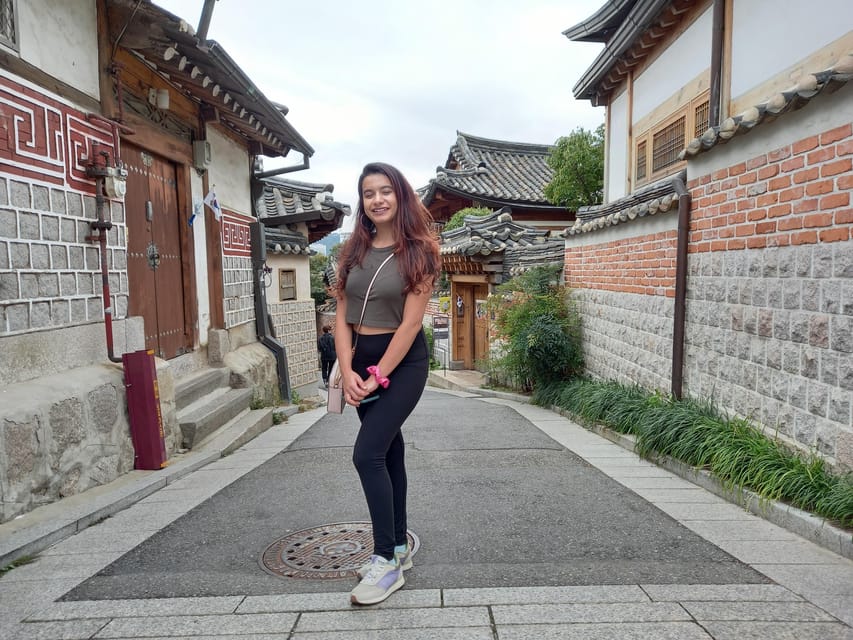
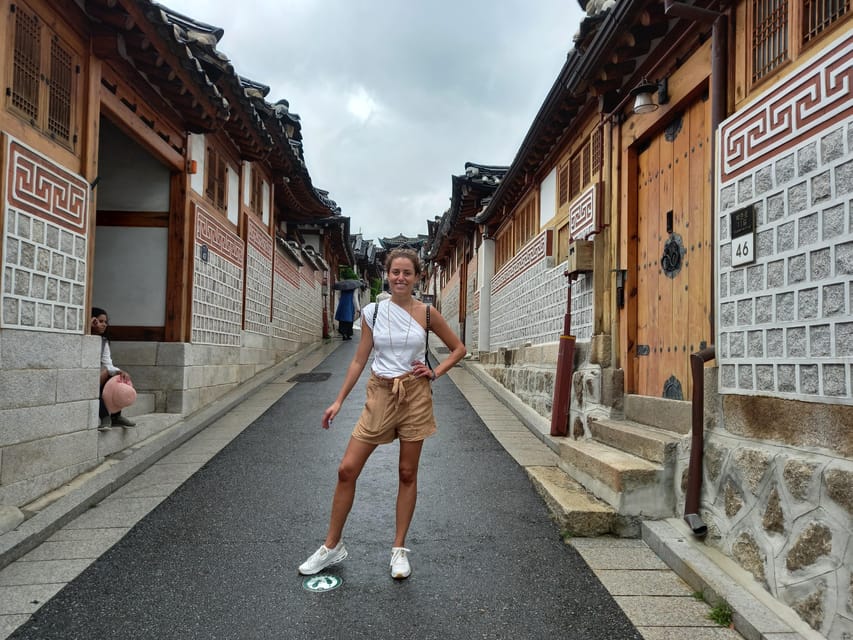
Bukchon Hanok Village receives about 40 minutes. Bukchon is known for its large cluster of traditional Korean homes, called hanoks, with about 1,000 buildings in the village.
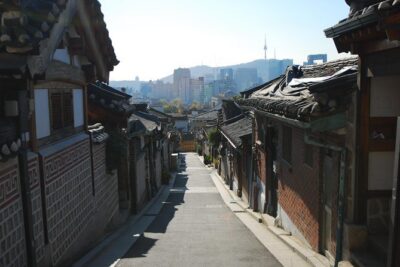
The special pleasure here is the contrast. Traditional rooflines and narrow residential streets appear alongside the modern city, with skyscrapers and N Seoul Tower visible in the background. It is one of the clearest places in central Seoul to see the past and present occupying the same view.
Paul is also praised for knowing good photo spots and angles. That is practical in Bukchon, where the best picture often depends on where you stand rather than how long you stay. You can ask him to help frame the older houses with the modern city behind them.
The 40-minute visit is useful for seeing the character of the area, but it is not a long neighborhood exploration. If you want time for every lane, shop, and viewpoint, plan a separate return visit. Bukchon is a residential area, so a guided visit also gives you a better chance of keeping the stop focused and respectful.
This is one place where comfortable shoes help, though the supplied information does not specify the exact walking conditions. The route is not described as a bus tour, and transportation is excluded, so you should be ready for movement between central Seoul sights.
Insadong, Jogyesa, and the route question
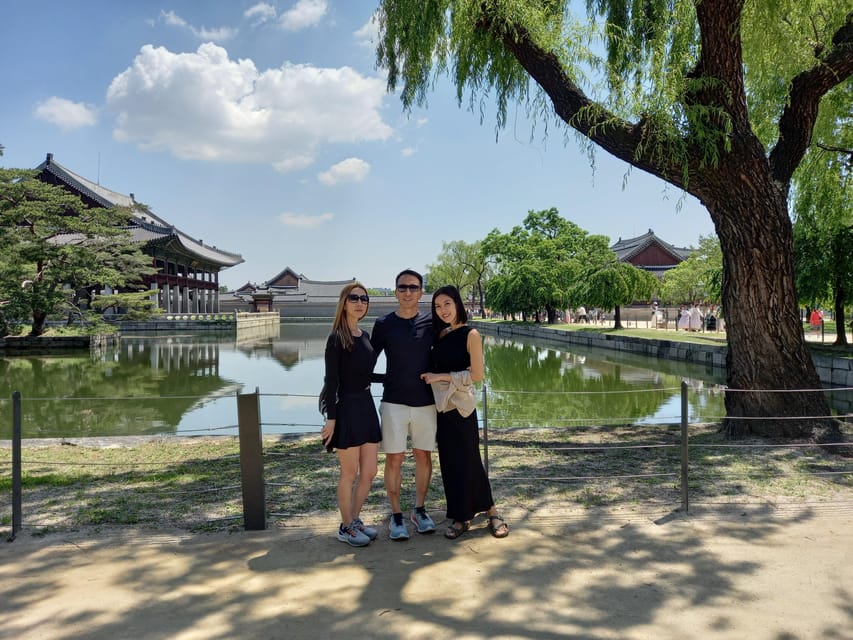
The stated itinerary gives Insadong 30 minutes. Insadong is a natural cultural stop near the palace and Bukchon area, and it provides a different mood from the formal palace grounds and residential lanes of Bukchon.
The description also highlights Jogyesa Buddhist Temple, described as the headquarters of Korea’s Buddhist organization. The temple was built in 1926 in Insadong and is located near Gyeongbokgung. It is presented as a small but important religious site, showing another side of Korean culture beyond Confucian royal architecture.
There is a small planning issue here. The timed itinerary lists Insadong, but it does not list Jogyesa as a separate stop. The broader description discusses Jogyesa in detail, and one recent account describes a Gyeongbokgung, Bukchon, and Jogyesa visit with Paul. Because of that mismatch, I would send a clear message before booking: ask if the 30-minute Insadong portion includes Jogyesa, and ask if Bongeunsa is part of your route.
Bongeunsa is also mentioned among the highlights, but it does not appear in the four-stop itinerary. Do not assume both Buddhist temples are included. The final route may depend on your agreed plan, available time, and transportation.
This is not a serious problem if you confirm in advance. It is simply the one part of the experience that needs clarification. The tour promises a cultural explanation of Buddhism, Confucianism, traditional homes, and royal architecture, but the exact temple stop should be settled before you pay.
What Paul Koo adds to the experience
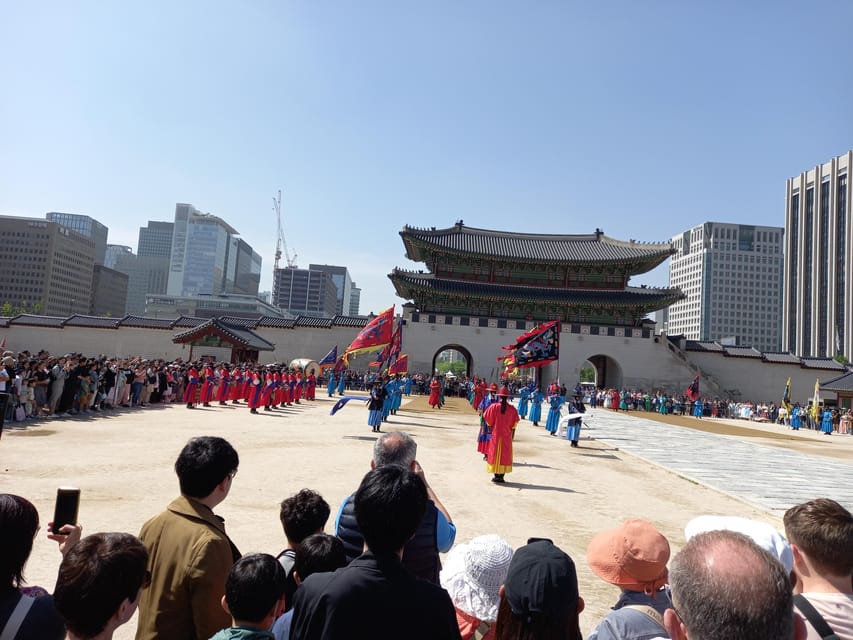
The guide is Paul Koo, and his strongest quality is his ability to turn background information into a clear story. Nitin praised the way Paul’s knowledge of the past made the visit engaging. Luis described his explanations of Korean culture, history, and religion as thoughtful and easy to understand, especially when viewed through Confucian ideas.
That praise points to the tour’s real value. You are not simply hiring someone to lead you from gate to gate. You are hiring a guide who can help connect the sites.
Paul is also praised for covering planned stops, explaining details, and helping with photographs. The photo help may sound minor, but it is useful at places such as Bukchon, where a good angle can make the difference between a cluttered snapshot and a clear picture of old Seoul beside modern Seoul.
The English guiding is live and private. That gives you room to ask about topics that interest you, whether that is Korean history, Buddhist practice, palace design, family customs, or the contrast between old neighborhoods and the modern capital.
Is $152 good value for four hours?
The price is $152 per group of up to two people. The guide fee is included for four hours, but admission fees, transport, food, drinks, and insurance are not.
For a pair, the price works out to $76 per person before extra costs. That is a reasonable way to think about the value, especially if you want a private guide with a clear cultural theme rather than a large group tour. You are paying for personal attention, a flexible meeting point, and explanations that connect several major sites.
For one person, the same $152 price is harder to justify unless private guiding is a priority. The tour is not a bargain attraction pass, and the entrance fees still need to be paid separately.
You should also remember that four hours includes several stops and movement around central Seoul. The palace receives most of the time, while the Folk Museum, Bukchon, and Insadong are shorter visits. If you want a slow museum day or extensive shopping, this is not the right format.
Who should book this private Seoul tour?
I would recommend it most strongly to:
- Couples or two friends who want a private guide
- First-time visitors who want historical context at major Seoul sights
- People interested in Confucianism, palace design, and Korean traditions
- Families who prefer a flexible meeting point and private pace
- Visitors who want help with photos as well as explanations
- Anyone who would otherwise walk through historic sites without understanding their purpose
I would be more cautious if you want a low-cost outing, independent wandering, or a tour focused mainly on Buddhist temples. The itinerary gives Gyeongbokgung the largest share of time, and the exact role of Jogyesa and Bongeunsa should be confirmed.
The activity offers free cancellation up to 24 hours before the start and lets you reserve now and pay later. Those terms are useful when your Seoul schedule is still moving, but they do not replace the need to confirm the meeting point and route.
Final verdict: a strong choice for cultural context
Book this tour if you want Seoul’s historic sites explained rather than simply photographed. Gyeongbokgung is the main prize, and the National Folk Museum, Bukchon, and Insadong give you useful contrasts between royal life, ordinary families, traditional homes, religion, and the modern city.
Paul Koo receives especially strong praise for clear historical explanations, cultural insight, and practical photo help. The cost is fair for two people who value a private guide, but less attractive for solo visitors or anyone trying to keep expenses low.
Before booking, confirm whether the Insadong segment includes Jogyesa and whether Bongeunsa is included at all. With that point settled, this is a thoughtful four-hour introduction to Seoul’s traditional culture, with enough structure to help you see much more than attractive roofs and palace gates.
FAQ
How long is the tour?
The tour lasts four hours.
What is the starting point?
The stated starting point is Gwanghwamun Square. After booking, you can choose the meeting place and time, including meeting at your hotel.
Is the tour private?
Yes. It is a private group tour for up to two people.
What language does the guide speak?
The live tour guide provides the experience in English.
Is palace admission included?
No. Admission fees for the palace are not included in the tour price.
Is transportation included?
No. Transportation for moving between locations is not included.
Does the tour include food and drinks?
No. Food and beverages are not included.
Is Jogyesa Temple definitely part of the itinerary?
Jogyesa is described as a featured cultural stop, but the timed itinerary lists Insadong rather than Jogyesa as a separate stop. Confirm with Paul Koo whether the Insadong portion includes the temple.
More Hanok Village Tours in Seoul
- Seoul: Gyeongbok Palace, Bukchon Village, and Gwangjang Tour
★ 5.0 · 1,044 reviews - Seoul: Gyeongbok Palace and Bukchon Hanok Walking Tour
★ 4.8 · 157 reviews - Best Walking Tour to Gyeongbok Palace Bukchon Hanok Village
★ 5.0 · 138 reviews - Royal Seoul Cooking Class in a 100-Year-Old Hanok
★ 5.0 · 81 reviews
Just added in Seoul
- Your Personal Seoul Photographer!★ 4.1 · 15 reviews
- You’re Invited to Our Home in Seoul: The Only Cooking Class!★ 5.0 · 8 reviews
- Seoul: Korean & English Language Exchange Global Party★ 5.0 · 28 reviews
- From Seoul: Yongpyong Ski Day Tour with Transportation★ 4.9 · 40 reviews
- From Seoul: Hwacheon Ice Fishing and Lighting Festival Tour★ 4.5 · 4 reviews
- Seoul: Gangneung BTS K-Pop & K-Drama Filming Locations Tour★ 4.6 · 14 reviews
- Unique Native Experience : Han River Picnic, Board game, BBQ★ 5.0 · 3 reviews
- Seoul: Euljiro Gastroventure Tour★ 4.0 · 1 review
Palace Tours, compared.
Gyeongbok Palace, Bukchon Village, and Gwangjang Tour
Read our review →
Best Seoul City Tour (Gyeongbokgung Palace,Insadong,Namsan Tower)
Read our review →
Small-Group Royal Palace and Seoul City Tour (hotel pick-up)
Read our review →
Seoul City Sightseeing Tour Including Gyeongbokgung Palace, N Seoul Tower, and Namsangol Hanok Village
Read our review →Gyeongbok Palace, Bukchon Village, and Gwangjang Tour
Read our review →
Seoul Highlights: Gyeongbok Palace, Insadong & N Seoul Tower
Read our review →
Seoul City Half Day Tour-Gyeongbok Palace Guard Changing Ceremony
Read our review →Browse the lists this tour appears in