
Reviewed · WALKING TOURS
(Closed) Korea’s White House Walking Tour Blue House
Power once hid behind these blue roofs. This small-group walk offered rare access to Cheong Wa Dae, Korea’s former presidential home and office, with a licensed English-speaking guide explaining the buildings, politics, and customs behind them. I especially like the nine-person limit and the chance to see places that were closed to ordinary visitors for more than 70 years. The main drawback is the $199 price, which is steep for a 2.5-hour tour, especially since hotel transport is not included.
I also like that the route moved beyond the famous front building. You saw the reception hall, former presidential office, family residence, press center, and several traditional structures. Guide Jungho earned repeated praise for clear meeting instructions, excellent English, lively storytelling, and even helping one participant find the metro afterward.
There is an important catch: this experience is marked closed, and its original description said public access would end in June after a short period of openness. You should not assume the tour can currently be booked. If it returns, the advice below will help you decide if its high price suits your Seoul plans.
In This Review
- Key points to know before you go
- Why the Blue House mattered to Korea
- Meeting at Gyeongbokgung Station at 10:00 a.m.
- Yeongbingwan, where Korea welcomed important guests
- The main Blue House and its blue roof
- The former presidential office site
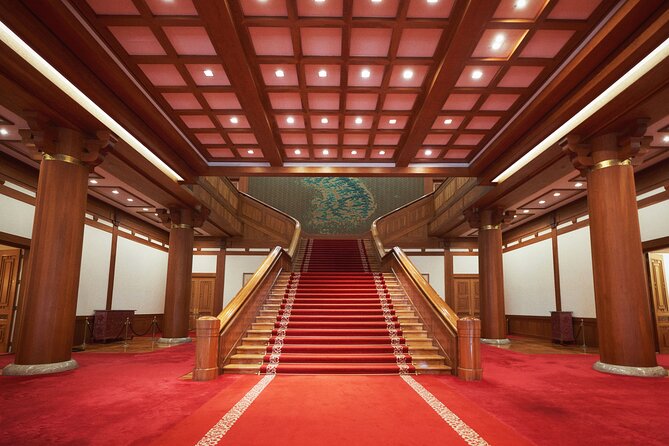
- The private residence and presidential family life
- Chimnyugak House and the quieter side of the grounds
- Sangchunjae and traditional Korean design
- Chunchugwan, where the press heard from the president
- What the guide adds to the visit
- Is $199 a fair price?
- Who should choose this walking tour?
- Booking, cancellation, and the closure issue
- Should you book the Blue House tour?
- FAQ
- Where does the tour start?
- What time does the tour begin?
- How long does the Blue House tour last?
- Where does the tour finish?
- How many people can join the tour?
- What does the price include?
- Is transportation from my hotel included?
- Can I cancel for a full refund?
Key points to know before you go
- The Blue House was off-limits for more than 70 years: Entry once depended on a presidential invitation, making this a rare look at Korea’s seat of power.
- Only nine people join each tour: The small group gives you a better chance to hear the guide and ask questions.
- Jungho is a major strength: His English, historical explanations, and personal attention received especially strong praise.
- The route covers seven distinct sites: You see formal state rooms, private living areas, traditional buildings, and the former press center.
- The tour begins at 10:00 a.m. at Gyeongbokgung Station: You must make your own way there, and the tour returns to the same meeting point.
- The $199 fee buys context as much as access: Reserved entry matters, but the value depends on how much you care about Korean government and modern history.
Why the Blue House mattered to Korea
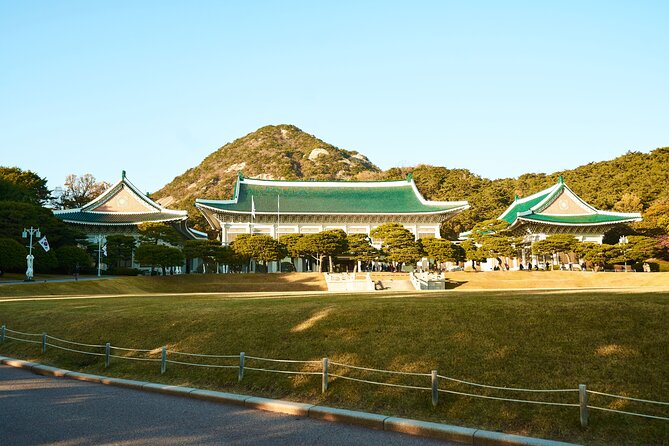
Cheong Wa Dae, usually called the Blue House, served as the president’s residence and office for more than seven decades. Its blue roof became a familiar symbol of the Korean government, much as a national parliament or executive residence can represent a country’s political life.
For years, ordinary people could not simply walk through the gates. Access was limited to select invitees, including foreign leaders, Olympic medalists, K-pop performers such as BTS, and executives from major companies including Samsung and LG.
That background changes the tone of the visit. You are not just looking at attractive buildings. You are walking through a place tied to presidential meetings, international diplomacy, official announcements, and private family life.
The political setting also gives the tour more weight than a standard architecture walk. You can ask how the buildings were used, why the office and residence were separated, and how Korea presented itself to the outside world.
More Walking Tours in Seoul
- Seoul moonlight walking tour with local historian
★ 5.0 · 940 reviews - Seoul: Nighttime Hidden Gems Walking Tour
★ 5.0 · 775 reviews - Seoul: Evening Dark History, Folklore & Ghost Story Walking Tour
★ 5.0 · 593 reviews
Meeting at Gyeongbokgung Station at 10:00 a.m.
The tour begins at Gyeongbokgung Station in Seoul at 10:00 a.m. This is a practical meeting point near one of the city’s major historic areas, but you must arrange your own transportation. Hotel pickup and drop-off are not part of the fee.
That detail matters because $199 can create the impression of a door-to-door private experience. It is not. You get reserved entrance and a licensed English-speaking guide, then make your own way to the start and back from the finish.
The maximum group size is nine people. That is small enough for a guide to keep the walk personal without making the cost feel quite like a private tour. If Jungho leads your group, clear directions should help you arrive without fuss. One participant specifically praised his meeting instructions, and he later walked her back to a metro station.
The experience lasts about two and a half hours. The listed stops add up to roughly 85 minutes of planned time, so the rest is used for walking between buildings, orientation, questions, and explanations. Wear comfortable shoes. The route covers a large presidential compound rather than one single interior room.
Yeongbingwan, where Korea welcomed important guests
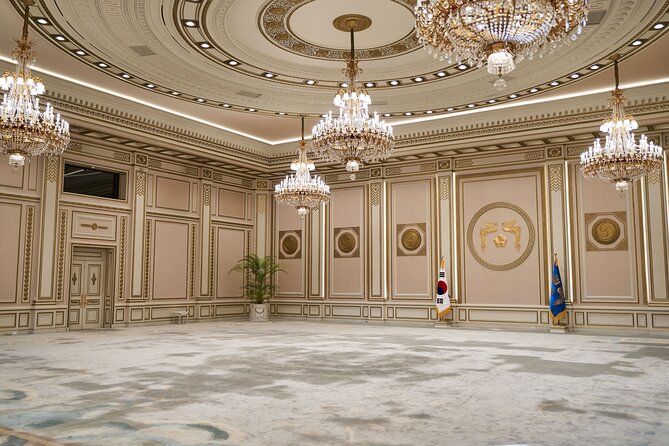
Your first main stop is Yeongbingwan, the reception building used for important visitors from abroad. Presidents welcomed foreign leaders here, and the building hosted formal dinners, meetings, and other major events.
This is a useful opening because it shows the public face of the presidency. The Blue House was not only a workplace or family residence. It was also a stage where Korea received other governments and marked important occasions.
You spend about 10 minutes here. The building has a modern appearance, but the tour connects its design with Korean identity and official ceremony. Rather than simply photographing the exterior, you get help reading the building as a place of diplomacy.
The short stop may feel quick if you enjoy architecture, but that is part of the wider route. The tour aims to give you a working sense of the compound instead of keeping you in one reception hall for most of the morning.
The main Blue House and its blue roof
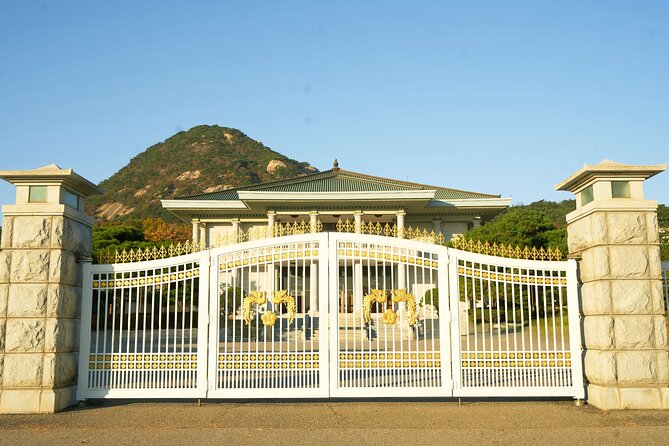
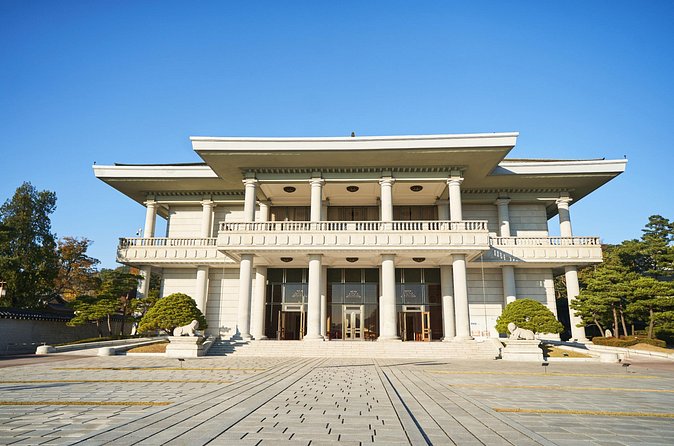
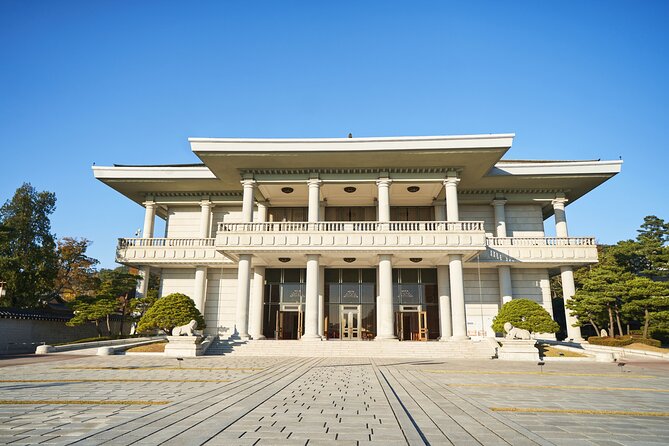
The central stop is the main Cheong Wa Dae building, where the president worked and held important meetings. This is the image most people associate with the Blue House, especially its distinctive blue roof.
You spend about 20 minutes here. The guide explains how the building functioned and why it became such a strong government symbol. The design also mixes modern official architecture with Korean elements, giving the site a national character rather than a purely bureaucratic one.
This is likely the most photographable part of the walk, but the real benefit comes from knowing what took place inside. Important decisions were made here, and the building served as the working center of the presidency.
I would not expect a museum-style display packed with objects at every turn. The value is in the setting and the explanation. Without a guide, you might recognize the roof but miss the meaning of the building, its role in government, and its place in recent Korean life.
A completely different kind of day:
- Best DMZ Tour Korea from Seoul (Red Suspension Bridge Optional)
★ 5.0 · 41,422 reviews - DMZ Tour: 3rd Tunnel, Option(Suspension Bridge, Boat) from Seoul
★ 5.0 · 21,373 reviews - DMZ tour south Korea from Seoul (NK experience hall, defector)
★ 5.0 · 20,599 reviews - Seoul: DMZ Tour with Optional Suspension Bridge
★ 4.8 · 5,277 reviews
The former presidential office site
The third stop takes you to the area where the older main presidential office once stood, before the current Blue House building was built. Presidents worked here and held important meetings, linking the site to major moments in modern Korea.
You spend about 20 minutes at this location. It gives the tour a useful time dimension. Instead of seeing the compound as one fixed presidential complex, you learn that its buildings and uses changed over the years.
This stop may be less visually dramatic than the main Blue House. That is worth knowing if your priority is grand architecture. Its appeal is historical context, especially for anyone interested in how Korea’s executive center developed.
Jungho’s style appears well suited to this kind of place. The strongest comments about his guiding focus on the way he connected architecture with Korean history and politics. His conversational English also seems to make room for questions, which is important at a site where the visual details alone cannot tell the whole story.
The private residence and presidential family life
The Blue House was also home to the president and the president’s family. The residence was kept separate from the office, giving the family privacy away from formal government work.
You spend about 10 minutes here. The house was described as quiet and surrounded by trees, with bedrooms, living spaces, and other domestic rooms inside. This changes the mood of the visit. After formal reception areas and offices, you see the more private side of the presidency.
The separation between office and residence is easy to understand, but it also says something about the demands of the job. A president needed a place for family life while remaining close to the machinery of government.
This part may appeal most to people curious about how leaders actually lived, rather than only how they conducted official business. It is also a reminder to keep expectations sensible. Ten minutes is a short visit, so the guide’s explanation will matter more than a long, leisurely examination of rooms.
Chimnyugak House and the quieter side of the grounds
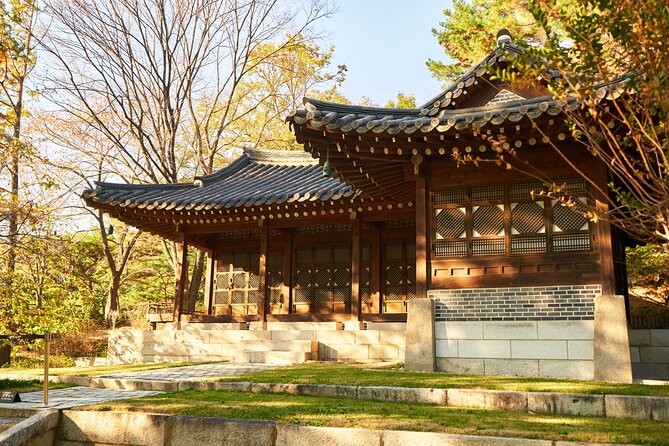
At Chimnyugak House, the pace slows. This small traditional pavilion sits among trees and provides a calm break from the formal buildings.
You spend about 10 minutes here while the guide discusses its architecture and history. The stop adds variety to the route, showing that the Blue House compound was not built only from large offices and reception halls.
I like this pause because it gives the tour a more Korean sense of place. The presidential compound includes traditional forms and quiet outdoor settings, not just symbols of state power.
It is also a useful moment to catch your breath and ask questions. With a group capped at nine, you have a better chance of having a real exchange instead of waiting for a guide to repeat the same speech over a crowd.
Sangchunjae and traditional Korean design
Sangchunjae is one of the most attractive traditional buildings on the grounds. The tour takes about 10 minutes here, with time to walk around its wooden structure and learn how it was used for special guests and private meetings.
This stop helps explain the Blue House’s blend of official function and Korean design. You are not looking at a palace from the Joseon period, but the traditional building style connects the modern presidency with older ideas about hospitality, ceremony, and national culture.
The visit is mainly about the exterior and setting, based on the available tour details. If you are especially interested in traditional architecture, you may wish the stop lasted longer. Still, it gives the route a welcome change from the main offices and formal reception spaces.
Chunchugwan, where the press heard from the president
The final listed stop is Chunchugwan, the former press center. It is where Korean and international reporters gathered for official announcements and presidential speeches.
You spend about five minutes here, making it the briefest stop. Even so, the location completes the story of how the Blue House communicated with the public. Yeongbingwan showed diplomacy, the main building showed executive work, and Chunchugwan shows the public message leaving the compound.
Five minutes will not satisfy anyone hoping for a long media-history presentation. Think of it as a final piece of the route, with the guide explaining the building’s role before the group returns to the meeting point.
What the guide adds to the visit
The guide is not a minor extra here. The buildings have symbolic value, but much of that meaning is invisible unless someone explains it.
Jungho is the named guide associated with this experience, and the feedback about his work is unusually consistent. His excellent English, conversational manner, historical explanations, and enthusiasm are praised again and again. He also used questions and quiz-style exchanges to keep the walk active rather than turning it into a long lecture.
That matters at the Blue House because political history can become dry fast. A good guide helps you connect a reception hall with diplomacy, a former office with government decisions, and a press center with the way presidents addressed the public.
Jungho also seems attentive to practical needs. He sent clear instructions before the meeting, kept the group moving for about two hours, and helped one participant reach the metro afterward. That extra care is not formally promised, so do not book on the assumption that every group will receive it. Still, it gives you a useful picture of the tour’s personal approach.
Is $199 a fair price?
At $199 per person, this is an expensive Seoul activity. The fee includes reserved entrance to the Blue House and an English-speaking licensed guide, but not transportation, meals, or hotel transfers.
The small group helps justify part of the cost. A maximum of nine people is far more comfortable than joining a large coach group, especially when you want to hear political background or ask about Korean customs. Reserved entry also has value during a limited opening period, when access may be uncertain or in demand.
Still, the price will not suit everyone. If you mainly want a quick photo of the blue roof, you can find better value elsewhere in Seoul. If you already have strong knowledge of Korean politics and prefer to explore at your own pace, the guided format may feel costly.
I would consider it for someone with a serious interest in Korea, government, architecture, or recent political change. The experience is less convincing as a general sightseeing purchase unless this is one of the few places you particularly want to enter.
Who should choose this walking tour?
This tour is a good match for you if:
- You care about Korean government and modern political history.
- You want a small group rather than a large organized visit.
- You value a strong English-speaking guide.
- You enjoy comparing formal state buildings with traditional Korean structures.
- You have already planned time around Gyeongbokgung Station.
- You want access to a site that was once closed to the public.
It is less suitable if you need hotel pickup, dislike walking, want a low-cost activity, or prefer a long, unhurried visit inside each building. The tour covers many locations in a short period, so the experience is broad rather than slow and museum-like.
The activity is described as suitable for most people, near public transportation, and open to service animals. That gives it broad practical appeal, but the information provided does not spell out detailed mobility arrangements for every part of the route. If you need specific access support, confirm it before booking.
Booking, cancellation, and the closure issue
The tour offered free cancellation up to 24 hours before the 10:00 a.m. start time. Canceling later, or making changes within that 24-hour window, did not qualify for a refund.
More important, the experience is now marked closed. Its original sales pitch described a limited window before public access ended in June. That means this article is useful for judging the experience and understanding its former format, but you should verify availability before making any plans or payment.
The tour was highly rated, with a five-star score and a 100 percent recommendation rate from the available feedback. That strong record is driven mainly by the guide and the rare access, not by luxury transport or a long list of inclusions.
Should you book the Blue House tour?
If the experience reopens, I would recommend it to you if the Blue House is a priority and you want its political meaning explained in clear English. The nine-person cap, reserved entrance, seven-site route, and Jungho’s praised storytelling make it more than a quick look at a famous roof.
I would skip it if $199 strains your budget or if you only want general Seoul sightseeing. The fee is high, the visit lasts about two and a half hours, and you must reach Gyeongbokgung Station yourself.
For the right person, this was a rare chance to walk through a place that had been closed for generations. For everyone else, Seoul offers less costly ways to see palaces, traditional neighborhoods, and Korean architecture. First confirm that the tour has reopened. If it has, book it for access and interpretation, not simply for the photograph.
FAQ
Where does the tour start?
The tour starts at Gyeongbokgung Station in Seoul.
What time does the tour begin?
The scheduled start time is 10:00 a.m.
How long does the Blue House tour last?
The experience lasts approximately two hours and 30 minutes.
Where does the tour finish?
The tour ends back at the meeting point.
How many people can join the tour?
The group has a maximum of nine participants.
What does the price include?
The price includes reserved entrance to Cheong Wa Dae and an English-speaking licensed tour guide.
Is transportation from my hotel included?
No. Hotel pickup and drop-off are not included.
Can I cancel for a full refund?
Yes, if you cancel at least 24 hours before the experience start time. Cancellations or changes made less than 24 hours in advance are not accepted for a refund.
Just added in Seoul
- Seoul: Korean & English Language Exchange Global Party★ 5.0 · 28 reviews
- Your Personal Seoul Photographer!★ 4.1 · 15 reviews
- You’re Invited to Our Home in Seoul: The Only Cooking Class!★ 5.0 · 8 reviews
- From Seoul: Yongpyong Ski Day Tour with Transportation★ 4.9 · 40 reviews
- From Seoul: Hwacheon Ice Fishing and Lighting Festival Tour★ 4.5 · 4 reviews
- Seoul: Gangneung BTS K-Pop & K-Drama Filming Locations Tour★ 4.6 · 14 reviews
- Unique Native Experience : Han River Picnic, Board game, BBQ★ 5.0 · 3 reviews
- Seoul: Euljiro Gastroventure Tour★ 4.0 · 1 review
Walking Tours, compared.
Seoul moonlight walking tour with local historian
Read our review →
Evening Dark History, Folklore & Ghost Story Walking Tour
Read our review →
Dark Side of the City and Ghost Stories Walking Tour
Read our review →
Gangnam Walking Tour on Youth and Society in Seoul Korea
Read our review →
Gyeongbok Palace and Bukchon Hanok Walking Tour
Read our review →
Best Walking Tour to Gyeongbok Palace Bukchon Hanok Village
Read our review →
Highlights & Hidden Gems With Locals: Best of Seoul Private Walking Tour
Read our review →Browse the lists this tour appears in