
Reviewed · HISTORICAL TOURS
Seoul History Walking Tour
Seoul tells its story one bell at a time. This compact walking tour follows 630 years of change through the city center, from Joseon royal power to Japanese occupation, military rule, democracy, and modern civic life. I like the clear historical thread and the small maximum group of eight, which should make it easier to ask questions.
I also like that the route connects famous figures such as King Sejong and Admiral Yi Sun-sin with less familiar places, including Jungmyeongjeon Hall and the former Russian Legation. The main consideration is pace: 15 stops in about three and a half hours means some locations receive only five or ten minutes.
In This Review
- Key Points Before You Book
- Why This Seoul History Walk Works
- Starting at Bosingak, Where Seoul’s Bells Marked Time
- Cheonggyecheon Stream and the City’s Changing Needs
- City Hall, Seoul Plaza, and the Public Face of Modern Seoul
- Views From Jeongdong and the Stone Wall of Deoksugung
- Jungmyeongjeon Hall and Korea’s Loss of Independence
- Ewha Museum and the Changing Role of Korean Women
- The Former Russian Legation and a King in Hiding
- Admiral Yi Sun-sin, King Sejong, and the Two Men in Gwanghwamun
- Gwanghwamun Square and Korea’s Fight for Democracy
- Rooftop History at the National Museum of Korean Contemporary History
- The Japanese Embassy and a Long-Running Protest
- Ending at Jogyesa Temple With Bells and the Universe
- What Is Included and What to Bring
- Who Should Book This Tour?
- Final Verdict: A Strong Introduction for $26.60
- FAQ
- How long does the Seoul History Walking Tour last?
- What time does the tour begin?
- Where does the tour start?
- Where does the tour end?
- How many people can join the tour?
- Is admission included at the stops?
- Is bottled water included?
- Are snacks provided?
- Is the tour suitable for most people?
- Can I cancel for a full refund?
Key Points Before You Book
- A 630-year timeline: The route links the Joseon Dynasty, imperial Japan, the Korean War era, dictatorship, and modern democracy.
- A small group of eight: The limited size should make conversation with the Australian guide easier than on a large city tour.
- Free sights, useful context: Admission is free at every listed stop, while the value comes from the explanations and connections between places.
- An afternoon in central Seoul: The tour begins at 2:30 pm and ends near its starting point at Jogyesa Temple.
- Strong guide feedback: Eric receives especially warm praise for explaining clearly and answering questions throughout the walk.
- Bring your own water: Korean snacks are included, but bottled water is not.
Why This Seoul History Walk Works
At $26.60 per person, this is priced as an affordable introduction to central Seoul rather than a specialized palace tour. You are not paying for entry tickets, since all 15 stops are listed with free admission. You are paying for a guide who gives shape to places you could otherwise pass without understanding.
That distinction matters in Seoul. A bell pavilion, a city plaza, a statue, and a stream may look unrelated at first. Put together, they explain how the capital was governed, defended, occupied, rebuilt, and claimed by ordinary citizens.
The tour lasts about three hours and 30 minutes. That is long enough to cover a lot, but not long enough for extended visits at every stop. Seoul’s history is not being presented as a series of museum lectures. Instead, you move through the city and receive short explanations at the places where events happened.
The group limit of eight is one of the strongest practical features. You can ask about a confusing date, a Korean name, or a political reference without interrupting a crowd. The published feedback gives special attention to Eric, who is praised for answering questions and maintaining a high level of information from beginning to end.
More History Tours in Seoul
- Seoul: Evening Dark History, Folklore & Ghost Story Walking Tour
★ 5.0 · 593 reviews - Hanbok Photoshoot and History Tour at Gyeongbokgung Palace
★ 5.0 · 276 reviews - From Seoul: Dae Jang Geum Park Historic K-Drama Set Tour
★ 4.9 · 143 reviews
Starting at Bosingak, Where Seoul’s Bells Marked Time
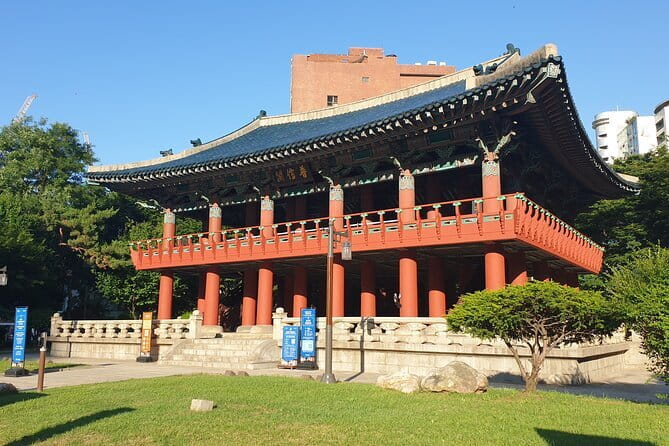
Meet at the Bosingak Bell Pavilion on Jong-ro at 2:30 pm. The first stop is brief, only about 15 minutes, but it sets up an important question: why did the city bell ring 28 times at night and 33 times in the morning?
That question gives the tour an immediate sense of place. You are not beginning with a broad speech about Seoul. You are beginning with one object and one daily custom, then using it to explain how the old city operated.
Bosingak is also a sensible meeting point. The tour takes place in central Seoul and remains near major city sights, with public transportation nearby. If you arrive early, this is a useful place to get oriented before the group begins.
Cheonggyecheon Stream and the City’s Changing Needs
The longest early stop is Cheonggyecheon Stream, with about 40 minutes devoted to it. That extra time signals its importance. The stream is used to explain Seoul during the Joseon Dynasty, the Korean War, and the present day.
This is one of the tour’s most appealing ideas: the same urban feature can tell different stories depending on the era. You will hear how it served the city in the Joseon period, what it meant during wartime hardship, and how its modern role reflects changing ideas about Seoul.
I like this kind of stop because it helps you read the city as more than a collection of monuments. The stream becomes a way to understand daily life, public needs, and urban change.
The limitation is that a guided explanation cannot provide every detail from each period. If Cheonggyecheon is a major personal interest, you may want extra time on your own after the tour.
City Hall, Seoul Plaza, and the Public Face of Modern Seoul

The next stops move from older urban life into modern government and public expression. Seoul City Hall receives about five minutes, enough for a concise look at its architecture from inside and outside.
That short visit is useful for travelers who want to understand how Seoul presents itself today, but it is not a full architectural tour. The guide’s job here is to connect the building to the wider story, not to spend half an hour on design details.
At Seoul Plaza, the focus shifts from government to citizens. The tour asks how the open space reflects the hearts of modern Seoul residents. That wording points toward public gatherings, civic identity, and the way a central square can become a place where people express hopes, anger, and solidarity.
You will likely find this pairing effective: City Hall represents official power, while Seoul Plaza represents public life. Ten minutes at the plaza is enough to understand the point, though not enough to explore every event associated with it.
More Walking Tours in Seoul
- Seoul moonlight walking tour with local historian
★ 5.0 · 940 reviews - Seoul: Nighttime Hidden Gems Walking Tour
★ 5.0 · 775 reviews - Seoul: Dark Side of the City and Ghost Stories Walking Tour
★ 4.8 · 484 reviews - Gangnam Walking Tour on Youth and Society in Seoul Korea
★ 5.0 · 401 reviews
Views From Jeongdong and the Stone Wall of Deoksugung
Jeongdong Observatory gives you about ten minutes to look across the palace and city. The value here is visual. After hearing about the capital’s institutions, you get a chance to see how the historic core and modern city fit together.
The stop is short, so the view functions as a pause rather than a long sightseeing session. If you care about photographs, keep your camera ready and listen for the guide’s explanation before the group moves on.
Next comes Deoksugung Doldam-gil, the stone-wall road beside Deoksugung Palace. The tour uses a memorable Korean superstition: couples who walk along the wall together will soon divorce.
It is a light moment in a route that soon turns toward occupation and political crisis. That balance helps. Seoul’s past is not only kings, treaties, and national trauma. Folklore and everyday customs also shape how people experience historic places.
The walk itself may be one of the more pleasant stretches of the afternoon, but the tour does not list a separate palace admission or extended palace visit. You should think of this as a historical street walk, not a full Deoksugung Palace tour.
Jungmyeongjeon Hall and Korea’s Loss of Independence
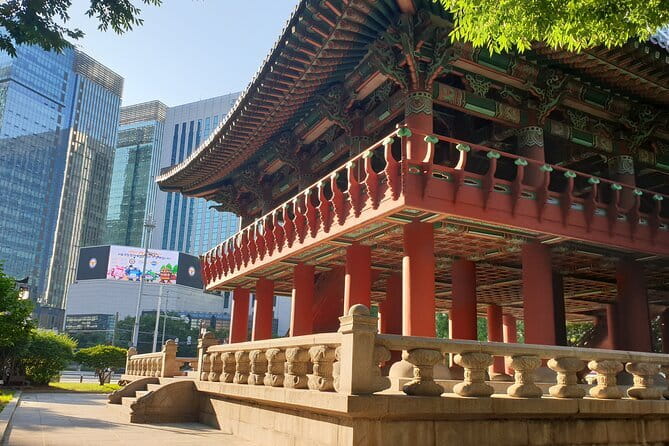
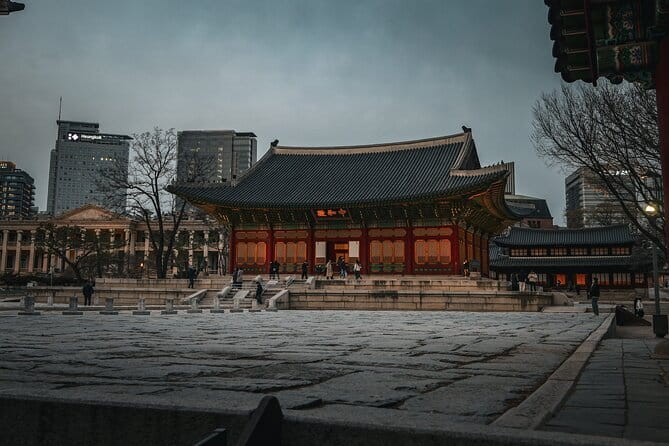
Jungmyeongjeon Hall brings the tour into one of its more serious chapters. Here you learn how Imperial Japan forced Korea to surrender its independence.
This stop matters because it gives a specific place to a major national turning point. Instead of treating the period as a vague reference to foreign control, the guide connects political pressure to a building and a historical event.
Ten minutes is enough for an introduction, especially in a small group where you can ask a follow-up question. It is not enough to cover every figure, treaty, and consequence. Still, the stop adds needed weight to the route and prevents the tour from becoming only a royal sightseeing walk.
Ewha Museum and the Changing Role of Korean Women
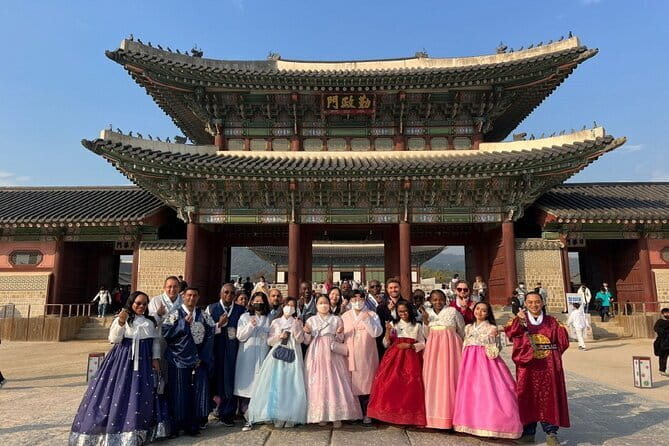
The Ewha Museum introduces social change through Korea’s first school for girls. The guide explains how the institution challenged older views about women’s roles.
This is an important addition because political history can easily become a parade of kings and generals. The museum shifts attention toward education and the gradual expansion of opportunities for women.
The stop lasts about ten minutes. That makes it a concise introduction rather than a full museum visit, but the subject fits well into the wider route. You see that national change was not only about military threats and royal decisions. It also happened through schools, ideas, and changing expectations inside society.
The Former Russian Legation and a King in Hiding
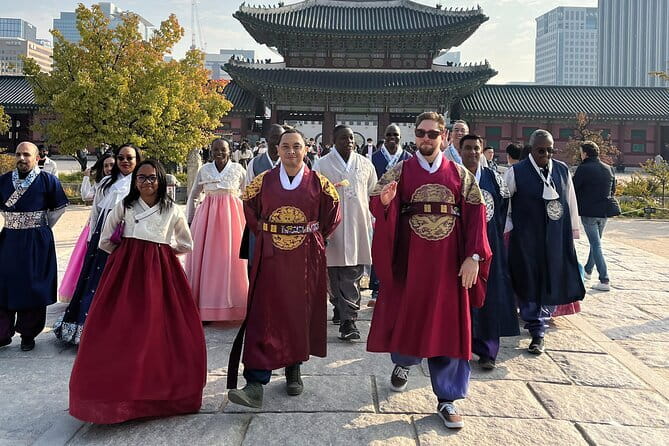
At the former Russian Legation, the tour asks why Korea’s penultimate monarch fled his palace in the middle of the night and stayed there for a year. The answer places royal fear and international pressure in a clear setting.
This is one of the route’s more dramatic episodes. A king leaving his own palace at night is easy to remember, and the building gives the story a physical anchor. The 20-minute stop is among the longest on the itinerary, which suggests that the guide has room to explain the political background rather than rushing through the event.
For me, this is the type of place that benefits most from a guide. Without context, a former diplomatic building can be easy to overlook. With the story attached, it becomes part of the struggle over Korea’s sovereignty.
Admiral Yi Sun-sin, King Sejong, and the Two Men in Gwanghwamun
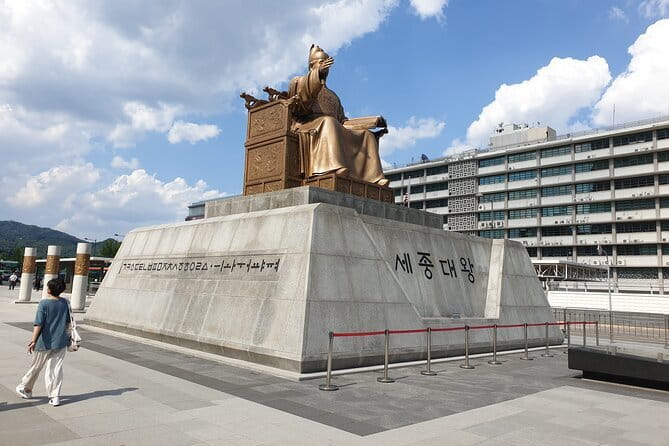
The statues of Admiral Yi Sun-sin and King Sejong are central points on the route. Each receives about ten minutes, and each represents a different kind of leadership.
Admiral Yi Sun-sin is presented as the general who saved Korea and changed the course of world history. The wording is bold, but his place in Korean memory is unmistakable. The guide uses the statue to explain military leadership and national survival.
King Sejong is considered the greatest Joseon king, and the tour asks why. This opens the door to his contributions to Korean society and culture, rather than reducing him to a name on a monument.
Placing the two statues together works well. Yi represents defense, while Sejong represents government, learning, and public benefit. You get two memorable figures without needing to visit a palace or museum for the basic introduction.
Gwanghwamun Square and Korea’s Fight for Democracy
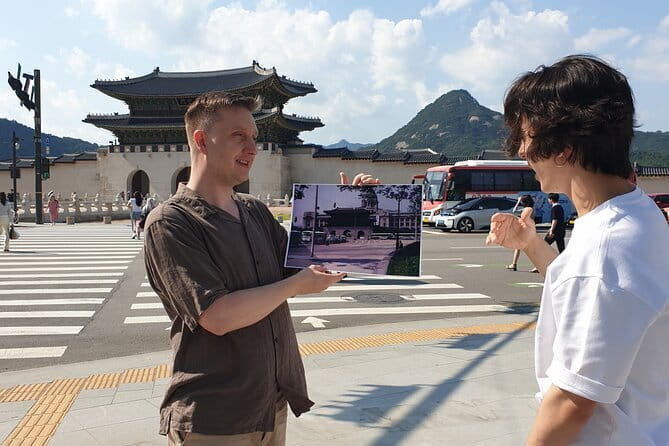
Gwanghwamun Square receives about 25 minutes, making it another major stop. The central question is how many protests it takes to change a democracy.
This part of the tour moves beyond dynastic history. You learn about South Korea’s struggle against dictatorship and the role of public protest in shaping modern political life. The square becomes a place where the country’s recent past can be discussed in direct, human terms.
I especially like this part of the route because it explains modern Seoul through civic action. A city center is not only where officials work. It is also where people gather, demand change, and test the limits of government.
The subject may feel heavier than the opening bell story or the divorce superstition. That is appropriate. A good history walk should not smooth away difficult chapters. It should help you see how the modern country developed through conflict as well as achievement.
Rooftop History at the National Museum of Korean Contemporary History
The National Museum of Korean Contemporary History gives you about 15 minutes, with attention to how much of Seoul’s story can be seen from the rooftop.
This is a smart pause after the discussion of democracy. You can look across the city while considering the changes just described. The viewpoint also helps connect the older royal center with the modern capital around it.
The listed experience does not include a separate museum admission or long indoor visit. Treat the stop as a rooftop perspective and a short historical orientation, not as a complete museum tour.
The Japanese Embassy and a Long-Running Protest
The route then turns to the Embassy of Japan, identified as the site of the world’s longest running protest. The stop lasts about ten minutes.
This is another moment when the tour connects a physical address with a continuing political issue. The location is not presented as a neutral building. It carries the memory of unresolved pain and public action.
You may find this stop emotionally weightier than the earlier sightseeing points. That is part of the tour’s purpose. Seoul’s history includes living disagreements, not only events safely locked in the past.
The explanation should help you understand why this part of central Seoul matters, even if you do not know the background before arriving. As with the discussion of occupation and dictatorship, the guide’s context is the main value.
Ending at Jogyesa Temple With Bells and the Universe
The final stop is Jogyesa Temple, where the tour asks how the ringing of bells connects people with the universe. The route ends directly up the street from where it began, and the guide can assist with directions afterward.
This ending changes the mood again. After royal politics, invasion, education, military defense, protest, and democracy, the temple offers a spiritual note. The bell is no longer only a tool for marking city time, as it was at Bosingak. Here it becomes part of a larger Buddhist idea.
That circular feeling is satisfying. You begin with a bell tied to civic routine and finish with a bell tied to the universe. You also end near the original meeting area, which is convenient if you plan to continue exploring central Seoul or return to your hotel by public transportation.
What Is Included and What to Bring
Traditional Korean snacks are included, along with an informative memento of the tour. These extras are modest, but they fit the experience. The snacks give the afternoon a local touch, while the memento may help you remember the main dates and figures afterward.
Bottled water is not included. Bring your own, especially because the walk lasts three and a half hours and includes many stops. The provided information does not specify the total walking distance, so comfortable shoes are a sensible choice without assuming a particular route length.
The tour is near public transportation, allows service animals, and is described as suitable for most people. It has a maximum of eight participants. Group discounts are available, although no discount amount is given.
Who Should Book This Tour?
I would choose this tour if you want a first look at Seoul’s historical center and prefer a connected story over isolated attractions. It suits you particularly well if you are curious about the Joseon Dynasty, Korea’s struggle for independence, Admiral Yi Sun-sin, King Sejong, and the country’s fight for democracy.
It is also a good choice if you like asking questions. The small group should make that easier, and Eric is specifically praised for answering questions throughout the afternoon. The feedback is uniformly positive, with a perfect five-star rating from nine reviews, including strong praise for the overall quality of the history presentation.
I would hesitate if you want long visits inside museums or palaces. Several stops last only five or ten minutes, and the route covers a lot of ground. This is a broad introduction, not a slow architectural study or a complete visit to every site.
You also need to be comfortable with serious subjects. The tour includes forced loss of independence, royal flight, dictatorship, protest, and an ongoing political dispute. The lighter stories about bells and the stone wall provide balance, but this is not a sightseeing walk built only around pretty views.
Final Verdict: A Strong Introduction for $26.60
For $26.60, I think this is good value if you want Seoul’s history explained in the streets where it unfolded. The free admission at every stop keeps the cost low, while the guide supplies the structure that individual sightseeing often lacks.
Book it for the connections: the bell at Bosingak, the stream, the palace district, the statues, Gwanghwamun Square, the Embassy of Japan, and Jogyesa Temple all become parts of one story. Skip it if you want an unhurried palace interior tour or a museum-heavy afternoon.
The best practical choice is to reserve ahead, since the experience is booked an average of 81 days in advance. Free cancellation is available up to 24 hours before the 2:30 pm start, giving you some flexibility. Bring water, arrive at Bosingak with time to spare, and come ready to listen, ask questions, and walk through Seoul’s past at a steady pace.
FAQ
How long does the Seoul History Walking Tour last?
The tour lasts approximately 3 hours and 30 minutes.
What time does the tour begin?
It begins at 2:30 pm.
Where does the tour start?
The meeting point is Bosingak Bell Pavilion, 54 Jong-ro, Jongno District, Seoul, South Korea.
Where does the tour end?
The tour ends at Jogyesa Temple, directly up the street from the starting area.
How many people can join the tour?
The maximum group size is eight travelers.
Is admission included at the stops?
Admission is listed as free at every stop on the route.
Is bottled water included?
No. Bottled water is not included.
Are snacks provided?
Yes. Traditional Korean snacks are included.
Is the tour suitable for most people?
The experience states that most travelers can participate. Service animals are also allowed.
Can I cancel for a full refund?
Yes. You can cancel at least 24 hours before the experience start time for a full refund. Cancellations or changes made less than 24 hours before the start are not accepted for a refund.
Just added in Seoul
- Seoul: Korean & English Language Exchange Global Party★ 5.0 · 28 reviews
- Your Personal Seoul Photographer!★ 4.1 · 15 reviews
- You’re Invited to Our Home in Seoul: The Only Cooking Class!★ 5.0 · 8 reviews
- From Seoul: Yongpyong Ski Day Tour with Transportation★ 4.9 · 40 reviews
- From Seoul: Hwacheon Ice Fishing and Lighting Festival Tour★ 4.5 · 4 reviews
- Seoul: Gangneung BTS K-Pop & K-Drama Filming Locations Tour★ 4.6 · 14 reviews
- Unique Native Experience : Han River Picnic, Board game, BBQ★ 5.0 · 3 reviews
- Seoul: Euljiro Gastroventure Tour★ 4.0 · 1 review
Historical Tours, compared.
Gyeongju UNESCO World Heritage Guided Day Tour
Read our review →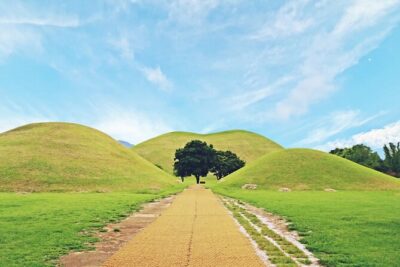
Gyeongju UNESCO World Heritage Guided Day Tour from Busan
Read our review →
Evening Dark History, Folklore & Ghost Story Walking Tour
Read our review →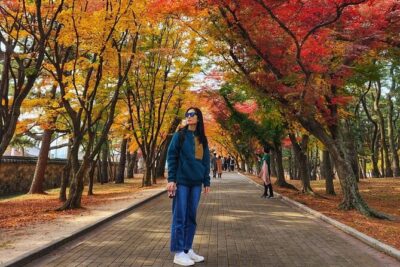
Old Korea Thousand History Tour of Gyeongju from Busan
Read our review →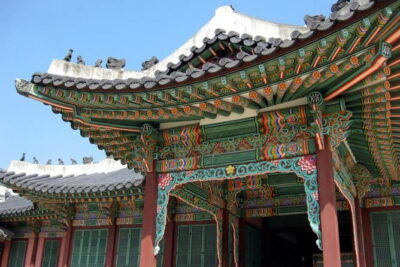
Hanbok Photoshoot and History Tour at Gyeongbokgung Palace
Read our review →
UNESCO Heritage Tour Including Bulguksa Temple
Read our review →
Gyeongju UNESCO World Heritage Sites and History Full-Day Tour with Lunch
Read our review →Browse the lists this tour appears in