
Reviewed · COOKING CLASSES
Traditional Korean 6-Dish Cooking Class + Hidden Alley Tour Seoul
Come hungry, leave with recipes. This three-and-a-half-hour Seoul experience combines a hands-on Korean cooking class with a guided walk through Euljiro’s lesser-known lanes. I especially like the clear step-by-step teaching and the chance to cook the full menu yourself, rather than simply watching a chef work. I also like the personal touches, including tea, printed recipes, photos, a quiz, and a small souvenir.
The main consideration is time. Six dishes plus a neighborhood walk is a generous program for three hours and 30 minutes, so the class may feel full and active. You will also need to make your own way to the studio at 2f, 50-4 Chungmu-ro, in Jung District.
In This Review
- Key Points Before You Book
- Starting With Tea in a Traditional Seoul Kitchen
- Why Korean Food Culture Comes Before the Knives
- Six Dishes, Six Different Cooking Lessons
- Hot Stone Bibimbap
- Bulgogi
- Japchae
- Doenjang-Jjigae
- Kimchi Pancake
- Vegetable Skewers
- Eating Together Like a Korean Family
- Euljiro’s Alleys After the Meal
- Jiny’s Teaching Style Makes the Difference
- What the $85 Price Really Covers
- Practical Details for a Smooth Visit
- Who Should Book This Seoul Experience?
- Should You Book It?
- FAQ
- Where does the cooking class begin?
- Where does the experience end?
- How long does the experience last?
- What dishes will I cook?
- Is this a private activity?
- What is included in the price?
Key Points Before You Book
- Cook six substantial Korean dishes: Make hot stone bibimbap, bulgogi, japchae, doenjang-jjigae, kimchi pancake, and vegetable skewers.
- Learn the meaning behind the food: Jiny explains Korean food customs, ingredient stories, and the importance of color balance in bibimbap.
- Explore Euljiro beyond the main roads: The walking portion visits quiet alleys and small local places that are easy to miss on your own.
- Small, personal setting: This is a private activity for your group, with individual cooking stations in a cozy studio.
- Useful take-home extras: You receive a printed Korean recipe, photos, and a special souvenir.
- Strong value at $85: You get instruction, a full meal, drinks, snacks, the walk, recipes, photos, and a gift in one booking.
Starting With Tea in a Traditional Seoul Kitchen
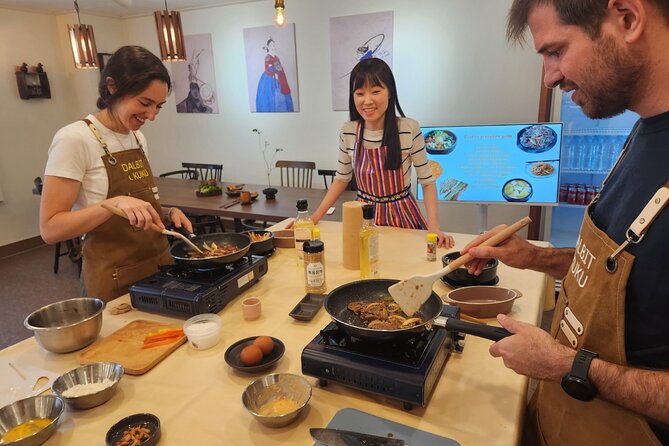
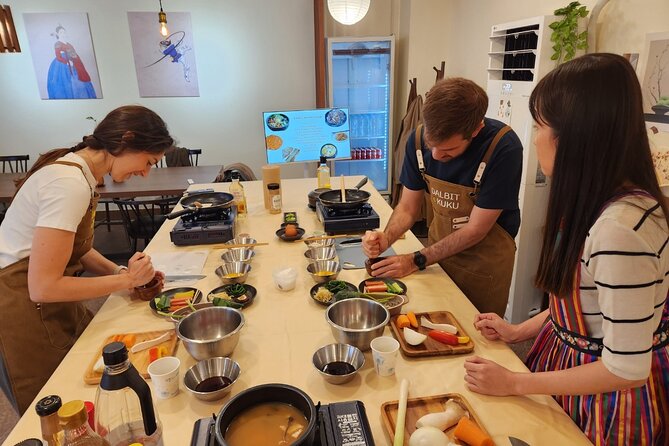
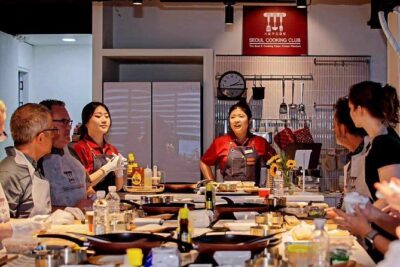
The class begins in a second-floor studio tucked into a quieter alley near Chungmu-ro. The setting blends traditional Korean touches with a clean, modern cooking space. It is not a large commercial school with rows of anonymous workstations. The atmosphere is more like being welcomed into someone’s carefully prepared home kitchen.
Jiny greets you with a cup of traditional Korean tea, then explains how the session will work. She takes time to learn names and set expectations before the cooking begins. That small step matters because the class is built around participation, not a demonstration followed by a quick tasting.
The studio has a dining table and cooking stations for roughly 10 people, based on the setup described by participants. The activity itself is private, so only your group takes part. That makes it a good choice for a family, couple, birthday outing, or group of friends who want attention at their own pace.
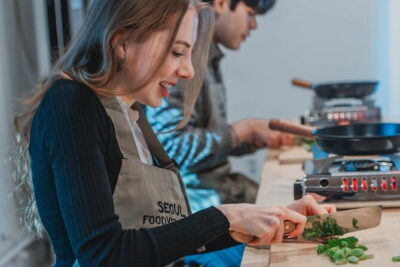
You do not need advanced cooking skills. The teaching is designed for different ability levels, and Jiny breaks the work into simple stages. Several people who described themselves as inexperienced cooks still managed the complete menu with her help.
More Cooking Classes in Seoul:
- Local Home Korean Cooking Class & Market Adventure in Seoul
★ 5.0 · 1,024 reviews - Master Korean traditional cooking with a Kimchi chef
★ 5.0 · 385 reviews - Seoul: Korean Cooking Class at a Local Home and Market Tour
★ 5.0 · 348 reviews
Why Korean Food Culture Comes Before the Knives
Before you start chopping and stirring, Jiny gives context for the dishes. This is one of the best parts of the experience because Korean food is tied closely to balance, seasonality, family meals, and presentation.
Bibimbap provides a useful example. The dish is not just rice with assorted toppings. Its vegetables and other ingredients are arranged with attention to color harmony, making the bowl pleasing to look at as well as satisfying to eat. Hearing this before preparing your own bowl gives the cooking a cultural frame.
Jiny also shares stories about ingredients, language, food customs, and Korean history. The exact amount of discussion will depend on the pace of your group, but the class clearly aims to explain the meaning behind the food rather than treat it as a set of recipes.
I appreciate this approach. A cooking class can become a checklist of chopping, frying, and eating. Here, you get a better sense of why these dishes belong together and how Korean meals work as a social experience.
Six Dishes, Six Different Cooking Lessons
The menu gives you a broad introduction to Korean home-style cooking. You are not making six versions of the same dish. Each item uses different techniques and textures.
Hot Stone Bibimbap
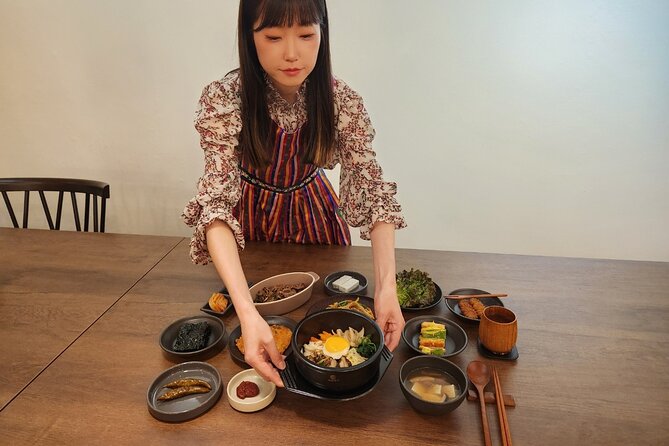
Bibimbap brings together rice, vegetables, seasoning, and color. The hot stone version adds heat and texture, helping create the crisp rice at the bottom that many people consider the best part.
The dish also teaches visual balance. You will work with separate ingredients before combining them, which makes the final bowl look more varied than a simple rice dish. It is a good first lesson in how Korean food can be both practical and carefully presented.
More workshops in Seoul:
- Yongpyong Ski Resort from Seoul with Optional Lesson and Packages
★ 5.0 · 217 reviews - Korean Cooking Class with Grocery Shopping at Seoul Local Market
★ 5.0 · 107 reviews - Royal Seoul Cooking Class in a 100-Year-Old Hanok
★ 5.0 · 81 reviews - Seoul : Taste of Korea, Authentic Home-Style Cooking Class
★ 5.0 · 64 reviews
Bulgogi
Bulgogi is a familiar Korean favorite, but preparing it yourself gives you a better feel for the seasoning and cooking process. You learn how the meat fits into a larger meal rather than meeting it only as a restaurant order.
Participants consistently describe the finished food as delicious, and several singled out their homemade bulgogi or bulgogi bibimbap as a highlight. You should expect guidance at each step, with Jiny checking that everyone understands the process.
Japchae
Japchae adds a different texture and rhythm to the meal. The glass noodles and vegetables require care so the finished dish stays balanced rather than becoming heavy or greasy.
This was a particularly useful inclusion for people who wanted a recipe they could repeat at home. One participant specifically noted loving japchae and enjoying the class recipe. The printed recipe gives you a practical reference after returning home.
Doenjang-Jjigae
The soybean stew gives the menu a warm, savory center. It also introduces you to the flavor of doenjang, a fermented soybean paste central to many Korean dishes.
For someone new to Korean food, this is a valuable taste lesson. It is less about a single dramatic ingredient and more about the deep, earthy flavor that helps define Korean home cooking.
Kimchi Pancake
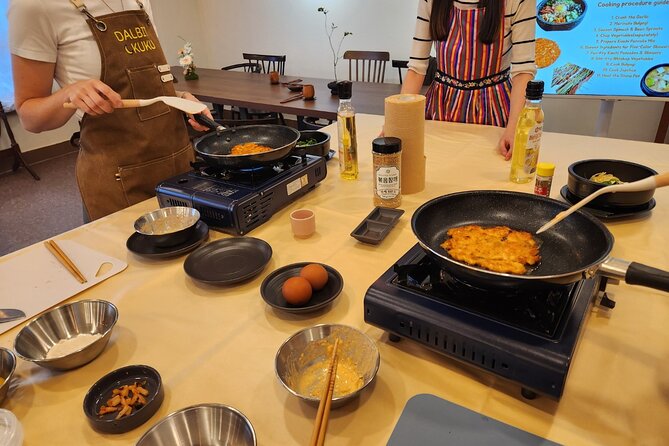
The kimchi pancake is an approachable dish with a strong Korean character. It is also fun to prepare because the mixture changes quickly once it reaches the pan.
This part of the menu gives the class a casual, shareable food alongside the rice, noodles, meat, and stew. It helps the final meal feel like a full Korean table rather than a formal sequence of courses.
Vegetable Skewers
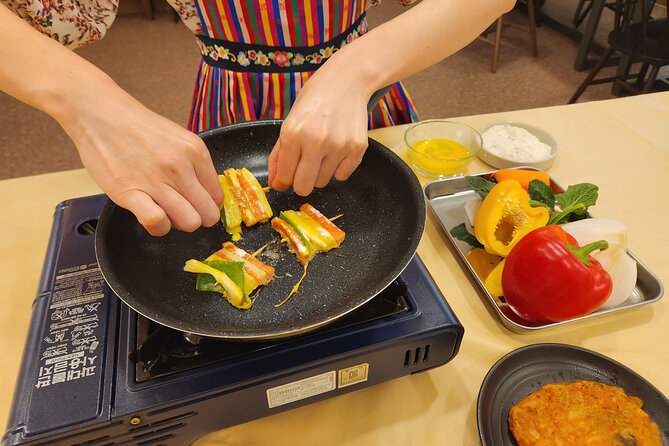
The vegetable skewers, also described as sanjeok, add color and a more decorative element to the spread. They show how vegetables can play a central role in a Korean meal instead of being treated as an afterthought.
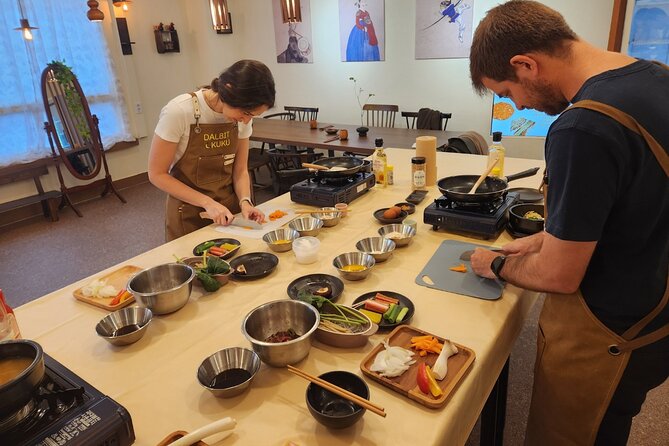
Preparing each dish yourself is important here. You do not simply watch Jiny cook six items while standing at the edge of the room. The activity is set up so each participant has a chance to work through the menu.
Eating Together Like a Korean Family
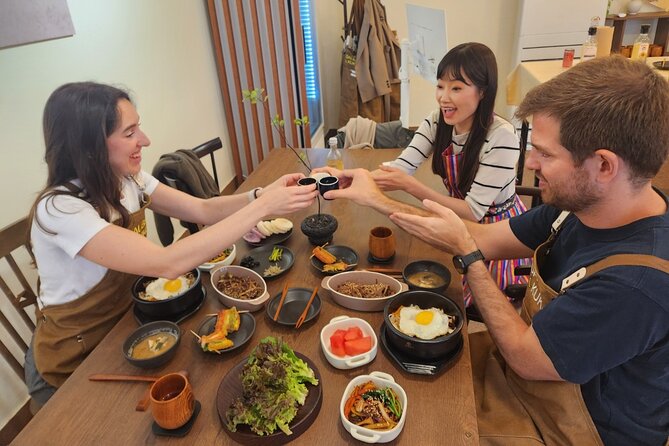
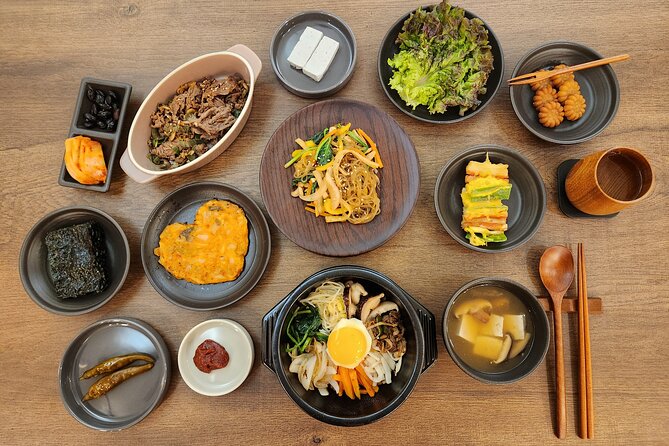
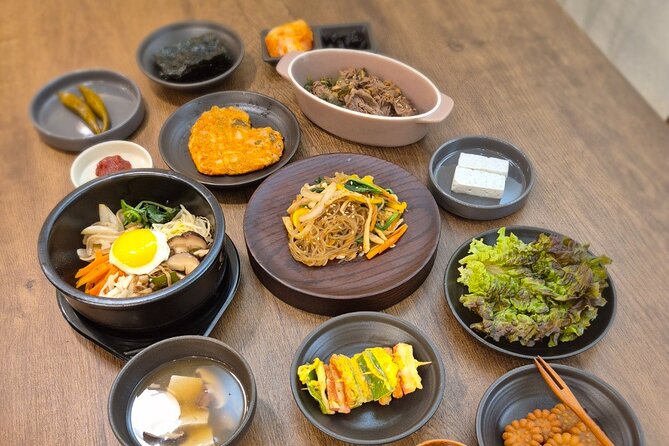
Once the cooking is finished, everyone sits down to eat the meal together. This is not a rushed tasting at the counter. The shared table is meant to reflect the social side of Korean dining, where food creates time for conversation.
You also receive drinks, beverages, and snacks as part of the experience. Traditional desserts are included in the overall food program, though specific dessert names are not provided. Expect the meal to be filling, especially since the menu includes rice, meat, noodles, stew, pancakes, and skewers.
The portion of the class devoted to eating is more than a reward for finishing the work. It lets you compare the dishes, talk with your group, and ask follow-up questions while the food is fresh.
Bring an empty stomach. The menu is substantial, and the walk afterward comes when you have already eaten a full meal. One practical advantage is that lunch or dinner is built into the booking, so you do not need to arrange a separate restaurant stop during this part of your day.
Euljiro’s Alleys After the Meal
After eating, Jiny leads you outside for a walking tour through Euljiro. This district is known for its changing mix of old workshops, local businesses, and newer creative spaces, but this experience focuses on the quieter lanes and less obvious corners.
The walk is not simply a transfer from the studio to another attraction. Jiny points out places that you would likely pass without understanding, then explains stories about the neighborhood’s past and transformation.
That makes the second half valuable for anyone who wants more than the standard Seoul route. You are not being sent to a major palace or shopping street. Instead, you see a local district through the eyes of someone who knows its small details.
The timing also works well. After several hours indoors, a neighborhood walk gives the experience a change of pace. You can take photos, hear more about Seoul, and notice the contrast between the cooking studio and the surrounding streets.
The drawback is that the walking portion is not described with a precise distance or route. If you need a tightly timed itinerary, ask for current details before booking. The experience ends back at the meeting point, so plan your next stop from there.
Jiny’s Teaching Style Makes the Difference
The strongest part of this experience is the host. Jiny is praised for warmth, patience, clear explanations, and an ability to keep the class cheerful without losing structure. Her husband also helps with hosting and is described as accommodating and kind.
She teaches at the group’s pace. That does not mean the class lacks direction. Ingredients are prepared in advance, stations are organized, and the steps are explained in a clear order. You get the help needed to complete the dishes without feeling that every mistake is a crisis.
Jiny’s English is described as excellent, which is important in a class where timing, texture, and seasoning need to be understood. She also encourages questions and makes participants feel capable, including people with little cooking experience.
The personal approach extends beyond the recipes. Birthday celebrations have received extra attention, including a small gift. Photos are taken during the class, and digital photos and recipes are sent afterward. These details help explain why the activity feels more like a personal gathering than a standard lesson.
What the $85 Price Really Covers
At $85 per person, this is not the cheapest food activity in Seoul. The value depends on how much of the program you use.
You are paying for a three-hour-30-minute private experience that includes:
- A traditional tea welcome
- Instruction for six Korean dishes
- A complete meal
- Drinks, beverages, and snacks
- Traditional desserts
- The Euljiro alley walk
- A guide
- Printed Korean recipes
- Photos
- A small souvenir
If you compare the price only with a restaurant meal, it may seem high. If you compare it with a cooking lesson plus a neighborhood tour, it becomes more reasonable. You leave with skills, recipes, a full meal, images of the experience, and a better understanding of Korean food culture.
The private format adds value for people who care about personal attention. Couples and families can ask questions freely, while a group of friends can make the class part of a special occasion. For solo participants, the value depends on whether the private arrangement is available for an individual booking, something worth confirming before payment.
The experience has received a five-star rating from 42 reviews, with 100 percent recommending it. That is a strong record, though the sample is still modest compared with long-running Seoul attractions.
Practical Details for a Smooth Visit
The meeting point is 2f, 50-4 Chungmu-ro, Jung District, Seoul. The activity ends at the same location. Since private transportation is not included, you need to arrange your own way there and back.
The meeting point is near public transportation, which makes it easier to reach without a taxi. Give yourself enough time to find the correct building and second-floor studio, especially if you are unfamiliar with Seoul’s alley addresses.
Confirmation is provided at booking. Mobile tickets are accepted, and service animals are allowed.
The activity takes place indoors for the cooking portion, followed by an outdoor walk. Wear comfortable clothes and shoes suitable for walking through uneven or narrow neighborhood lanes. An apron is provided for cooking, according to the class setup described by participants, but you should still choose clothing that can handle a small splash or food stain.
You can cancel for a full refund if you do so at least 24 hours before the start time. Changes or cancellations made less than 24 hours in advance are not accepted for a refund.
Who Should Book This Seoul Experience?
I would recommend this class to people who want a more active food experience. You should book it if you like learning by doing, want recipes you can use at home, or prefer a small personal setting over a large tour group.
It is particularly well suited to:
- Couples looking for a shared activity
- Families with older children who can take part in cooking
- Friends celebrating a birthday or special occasion
- First-time visitors who want an introduction to Korean food
- Food lovers who want to understand dishes beyond restaurant menus
- People who enjoy neighborhood walks and local stories
It may be less suitable if you dislike group meals, have limited time, or want a short demonstration with minimal participation. Six dishes require attention, and the alley tour adds walking after the meal.
Should You Book It?
Yes, if you want a full afternoon or evening built around Korean food, culture, and local streets. The combination is the real strength: you learn the dishes, eat what you made, then see a side of Euljiro that is easy to miss.
The clearest reasons to book are Jiny’s friendly teaching, the unusually broad menu, the private format, and the useful extras. The printed recipes mean the class can continue at home, while the photos and souvenir give you something more personal than a meal alone.
At $85, it is best viewed as a cooking lesson, a substantial meal, and a small neighborhood tour in one. If that sounds better than another restaurant reservation, this is a worthwhile choice for Seoul.
FAQ
Where does the cooking class begin?
It begins at 2f, 50-4 Chungmu-ro, Jung District, Seoul, South Korea.
Where does the experience end?
The activity ends back at the meeting point.
How long does the experience last?
The experience lasts approximately three hours and 30 minutes.
What dishes will I cook?
You will prepare hot stone bibimbap, bulgogi, japchae, doenjang-jjigae, kimchi pancake, and vegetable skewers.
Is this a private activity?
Yes. Only your group will participate.
What is included in the price?
The experience includes a guide, lunch or dinner, drinks, beverages, snacks, traditional desserts, photos, a printed Korean recipe, and a special souvenir. Private transportation is not included.
Just added in Seoul
- Seoul: Korean & English Language Exchange Global Party★ 5.0 · 28 reviews
- Your Personal Seoul Photographer!★ 4.1 · 15 reviews
- You’re Invited to Our Home in Seoul: The Only Cooking Class!★ 5.0 · 8 reviews
- From Seoul: Yongpyong Ski Day Tour with Transportation★ 4.9 · 40 reviews
- From Seoul: Hwacheon Ice Fishing and Lighting Festival Tour★ 4.5 · 4 reviews
- Seoul: Gangneung BTS K-Pop & K-Drama Filming Locations Tour★ 4.6 · 14 reviews
- Unique Native Experience : Han River Picnic, Board game, BBQ★ 5.0 · 3 reviews
- Seoul: Euljiro Gastroventure Tour★ 4.0 · 1 review
Cooking Classes, compared.
Local Home Korean Cooking Class & Market Adventure in Seoul
Read our review →
Master Korean traditional cooking with a Kimchi chef
Read our review →
Korean Cooking Class at a Local Home and Market Tour
Read our review →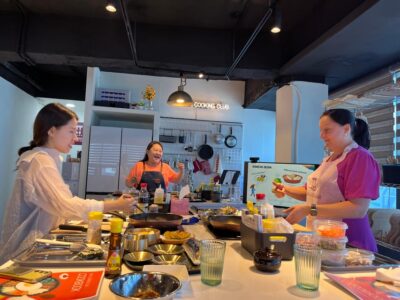
Korean Cooking Class with Grocery Shopping at Seoul Local Market
Read our review →
Korean Kimchi Making Day Experience with a Local Market Tour
Read our review →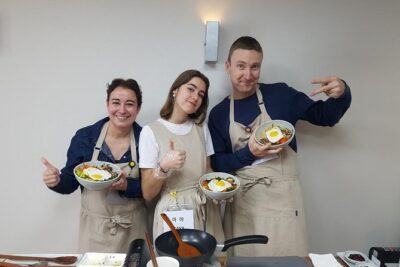
Browse the lists this tour appears in