
Reviewed · UNESCO WORLD HERITAGE TOURS
From Andong: 2-Day Andong and Gyeongju UNESCO Tour
Korea’s past feels close here. This private two-day tour links Andong’s Confucian villages and craft traditions with Gyeongju’s Silla temples, royal tombs, and night views. I especially like the mix of major UNESCO sites and smaller cultural stops, including Hahoe Village, Bongjeongsa Temple, Hanji paper-making, and the Andong Soju Museum.
I also like the careful transport plan from Andong KTX Station, plus the personal touch provided by guide Greg, who adjusted the schedule around train times, drove a comfortable vehicle, and sent photos taken during the visit. The main consideration is pace: this is a full two days with uneven paths, uphill sections, and many stops. Hotel, meals, and long-distance pickup are not included, so you need to plan those parts yourself.
In This Review
- Key points at a glance
- Why Andong and Gyeongju belong together
- Starting from Andong KTX Station
- Hahoe Folk Village and the Ryu family story
- Bongjeongsa Temple and Korea’s oldest wooden building
- Byeongsan Seowon and Confucian learning
- Hanji paper and Andong Soju
- Woryeonggyo Bridge after dark
- Gyeongju National Museum and Silla treasures
- Bulguksa and Seokguram, the Buddhist heart of Gyeongju
- Royal tombs, ancient science, and modern Gyeongju
- Donggung Palace and Wolji Pond at night
- What $830 buys you
- Who should book this two-day route
- Final decision: a strong choice for history-minded groups
- FAQ
- Where does the tour begin?
- What time is pickup at Andong KTX Station?
- Is this a private tour?
- Are meals and hotels included?
- Is the Hahoe Mask Dance performance guaranteed?
- Can I cancel or pay later?
Key points at a glance
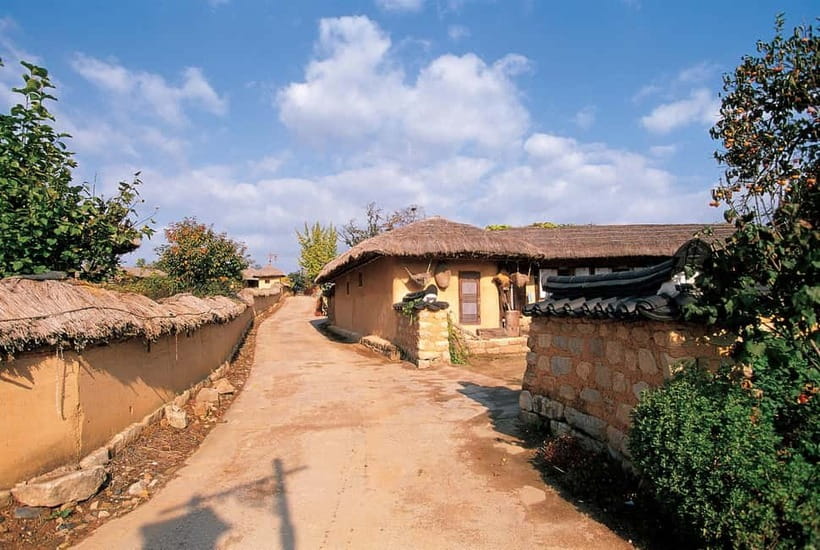
- Hahoe Village preserves Joseon-era life: Walk among traditional homes, old family residences, thatched roofs, and riverside scenery in one of Korea’s best-preserved historic villages.
- Andong adds hands-on culture: Try making Hanji paper and learn how Andong Soju became one of Korea’s best-known traditional spirits.
- Gyeongju covers more than temples: The route can include the National Museum, Daereungwon tombs, Cheomseongdae Observatory, Hwangnidan-gil, and Donggung Palace and Wolji Pond.
- A private vehicle makes the route practical: Pickup is arranged from Andong Station, Andong Bus Terminal, or certain nearby hotels, with an English or Korean-speaking guide.
- The price works best for four people: At $830 per private group of up to four, the cost is $207.50 per person when full, before hotels, meals, and personal expenses.
- The schedule rewards flexible visitors: Some stops may be shortened or skipped if time is tight, so this suits you best if you prefer a broad cultural overview to a slow visit at just one or two sites.
Why Andong and Gyeongju belong together
Andong and Gyeongju show two different sides of Korea’s past. Andong is closely tied to Confucian learning, family traditions, folk customs, and village life. Gyeongju was the capital of the Silla Kingdom for roughly a thousand years, and its royal and Buddhist sites give the second day a grander scale.
I like the pairing because the contrast keeps the tour from becoming a string of similar temples. You spend one day learning how scholars, artisans, and village families lived, then the next among royal artifacts, stone Buddhas, ancient observatories, and palace remains.
The two-day format also solves a common problem. Andong and Gyeongju are both rewarding, but fitting their best sights into separate day trips can be awkward. A private vehicle lets you connect them without repeatedly working out bus routes or hauling luggage between stops.
Still, this is not a relaxed countryside retreat. The route covers a lot of ground, and the schedule can change depending on opening hours, the mask dance performance, traffic, and how long you spend at each site. If you want quiet time for every museum and temple, you may need to drop some stops.
More Gyeongju trips:
- Busan: Gyeongju Guided Day Trip to Three Kingdoms Capital
★ 4.8 · 1,925 reviews - From Busan: Gyeongju UNESCO World Heritage Guided Day Tour
★ 4.8 · 1,250 reviews - Gyeongju UNESCO World Heritage Guided Day Tour from Busan
★ 5.0 · 660 reviews
Starting from Andong KTX Station
The planned meeting time is 9:14 AM at Andong KTX Station, matching the train from Seoul’s Cheongnyangni Station that departs at 7:07 AM. The guide waits in the station parking area with a yellow sign showing a hand symbol.
That precise meeting plan is useful. You do not need to guess where to go after stepping off the train, and the schedule connects naturally with the Seoul to Andong rail service. Pickup is also available at Andong Bus Terminal and at certain hotels, including Stanford Hotel Andong and Andong CM Park Hotel.
You should send your hotel details ahead of time if you want hotel pickup. The stated pickup area is limited, generally within about two kilometers, and faraway pickup is not included.
The tour is private for your group, with transportation and an English or Korean-speaking guide. That makes a real difference on a route like this. You can ask questions as you go, adjust the pace within reason, and avoid the fixed rhythm of a large coach group.
Hahoe Folk Village and the Ryu family story
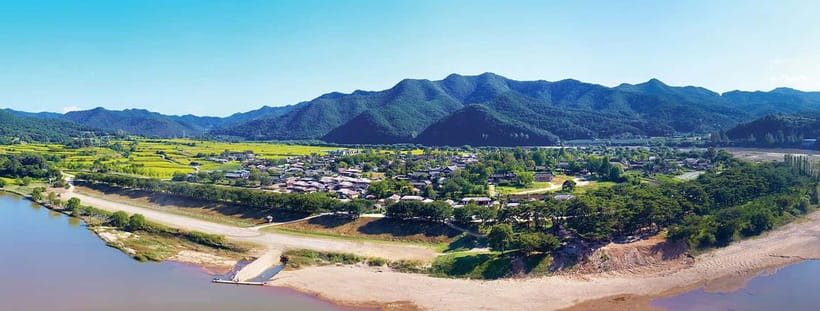
Hahoe Folk Village is the emotional center of the Andong day. Its traditional homes, thatched roofs, old lanes, and position beside the river give you a clear sense of how a Joseon-era settlement was organized.
The village is closely associated with the Ryu family and its Confucian scholarly tradition. At the Yangjin Residence, you learn more about the family’s place in local society and the ideals that shaped education, status, and daily life.
I recommend taking time to look beyond the most photogenic houses. Notice the different roof styles, courtyards, walls, and the way the village sits within the surrounding hills and river bend. The setting is not just decoration. It helps explain why this place survived with so much of its character intact.
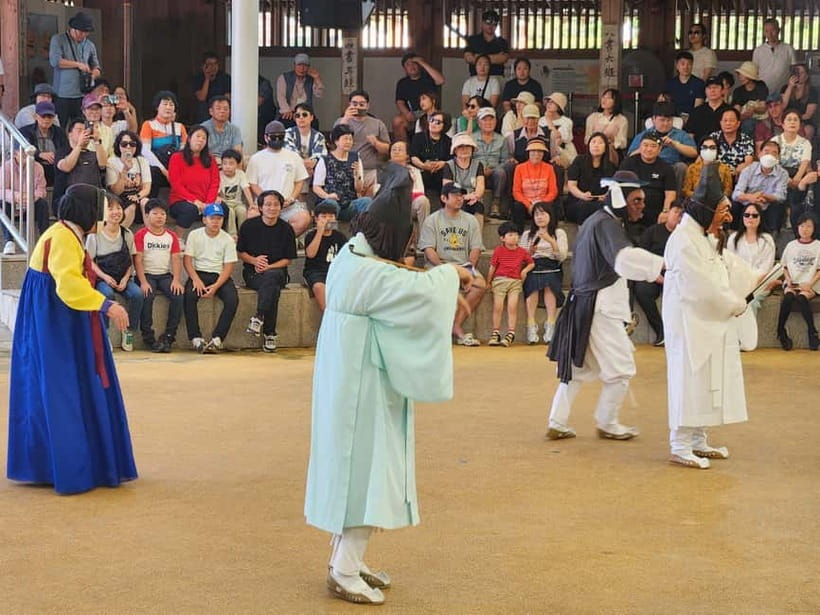
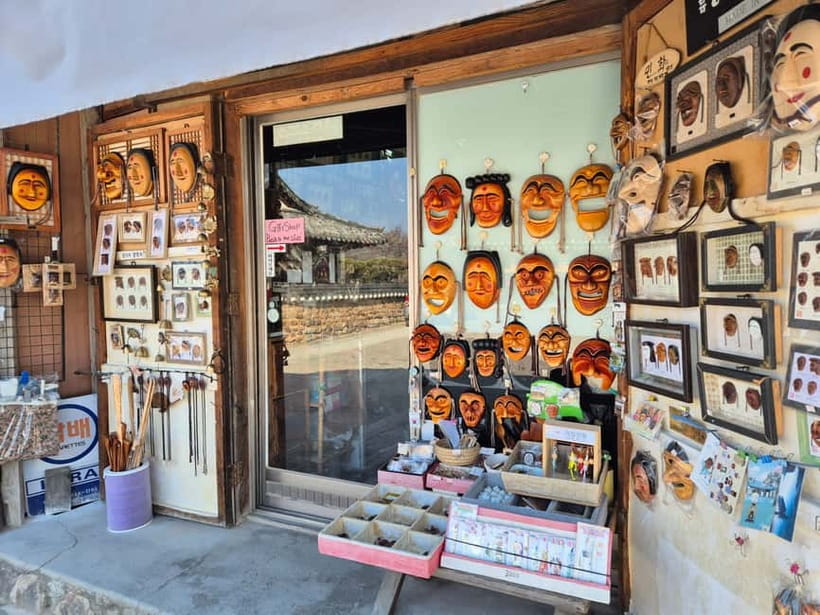
The Hahoe Mask Dance performance adds another layer. This folk theater uses masks, humor, and satire to poke at social roles and authority. It is recognized as UNESCO Intangible Cultural Heritage, but you do not need a background lecture to appreciate the lively performance.
The show is subject to schedule and is not held on Mondays, so check the day of your visit before you count on it. If the performance is unavailable, Hahoe still earns its place on the route, but the visit will feel more focused on architecture, family history, and village scenery.
Wear shoes with a firm sole here. Traditional village lanes and outdoor paths can be uneven, and you may walk more than expected while moving between homes and viewpoints.
Bongjeongsa Temple and Korea’s oldest wooden building
Bongjeongsa Temple brings a quieter mood after Hahoe. Set in the mountains, it offers a peaceful look at Korean Buddhist architecture without the crowded feel that can come with the country’s most famous temple complexes.
The key building is Geungnakjeon Hall, described as Korea’s oldest wooden building. That makes the stop valuable even if you are not a serious architecture enthusiast. The woodwork and simple setting show how old religious structures can feel both delicate and durable.
I like that the tour includes Bongjeongsa rather than stopping at only the best-known sites. A smaller temple gives you room to think about the spiritual side of Korean history, rather than simply collecting photographs.
The grounds include paths and may require uphill walking. Modest clothing is sensible, and you should follow site rules about shoes, noise, and touching exhibits or structures.
More UNESCO sites in Gyeongju:
- Gyeongju UNESCO sites Private tour with licensed tour guide
★ 5.0 · 275 reviews - Private Gyeongju Tour – Explore Gyeongju UNESCO Sites
★ 5.0 · 272 reviews - Busan: Gyeongju UNESCO Legacy Tour with National Museum
★ 5.0 · 172 reviews - Gyeongju: UNESCO Heritage Tour Including Bulguksa Temple
★ 4.8 · 104 reviews
Byeongsan Seowon and Confucian learning
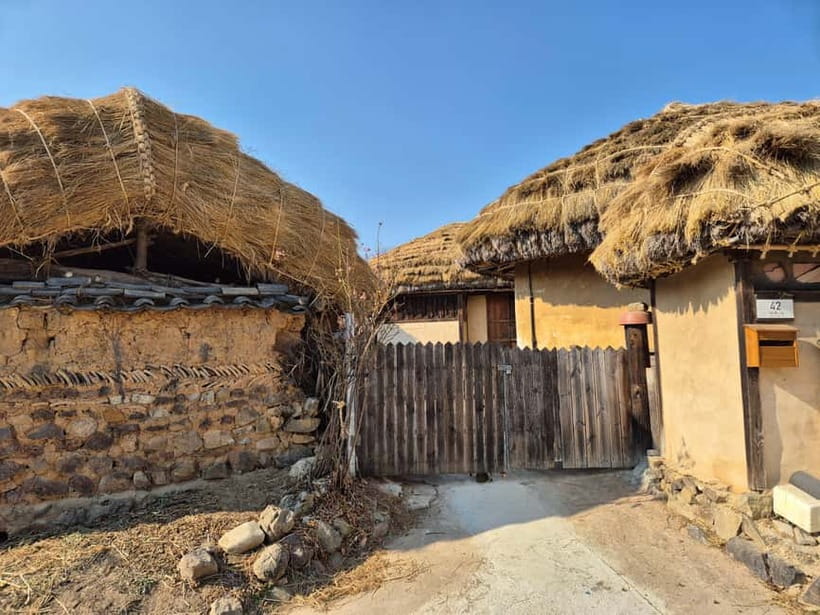
Byeongsan Seowon is a Confucian academy placed against the mountains. These academies were centers for study, teaching, ritual, and the preservation of scholarly traditions.
The buildings are restrained and elegant. Their placement beside the natural surroundings is part of the appeal, with wooden halls and open spaces arranged for learning and reflection. Your guide can help explain the difference between a Confucian academy and a Buddhist temple, which is useful because both can feature quiet courtyards and traditional wooden buildings while serving very different purposes.
This stop also gives context to Hahoe. You are not seeing isolated old buildings. You are following the ideas, families, and educational systems that shaped Andong for generations.
The drawback is that the academic setting may feel less immediately dramatic than a palace or temple. I would treat it as a place for context and atmosphere, not a quick photo stop.
Hanji paper and Andong Soju
The Hanji factory visit is one of the most distinctive parts of the first day. Hanji is traditional Korean paper made from mulberry bark, and the craft depends on careful preparation and repeated hand work.
You can watch artisans demonstrate the process and try making your own sheet. That short activity matters because it turns an old craft into something physical. Instead of only hearing about traditional production, you handle the material and leave with a better feel for the patience involved.
Next comes the Andong Soju and Traditional Liquor Museum. Andong Soju has more than 700 years of tradition behind it, and the museum displays brewing tools, old recipes, and stories connected with the drink.
You do not need to drink alcohol to enjoy this stop. It explains how food, household production, ceremony, and local identity overlap in Korean culture. Meals and drinks are not included in the tour price, so confirm what is available at each stop and bring water for the day.
Woryeonggyo Bridge after dark
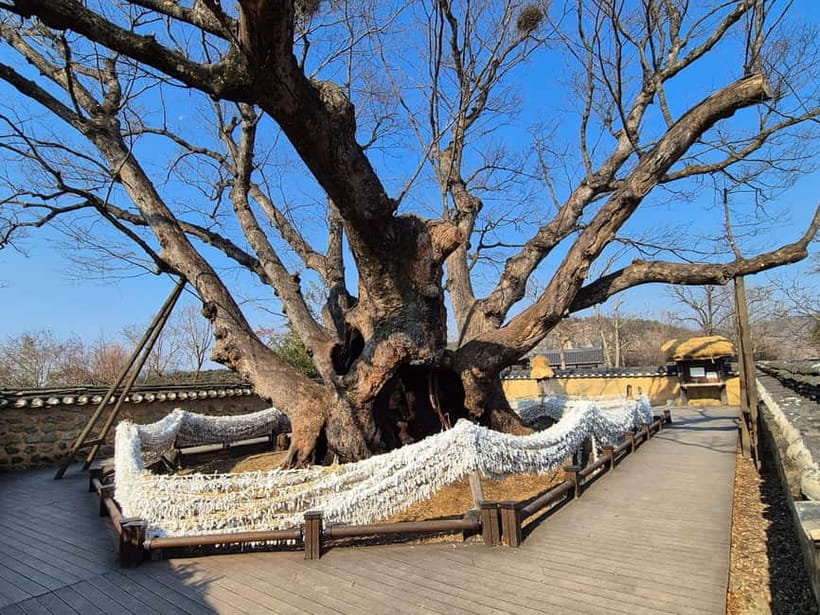
If you stay overnight in Andong, the route can include Woryeonggyo Bridge at night. It is Korea’s longest wooden pedestrian bridge, crossing the Nakdong River with lights reflecting on the water.
This is a welcome change after a day of historical buildings. The view is modern, calm, and easy to enjoy without a long explanation. Bring a jacket if the evening is cool, and keep your phone charged because the bridge is one of the best photo opportunities of the trip.
The overnight arrangement is not included, so you need to reserve your own hotel. If you stay elsewhere or the timing does not work, this stop may not be possible.
Gyeongju National Museum and Silla treasures
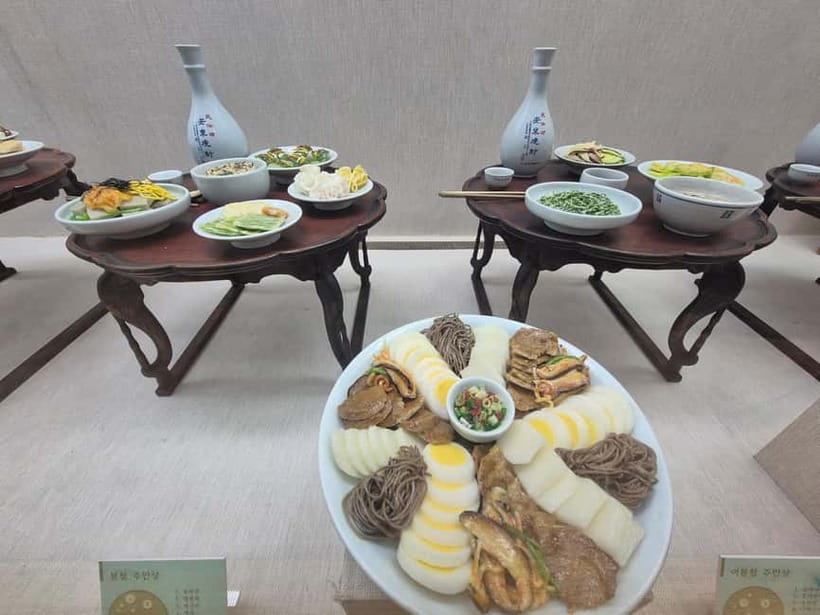
Day two shifts from local traditions to the scale of an ancient capital. At Gyeongju National Museum, you can see Silla golden crowns, Buddhist objects, and the Divine Bell of King Seongdeok.
The museum is important because it gives you a framework for the outdoor sites that follow. After seeing the objects used by Silla royalty and worshippers, temples and tombs feel less like attractive ruins and more like parts of a functioning kingdom.
The museum visit may depend on available time. The day already includes Bulguksa, Seokguram, and several central Gyeongju sights, so you may need to choose between a longer museum visit and more time outdoors.
If the museum is closed or cannot fit the schedule, the guide can continue with the other planned stops. The trip still includes plenty of Silla history, but I would tell your guide early if the museum is a priority.
Bulguksa and Seokguram, the Buddhist heart of Gyeongju
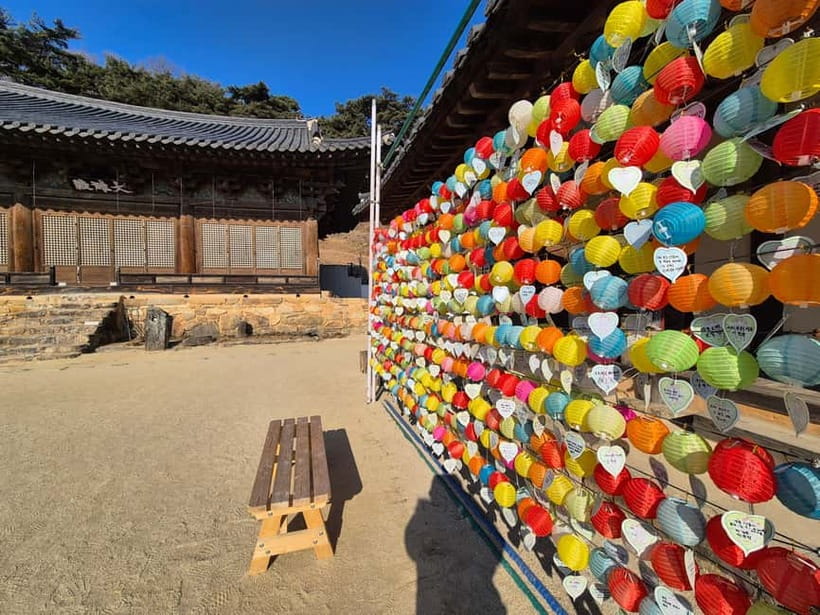
Bulguksa Temple is the major architectural stop of the second day. It represents Silla Buddhist design through its terraces, stonework, halls, and carefully arranged approach.
The value of a guide here is not just finding the entrance. The site has layers of religious meaning and architectural detail that can be easy to miss when you walk through on your own. Ask about the stone elements and the way the temple’s design connects the human world with Buddhist ideals.
Seokguram Grotto follows, with a serene Buddha statue in a stone cave overlooking the East Sea. The setting combines engineering, art, and devotion. The route to the grotto includes walking, so comfortable closed-toe shoes are important.
These sites can be especially demanding in hot, wet, or cold weather. Pack sunscreen, a hat, rain gear, and a light jacket. The tour information also recommends a refillable water bottle, which is sound advice for both days.
Royal tombs, ancient science, and modern Gyeongju
The central Gyeongju stops add variety after the temple visits. At Daereungwon, you see the large grass-covered royal tombs that mark the city’s Silla past. Their smooth shapes look simple, but their scale makes the power of the old kingdom clear.
Cheomseongdae Observatory offers another angle on Silla achievement. It is associated with astronomy and is one of Gyeongju’s best-known historic landmarks.
Hwangnidan-gil then brings you into present-day Gyeongju. Hanok-style cafes, small shops, and local places to eat occupy a street where old architectural forms meet current Korean life. Meals are your responsibility, but this is a natural place to ask the guide for restaurant suggestions.
I like this sequence because it avoids treating Gyeongju as a museum frozen in time. You see royal burial grounds and an ancient observatory, then have room for coffee, food, and modern street life.
Donggung Palace and Wolji Pond at night
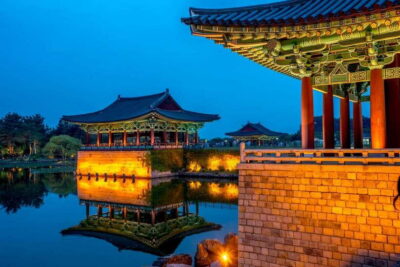
The final stop is Donggung Palace and Wolji Pond, where palace remains and the water create one of Gyeongju’s most memorable evening views.
Soft lighting reflects across the pond, and the ruins become easier to appreciate as a composed setting rather than scattered foundations. Timing matters here. If earlier visits run long, this evening stop may be shortened, so let your guide know if it is one of your priorities.
The name is sometimes written as Donggung and Wolji, while older references use Anapji. The provided tour information uses Donggung and Wolji, so look for that wording when checking directions or asking about the site.
What $830 buys you
The price is $830 per private group of up to four. With four people, that works out to $207.50 each for two days of guiding and private transportation, or $103.75 per person per day.
That is a reasonable value if you want the convenience of a private vehicle, a local guide, and a route that combines Andong and Gyeongju without arranging each transfer yourself. The value is strongest for a family or group of friends who can fill all four places.
For two people, the cost becomes $415 each. That is harder to justify if you are comfortable using public transport and planning independently, but the route is still complicated enough that the time saved may matter.
Remember to budget separately for hotel accommodation, meals, drinks, personal spending, and any luggage delivery. The guide may help with restaurant suggestions, hotel information, or luggage transport if it fits the route, but those favors are not guaranteed parts of the package.
The flexible cancellation policy allows a full refund when you cancel at least 24 hours in advance, and you can reserve now and pay later. Those terms help if your Korea schedule is still shifting.
Who should book this two-day route
I would recommend it most strongly to you if:
- You want Andong and Gyeongju in one organized trip.
- You value explanations at cultural and religious sites.
- You are traveling with up to four people.
- You prefer a private vehicle to several bus and taxi connections.
- You enjoy a full sightseeing day with many different stops.
- You can manage uneven ground, stairs, and moderate walking.
It is less suitable if you have serious back, heart, or mobility problems, use a wheelchair or mobility scooter, are pregnant, or have strong motion sickness. The activity is not suitable for children under four or people over 80, and the stated weight limits should be checked before booking.
Avoid high heels, sandals, and flip-flops. Bring closed-toe walking shoes, a daypack, cash and a card, a charged phone, personal medication, sunscreen, a hat, and rain protection. Smoking, vaping, alcohol in the vehicle, drones, oversized luggage, and pets are not permitted, except for assistance dogs.
Final decision: a strong choice for history-minded groups
You should book this tour if you want a practical, personal route through two of Korea’s most important cultural areas and do not want to spend your holiday solving transport puzzles.
The strongest parts are the range of experiences, the private vehicle, and the attentive guiding style associated with Greg. Stéphane from France praised the comfortable vehicle, the careful handling of train connections, the many scenic stops, and the fact that Greg took photos and sent them through WhatsApp. Susan from Australia described him as energetic, patient, organized, and thoughtful after two full days.
Those details point to the tour’s real value: not just checking off UNESCO sites, but having someone help you move through a busy cultural itinerary without losing the human side of the trip.
Book it for access, context, and convenience. Skip it if you want a slow schedule, included meals and hotels, or a route designed around accessibility. For four people with a shared interest in Korean history, the price is much easier to defend, and the two-day pairing of Andong and Gyeongju makes excellent use of your time.
FAQ
Where does the tour begin?
Pickup is available at Andong KTX Station and Andong Bus Terminal. Pickup can also be arranged at Stanford Hotel Andong and Andong CM Park Hotel. Send your hotel details in advance if you want to check hotel pickup.
What time is pickup at Andong KTX Station?
The planned meeting time is 9:14 AM in the station parking area, matching the train arriving from Seoul’s Cheongnyangni Station. The guide waits with a yellow sign showing a hand symbol.
Is this a private tour?
Yes. The tour is for a private group of up to four people, with transportation and a live guide in English or Korean.
Are meals and hotels included?
No. Meals, drinks, hotel accommodation, personal expenses, and luggage delivery are not included in the $830 group price.
Is the Hahoe Mask Dance performance guaranteed?
No. The performance is subject to the schedule and is not held on Mondays. Confirm the performance timing before your visit if it is a key reason for booking.
Can I cancel or pay later?
You can cancel up to 24 hours in advance for a full refund. The reserve-now, pay-later option lets you book without paying on the day of reservation.
Just added in Gyeongju
- Yangdong village & Gyeongju Unesco Site Private Van Tour★ 5.0 · 1 review
- Small Group 7D Korea package Tour with Seoul Gyeongju Busan Jeju★ 4.5 · 13 reviews
- Gyeongju UNESCO Sites Tour by KTX train; The Museum Without walls★ 4.5 · 11 reviews
- Full-Day Small Group GyeongJu History Tour from Seoul★ 5.0 · 2 reviews
- 7 days Flexible Tour for Major Cities(Seoul,Busan,Gyeongju etc)★ 5.0 · 5 reviews
- PREMIUM 5 Days Tour for Wonder of Korea(Mt. Seoraksan, Andong, Gyeongju, Busan)★ 5.0 · 1 review
- 5 Days Tour for Korea’s past and present(Mt.Seoraksan, Andong, Gyeongju, Busan)★ 5.0 · 1 review
- 7 Days Highlight Korea Tour(Seoul, Nami, DMZ, Andong, Gyeongju, Busan)★ 5.0 · 1 review
UNESCO World Heritage Tours, compared.
Gyeongju UNESCO World Heritage Guided Day Tour
Read our review →
East Jeju Essentials – Seongsan Ilchulbong (UNESCO) & Haenyeo
Read our review →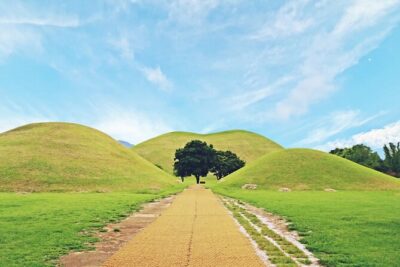
Gyeongju UNESCO World Heritage Guided Day Tour from Busan
Read our review →
Jeju Southern UNESCO Full Day Tour with Mt.Halla
Read our review →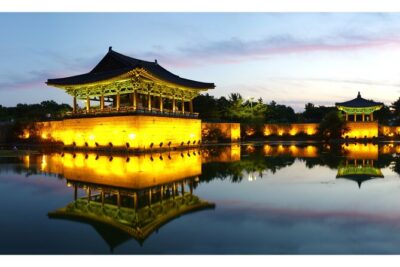
Gyeongju UNESCO sites Private tour with licensed tour guide
Read our review →
Private Gyeongju Tour – Explore Gyeongju UNESCO Sites
Read our review →Browse the lists this tour appears in