
Reviewed · UNESCO WORLD HERITAGE TOURS
Private Gyeongju Tour – Explore Gyeongju UNESCO Sites
Gyeongju rewards a full day. This private tour makes the city’s scattered monuments easy to reach, pairing Bulguksa Temple and Seokguram Grotto with royal tombs, an ancient observatory, a palace pond, and the Gyeongju National Museum. I like the personal guide service, especially for the history, and I like having a comfortable air-conditioned vehicle between sites. The main drawback is the pace: seven major stops in eight or nine hours can feel brisk, particularly in hot weather, rain, heavy holiday traffic, or with young children and older family members.
I also like the chance to shape the day around your group. Guides such as Jason, Lily, Joy, Finn, Cynthia, and Arthur have been praised for adjusting routes, explaining Korean culture in clear English, taking family photos, and choosing traditional restaurants. Check the lunch wording carefully, though: the overview describes local lunch as part of the package, while the detailed inclusions say meals are not included.
In This Review
- The day at a glance
- Why Gyeongju works so well as a private day
- Bulguksa Temple: Silla Buddhism in stone
- Seokguram Grotto: a short visit with great meaning
- Hongsi Hanjeongsik: the meal is part of the culture
- Daereungwon Tomb Complex: walking among royal burial mounds
- Cheomseongdae: ancient science in a compact form
- Donggung Palace and Wolji Pond: the atmospheric evening option
- Gyeongju National Museum: finish with real objects
- Guide quality and the personal touches
- Price, group size, and what you receive
- Who should book this Gyeongju day?
- Should you book it?
- FAQ
- How long does the private Gyeongju tour last?
- What sites are included?
- Is hotel pickup and drop-off included?
- Is the tour conducted in English?
- How many people can join a private group?
- Which entrance fees are not included?
- Is lunch included in the price?
- Can I cancel for a full refund?
The day at a glance
- Seven important Gyeongju stops in one private day: You visit Bulguksa, Seokguram, Hongsi Hanjeongsik, Daereungwon, Cheomseongdae, Donggung Palace and Wolji Pond, and the Gyeongju National Museum.
- A guide for one private group: Groups of 1 to 7 can book the intimate option, while groups of 8 to 15 can choose the mid-sized private format.
- Transport takes the strain out of Gyeongju: Pickup, drop-off, parking, tolls, fuel surcharge, and an air-conditioned vehicle are included.
- The best value is the explanation: A guide can connect Silla-era buildings and artifacts to Korean Buddhism, science, royal life, and modern Korea.
- Two listed admission charges are extra: Daereungwon Tomb Complex and Donggung Palace and Wolji Pond each list an entrance fee of ₩3,000 per person.
- Plan for a long, active day: Bring good shoes, check the weather, and tell your guide early if your group needs more breaks or a slower pace.
Why Gyeongju works so well as a private day
Gyeongju was the center of the Silla Kingdom, and its sights are spread across a broad area rather than packed into one walkable old quarter. That makes a private vehicle useful. You can move from the foothills around Bulguksa and Seokguram to the royal tomb district, then continue toward the palace pond and museum without spending the day working out buses or taxi connections.
The private format matters most when your group has mixed interests. A ten-year-old may need shorter explanations, a teenager may respond better to quiz questions, and an older relative may need more time on foot. Cynthia has been praised for using small quiz questions to keep the day engaging, while Mimi was able to adjust plans for a family with teenagers during cold, rainy weather.
You are not simply hiring a car. The guide is the person who gives the day shape. Jason has used a microphone in the vehicle so people in the back could hear his explanations, and several guides have helped connect ancient Korea with daily life in the country today. That background can turn a row of old stones into a story with people, politics, religion, and practical purpose.
Still, private does not mean leisurely by default. The plan assigns about an hour to each stop, and the day lasts roughly eight to nine hours. Bada Cho’s guests noted that three to four hours may be spent in the car, depending on traffic. If you want long museum visits, quiet temple contemplation, and a slow lunch, ask for a trimmed itinerary rather than trying to conquer every stop.
More Gyeongju trips:
- Busan: Gyeongju Guided Day Trip to Three Kingdoms Capital
★ 4.8 · 1,925 reviews - From Busan: Gyeongju UNESCO World Heritage Guided Day Tour
★ 4.8 · 1,250 reviews - Gyeongju UNESCO World Heritage Guided Day Tour from Busan
★ 5.0 · 660 reviews
Bulguksa Temple: Silla Buddhism in stone
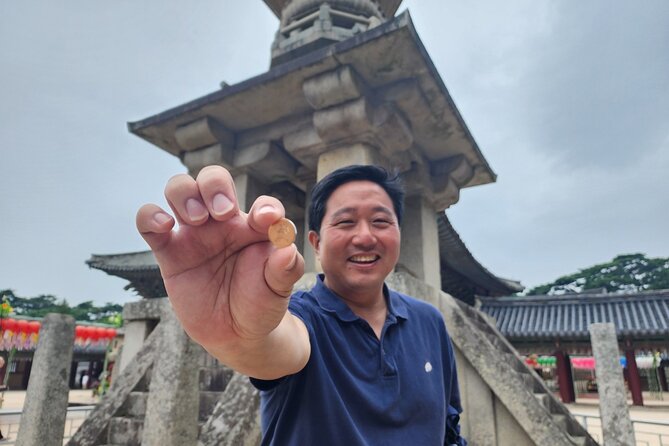
Bulguksa is the first major stop, and it gives you the architectural foundation for the day. The temple expresses Silla Buddhism through its buildings, stairs, courtyards, and carefully arranged stonework. Its UNESCO status is not just a label for a checklist. The site helps you see how religion, royal power, and design were joined in Silla Korea.
Plan to spend about an hour here. That is enough to see the main areas with a guide, but not enough for a slow wander through every corner. I would listen closely to the explanation of how the temple is arranged, then leave a little time to look at the stone details yourself.
The value of having a guide is especially clear at Bulguksa. Eunhee, also called Daisy, has been praised for explaining the subtleties of the temple complex and its Buddhist background. Kim has also received praise for calm explanations of Buddhism and Korean history. Those subjects can be hard to read from a sign alone, particularly when the English information is brief.
The temple visit involves walking, stairs, and outdoor exposure. Good shoes are a must. If your group includes a 90-year-old relative or a small child, say so before the day begins and agree on a pace that leaves room for comfort.
Seokguram Grotto: a short visit with great meaning
Seokguram is a purpose-built Buddhist grotto set within a cave, and it is paired with Bulguksa as another UNESCO site. The experience is different from the temple. Bulguksa presents religious ideas through open architecture and stone platforms, while Seokguram focuses attention on the grotto and its sacred sculpture.
The planned visit lasts about an hour. Your guide can explain why the grotto matters and how it fits the Silla Buddhist tradition. Daisy’s background in Silla and Buddhist history has been singled out as a strong part of this portion of the day.
The visit can feel more focused than the broad temple complex, which is helpful on a packed schedule. The tradeoff is that you have little spare time if you arrive late or traffic has already slowed the morning. Keep your group together and listen for the guide’s instructions so you do not lose time before the next stop.
Hongsi Hanjeongsik: the meal is part of the culture
Lunch is planned at Hongsi Hanjeongsik, a traditional Korean restaurant in the Gyeongju area. Hanjeongsik usually means a Korean set meal served with several dishes, so this is a chance to experience a style of eating that is different from grabbing a quick dish between monuments.
The restaurant choice is one of the tour’s more personal touches. Several guides have been praised for finding traditional restaurants that are difficult to locate without local help. Finn explained the dishes to one visitor, and Cynthia used the meal to teach a few Korean words. That is exactly the sort of small cultural exchange that makes a day feel less like a race between photo stops.
There is an important price detail here. The overview says local lunch is part of the tour package, but the inclusion list says meals are not included, and the Hongsi stop lists admission as not included, which appears to refer to the meal cost. Treat lunch as extra unless the operator confirms otherwise before you book.
You should also clarify whether your guide will sit and eat with you or simply recommend the restaurant. One critical account described confusion about this point. It is easy to prevent that problem with a clear conversation at the start of the day.
More UNESCO sites in Gyeongju:
- Gyeongju UNESCO sites Private tour with licensed tour guide
★ 5.0 · 275 reviews - Busan: Gyeongju UNESCO Legacy Tour with National Museum
★ 5.0 · 172 reviews - Gyeongju UNESCO World Heritage Sites and History Full-Day Tour with Lunch
★ 5.0 · 104 reviews - Gyeongju: UNESCO Heritage Tour Including Bulguksa Temple
★ 4.8 · 104 reviews
Daereungwon Tomb Complex: walking among royal burial mounds
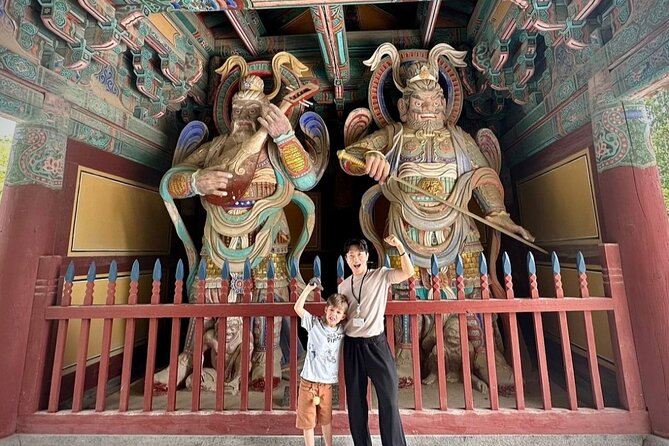
Daereungwon brings you into the royal side of Silla. The complex contains large burial mounds associated with ancient kings and nobles. Their size is striking, but the real interest comes from understanding why these rounded earth tombs were built and what they reveal about status, ceremony, and the Silla court.
The one-hour stop gives you time to walk around the grounds and take in the scale of the mounds. It also provides a useful change of setting after the temples. You move from Buddhist architecture to royal funerary monuments, which helps show that Gyeongju was both a religious center and a political capital.
Admission is listed separately at ₩3,000 per person. That is a small extra cost, but you should carry it in your day’s budget along with the charge for Donggung Palace and Wolji Pond.
This is another place where pacing matters. The tomb area may look simple at first, but the guide’s explanation supplies the context. If you are traveling with children, ask for a short, clear explanation of what lies beneath the mounds rather than expecting them to appreciate the site through scenery alone.
Cheomseongdae: ancient science in a compact form
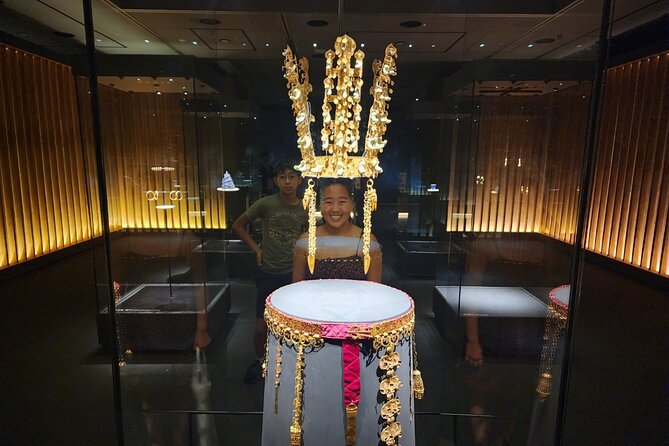
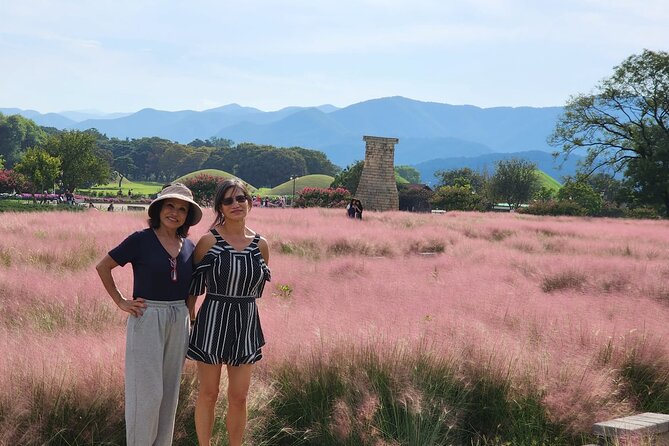
Cheomseongdae is one of Gyeongju’s most recognizable monuments. It is described as the oldest surviving astronomical observatory in the world, built with 362 stones that symbolize the days of the year. The structure is not large, so the stop is less about spending an hour inside a building and more about understanding its purpose and the scientific skill behind it.
Your guide can connect the observatory to Silla’s interest in the sky, calendars, farming, and royal decision-making. This is a good stop for anyone who thinks Gyeongju is only about temples and tombs. The city also preserves evidence of early engineering and astronomy.
The visit is listed as free. Because the monument is a brief outdoor sight, your guide may be able to adjust the time here if another location needs more attention. That flexibility is useful on a crowded day, and several guides, including Lily and Arthur, have been praised for changing the plan when traffic or holiday crowds interfere.
Donggung Palace and Wolji Pond: the atmospheric evening option
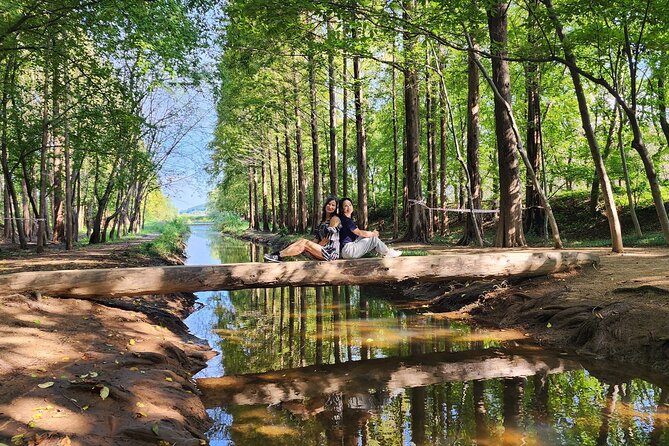
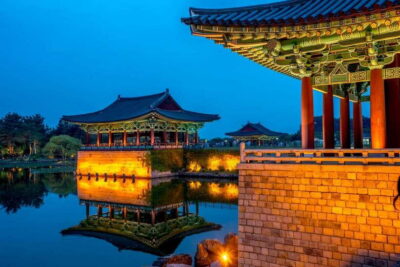
Donggung Palace and Wolji Pond, once called Anapji, was created in 674 during the reign of King Munmu of Silla. The artificial pond belonged to a palace complex and is now one of the city’s most atmospheric historic settings.
The planned visit lasts an hour. The water, reconstructed palace buildings, and reflections make this a strong photography stop, especially later in the day. Lily has been praised for taking a group to see the palace lit at night, when the setting becomes particularly memorable.
Do not assume the lighting schedule or arrival time without checking. The tour description allows an eight to nine-hour day, but the exact order and timing can change. Tell your guide if seeing the pond after dark is a priority, then let the guide judge the traffic and opening conditions.
Admission is listed as ₩3,000 per person. This is one of the two specific entrance charges you should expect in addition to the tour price.
Gyeongju National Museum: finish with real objects
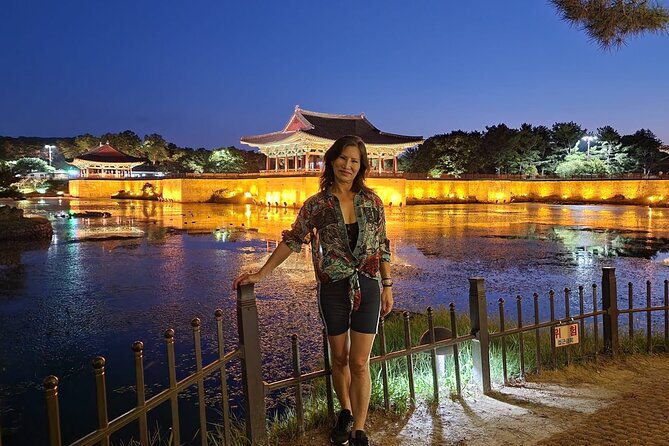
The Gyeongju National Museum is the day’s indoor counterpoint to the outdoor monuments. Its collections include artifacts unearthed in Gyeongju and objects connected with the Silla Kingdom. After seeing temples, tombs, and palace remains in place, the museum gives you the actual objects and smaller details that help complete the picture.
One hour is enough for a guided introduction, though museum lovers may want longer. If you are especially interested in gold, Buddhist art, royal objects, or archaeological finds, tell your guide before the day begins so the visit can match your interests.
The museum is listed as free. It is also a smart place to finish if the weather turns wet or hot. Mimi’s flexibility in poor weather and Lily’s ability to adjust holiday schedules suggest that the private setup can work well when conditions are not ideal, but the guide cannot remove the need for outdoor walking at the earlier sites.
Guide quality and the personal touches
The strongest part of this experience is the human service. The most praised guides explain clearly, keep the day moving, and adjust the plan without making you feel rushed. Jason has been praised for punctual pickups, comfortable transport, family photography, and flexible routing. Finn has been praised for working well with a group that included children and older adults. Joy, Lily, Cynthia, Arthur, Daisy, Mimi, Kim, Nick, Lee, and Bada Cho have also received positive comments for their English, cultural explanations, patience, or ability to handle unusual conditions.
That does not mean every guide will have the same style. One poor account raised concerns about slow pacing, limited bathroom breaks, incorrect information, parking far from an entrance, and confusion at lunch. The operator gave a detailed response, explaining that the guide was trying to accommodate a five-year-old and a 90-year-old relative, and that the day had been affected by the group’s needs.
The useful lesson is not to ignore the complaint or assume it represents every tour. Instead, be specific before departure. Ask for regular bathroom stops, tell the guide how far an older relative can walk, explain if you prefer independent time at each monument, and clarify the lunch arrangement. One person specifically advised making clear from the beginning if you want the guide to accompany you at each site or wait nearby.
Price, group size, and what you receive
The listed price is $186.50 per person. The value depends heavily on group size. For one or two people, it is a premium way to see Gyeongju. For a family or group of friends, the private vehicle, guide, parking, tolls, fuel surcharge, pickup, and drop-off become easier to justify because the cost buys a full day of shared service rather than separate transport and admission products.
The package covers a professionally qualified English-speaking guide and an air-conditioned vehicle. Parking fees and toll fees are included, which removes small but irritating costs during a long driving day. The mobile ticket and booking confirmation at the time of booking also make the arrangement straightforward.
Two admission charges are extra: ₩3,000 per person for Daereungwon and ₩3,000 per person for Donggung Palace and Wolji Pond. Meals are also listed as extra, despite the conflicting lunch language. Ask for a written clarification before paying.
Free cancellation is available if you cancel at least 24 hours before the start time. Changes or cancellations inside that window are not accepted for a refund.
Who should book this Gyeongju day?
I would choose this tour if you want to cover the major sites without figuring out Gyeongju’s transport system. It fits families, multigenerational groups, first-time visitors, and anyone who wants historical explanation in English. It is also useful if you are arriving from Busan or a ferry port and need a pickup plan, though confirm the exact pickup area.
The tour suits people who value flexibility more than a fixed group itinerary. A guide may alter the order for weather, crowds, traffic, or your interests. That was especially useful during Chuseok and other busy periods.
I would hesitate if you prefer slow, independent exploration. Seven stops in one day leave limited time at each place. You should also reconsider if someone in your group cannot handle several outdoor walks, unless you arrange a gentler plan in advance.
Should you book it?
Book this private Gyeongju tour if you want the city’s main Silla sites in one organized day, with a guide who can explain what you are seeing and adjust the route to your group. The strongest value comes with four or more people, when the private vehicle and personal service begin to compare well with piecing together transport yourself.
Before booking, confirm three things: the pickup location, whether lunch is included, and how much walking and guide accompaniment your group wants. If those details fit, this is a practical and rewarding way to see Gyeongju’s temples, tombs, science, palace remains, and museum in a single day.
FAQ
How long does the private Gyeongju tour last?
The tour lasts approximately eight to nine hours.
What sites are included?
The planned stops are Bulguksa Temple, Seokguram Grotto, Hongsi Hanjeongsik, Daereungwon Tomb Complex, Cheomseongdae Observatory, Donggung Palace and Wolji Pond, and the Gyeongju National Museum.
Is hotel pickup and drop-off included?
Pickup and drop-off are included at select locations. You should confirm that your location is covered when booking.
Is the tour conducted in English?
Yes. An English-speaking guide is included.
How many people can join a private group?
The intimate private option is for one group of 1 to 7 people. A mid-sized private option is available for one group of 8 to 15 people.
Which entrance fees are not included?
Daereungwon Tomb Complex lists an entrance fee of ₩3,000 per person. Donggung Palace and Wolji Pond also lists an entrance fee of ₩3,000 per person.
Is lunch included in the price?
The tour information is inconsistent. The overview describes a local lunch as part of the package, but the detailed inclusions say meals are not included. Confirm this with Korea Go Tours before booking.
Can I cancel for a full refund?
Yes, if you cancel at least 24 hours before the experience start time. Cancellations or changes made less than 24 hours before the start time are not refunded or accepted.
Just added in Gyeongju
- Yangdong village & Gyeongju Unesco Site Private Van Tour★ 5.0 · 1 review
- Small Group 7D Korea package Tour with Seoul Gyeongju Busan Jeju★ 4.5 · 13 reviews
- Gyeongju UNESCO Sites Tour by KTX train; The Museum Without walls★ 4.5 · 11 reviews
- Full-Day Small Group GyeongJu History Tour from Seoul★ 5.0 · 2 reviews
- 7 days Flexible Tour for Major Cities(Seoul,Busan,Gyeongju etc)★ 5.0 · 5 reviews
- PREMIUM 5 Days Tour for Wonder of Korea(Mt. Seoraksan, Andong, Gyeongju, Busan)★ 5.0 · 1 review
- 5 Days Tour for Korea’s past and present(Mt.Seoraksan, Andong, Gyeongju, Busan)★ 5.0 · 1 review
- 7 Days Highlight Korea Tour(Seoul, Nami, DMZ, Andong, Gyeongju, Busan)★ 5.0 · 1 review
UNESCO World Heritage Tours, compared.
Gyeongju UNESCO World Heritage Guided Day Tour
Read our review →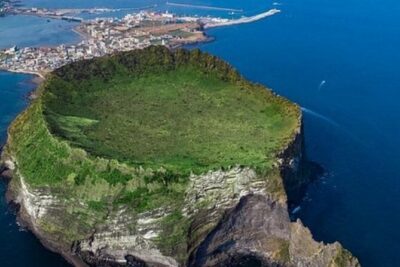

East Jeju Essentials – Seongsan Ilchulbong (UNESCO) & Haenyeo
Read our review →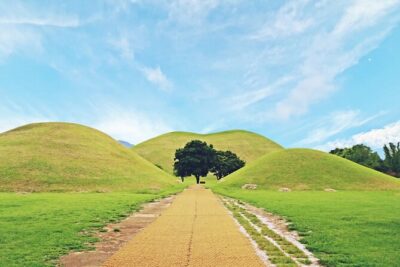
Gyeongju UNESCO World Heritage Guided Day Tour from Busan
Read our review →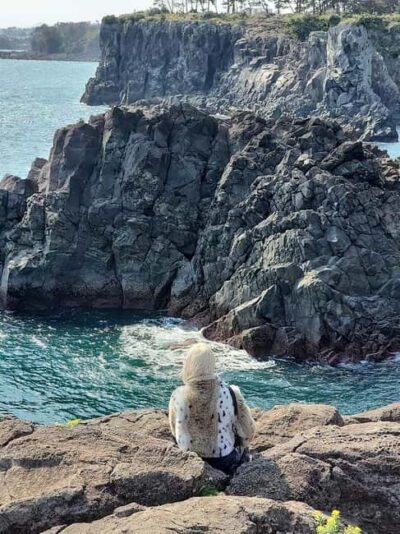
Jeju Southern UNESCO Full Day Tour with Mt.Halla
Read our review →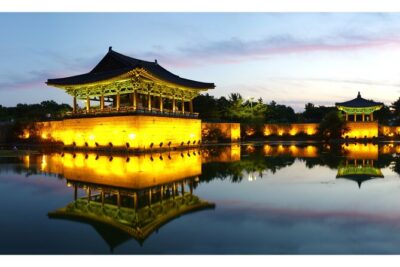
Gyeongju UNESCO sites Private tour with licensed tour guide
Read our review →
Browse the lists this tour appears in