
Reviewed · UNESCO WORLD HERITAGE TOURS
Gyeongju city tour From BUSAN – UNESCO World Heritage Site
History is everywhere in Gyeongju. This private day trip from Busan takes you into Korea’s former Silla capital, with visits to royal tombs, Buddhist monuments, palace ruins, and traditional homes. I especially like the combination of private transport and a professional English-speaking guide, since Gyeongju’s sites are spread across the city and countryside.
I also like that admission to the listed historic sites is included. That keeps the day simple, and the guide can explain why a grassy mound is a royal tomb, why a pond once hosted palace parties, and why a stone tower mattered to Silla astronomers. The main drawback is the price: at $340 per person, this is a serious splurge, particularly for a solo visitor or a pair traveling on a tight budget.
The reward is a focused look at Korea’s Silla period without having to arrange several buses, taxis, entrance tickets, and translations yourself. A past participant gave special praise to a guide named Jay for making the day interesting and educational. If your guide offers the same level of explanation, that human context may be the tour’s greatest value.
In This Review
- Key points to know before booking
- Why Gyeongju makes a worthwhile day trip from Busan
- Daereungwon Tomb Complex and the Silla royal dead
- Donggung Palace and Wolji Pond’s moonlit past
- Bulguksa Temple and its famous stone pagodas
- Seokguram Grotto and the mountain road
- Cheomseongdae Observatory and Silla astronomy
- Wolseong Fortress and the former royal center
- What the private format is really worth
- Timing, meals, and what to bring
- Guide quality can shape the whole day
- Cancellation and booking points
- Is this Busan to Gyeongju tour right for you?
- FAQ
- Where does the tour begin?
- Is hotel pickup included?
- Is transportation private?
- How long does the tour last?
- What sites are included?
- Are admission fees included?
- Is a guide included?
- Are meals included?
- Is bottled water included?
- What is the cancellation policy?
Key points to know before booking
- Six major historic stops: The route includes Daereungwon Tomb Complex, Donggung Palace and Wolji Pond, Bulguksa Temple, Seokguram Grotto, Cheomseongdae Observatory, and Wolseong Fortress.
- Private door-to-door travel: Hotel pickup and drop-off are included, along with private round-trip transportation from Busan.
- Silla history in several forms: You see royal burial mounds, palace remains, Buddhist art, astronomy, and a traditional Hanok village area.
- Bulguksa and Seokguram are the big draws: These two sites provide the strongest reason to make the long day trip from Busan.
- A full day with a firm start: The tour begins at 8:30 am and lasts about eight to nine hours.
- Bring money for food and drinks: Meals, travel insurance, and bottled water are not included.
Why Gyeongju makes a worthwhile day trip from Busan
Busan is a modern port city with beaches, markets, and busy streets. Gyeongju offers a very different Korea. It was the capital of the Silla dynasty and later the United Silla Kingdom, and its historic sites are scattered through a broad area rather than packed into one small old quarter.
That geography matters. You could visit Gyeongju independently, but you would need to plan the order of several distant sights and keep track of local transport. On this tour, your private vehicle handles the long connections while your guide gives the sites a common thread.
I like the range of places included. This is not simply a temple tour. You move from burial customs to royal ceremony, Buddhist sculpture, astronomy, palace life, and traditional architecture. In one day, you get a useful outline of how Silla society worked.
The schedule is also fairly ambitious. Six stops fit into eight or nine hours, so you should expect a sightseeing day rather than a slow, unplanned wander. If you prefer spending half a day at one temple, this may feel rushed. If you want a broad first look at Gyeongju, the pace makes good sense.
More History Tours in Busan
- From Busan: Gyeongju UNESCO World Heritage Guided Day Tour
★ 4.8 · 1,250 reviews - Gyeongju UNESCO World Heritage Guided Day Tour from Busan
★ 5.0 · 660 reviews - Old Korea Thousand History Tour of Gyeongju from Busan
★ 5.0 · 518 reviews
Daereungwon Tomb Complex and the Silla royal dead
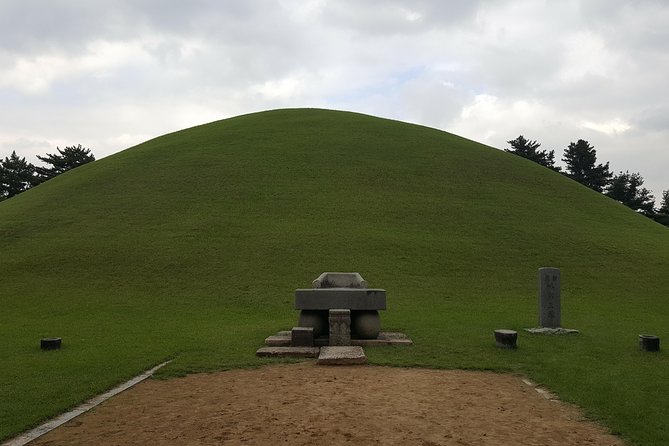
Daereungwon is a strong opening stop because the setting immediately looks different from ordinary city sightseeing. More than 20 large and small burial mounds rise across the Tumuli Park. Their smooth, rounded shapes are simple from the outside, but they represent the graves of kings and court officials from the Silla period.
Your guide can help you read the site. Most of the mounds are earthen and mound-shaped, while some have a double-gourd form associated with the joint burial of a husband and wife. Excavations found that the tombs were stone-piled, wood-lined chambers, a style believed to apply to many of the graves in the complex.
The discoveries here also show the power and ceremony of Silla’s ruling class. Excavations at Cheonmachong and Hwangnamchong uncovered a gold crown, gold girdles, gold and silver ornaments, horse fittings, and weapons. Those objects tell you that these were not ordinary burials. They were carefully prepared displays of rank, wealth, and military status.
You have about one hour here, with admission included. That is enough time to walk among the mounds and listen to the explanation, though you may want longer if archaeology is your main interest. The site is more about atmosphere and scale than dramatic architecture, so the guide’s storytelling matters.
Donggung Palace and Wolji Pond’s moonlit past
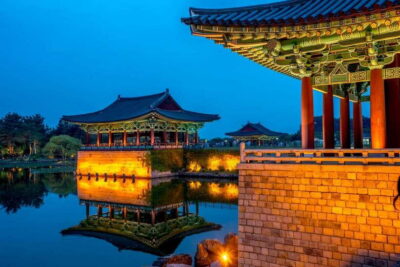
Donggung Palace and Wolji Pond gives the day a different mood. This was a secondary palace of the Silla dynasty, also known as Anapji Pond. Donggung means East Palace, while Wolji means Moon Pond, a fitting name for a carefully shaped royal setting.
The palace once included Imhaejeon Hall and other buildings. It was used for celebrations and for welcoming important visitors. Today, you mainly see the reconstructed or surviving historic setting around the water, with the palace’s former role explained through the remains.
This is one of Gyeongju’s best-known views at night, but the tour schedule begins at 8:30 am and includes several other stops. Do not book this excursion expecting a dedicated evening visit to the pond. You will see the site as part of the daytime route.
I like this stop because it adds palace life to the story. Daereungwon shows what happened after death. Wolji helps you picture ceremony, hospitality, and royal entertainment while the Silla court was still active. The one-hour visit should give you time to take in the water and hear the background without turning the stop into a long palace archaeology session.
Bulguksa Temple and its famous stone pagodas
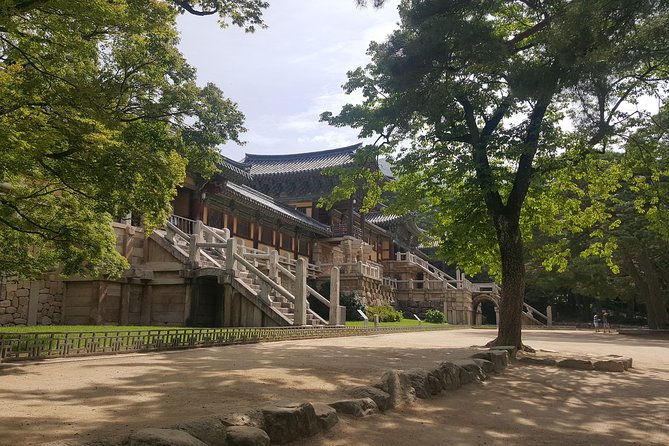
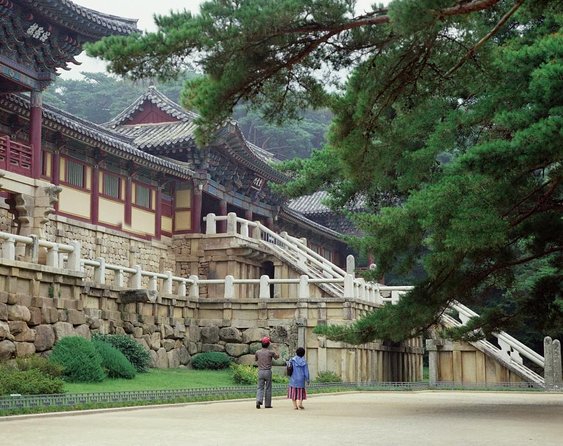
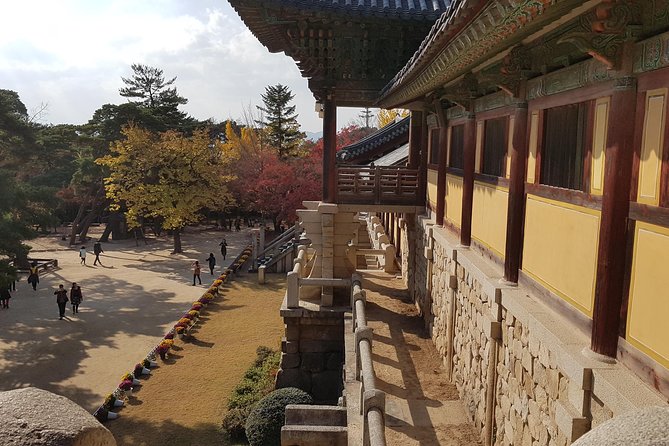
Bulguksa is likely the emotional center of the day. It is Korea’s best-known Buddhist temple and dates from the eighth century, though it has been rebuilt more than once. The grounds contain important Silla-era relics, including the two famous stone pagodas, Dabotap and Seokgatap.
The temple is valuable not only because it is old, but because its stonework, pagodas, stairs, and halls express the religious ambitions of the Silla kingdom. This is the point where the political story and Buddhist story meet. A good guide can explain what you are seeing instead of leaving you with a collection of unfamiliar names.
You have about 90 minutes here, with admission included. That is a sensible amount of time for a guided visit, though temple enthusiasts may wish for more. Wear comfortable shoes and expect a fair amount of standing and walking across historic grounds. The tour data does not specify the exact walking conditions, so anyone concerned about mobility should ask the provider before booking.
Bulguksa also works well as a contrast to the open tomb park. The tombs are low and grassy. Bulguksa is built upward, with formal stone features and religious buildings. The change keeps the day from feeling repetitive.
More History Tours in Gyeongju
- From Busan: Echoes of Silla Gyeongju Historical Day Tour
★ 4.8 · 55 reviews - Gyeongju Historic Areas Day Tour with Sky Capsule from Busan
★ 5.0 · 18 reviews - Gyeongju The UNESCO World heritage sites tour(Private tour)
★ 5.0 · 17 reviews - From Busan: Gyeongju Historical Day Tour with Sky Capsule
★ 4.7 · 17 reviews
Seokguram Grotto and the mountain road
Seokguram Grotto is part of the Bulguksa temple complex, but it deserves its own stop. The hermitage sits about 750 meters above sea level and overlooks the East Sea. Construction lasted from 742 to 774, placing the main work in the same broad Silla period as Bulguksa.
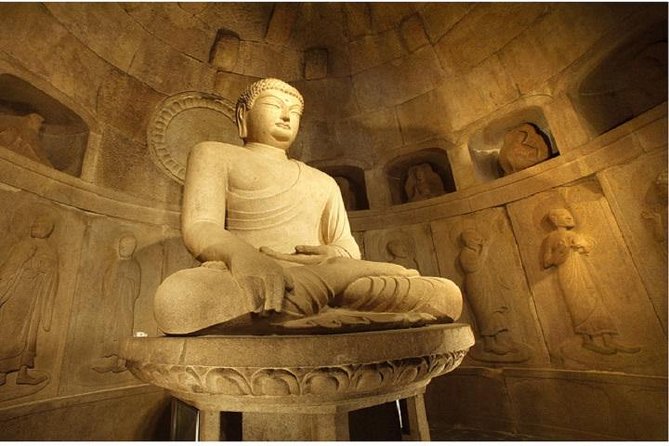
Inside the round main hall are the Bonjon Statue, bodhisattva figures, and disciples. The central Buddha sits on a lotus-carved platform and is described as wearing a gentle smile. The sculpture is the main reason to make the trip up the mountain.
You have one hour here, and admission is included. That should allow time for the approach, the grotto visit, and the view, but it is not an open-ended mountain outing. The site is also famous for sunrise, when people climb up early to see the morning light. This tour starts at 8:30 am, so it is not designed as a sunrise excursion.
Seokguram can be the most memorable stop for visitors interested in Buddhist art. It may be less satisfying if you want a long hike or plenty of quiet time. The tour gives you access and transport, but the schedule keeps the visit compact.
Cheomseongdae Observatory and Silla astronomy
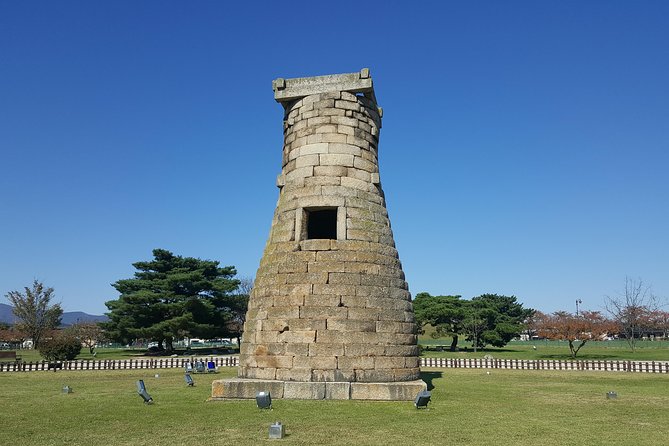
Cheomseongdae Observatory is a short stop of about 30 minutes, and admission is free. The name means Star Gazing Tower. Built during the reign of Queen Seondeok in 634, it is described as the oldest existing observatory in Asia.
The tower’s design carries a calendar in its stones. It has 27 levels arranged in a round form, with four sets of parallel bars forming a square at the top. Twelve rectangular base stones are arranged in a square, three on each side, representing the four seasons and twelve months.
For Silla’s court, watching the sky was not just an academic exercise. Court astrologers studied the movements of stars and planets, interpreted their findings for the king, and helped guide royal decisions. That gives the small stone tower an importance that is easy to miss if you only stop for a photograph.
Thirty minutes is enough for an explanation and a look around. The stop will appeal most to visitors who enjoy science, calendars, and the practical side of ancient government. It is a brief outdoor visit, so do not expect a museum-style presentation.
Wolseong Fortress and the former royal center
Wolseong Fortress is another 30-minute stop, with no admission charge. The site was the royal palace compound of the Silla monarchy during both the Silla and United Silla periods. Its walls were shaped roughly like a crescent moon, which explains the name Wolseong.
You will not find a complete palace waiting here. This is a palace site and fortress area, so the value comes from understanding its position in the old capital. After seeing tombs and a secondary palace, you get a sense of where the Silla court governed.
The short visit is useful as a final piece of the political story. It may feel understated if you expect intact halls or dramatic fortifications. Listen closely to the guide, since the meaning of the site depends more on its history and layout than on standing buildings.
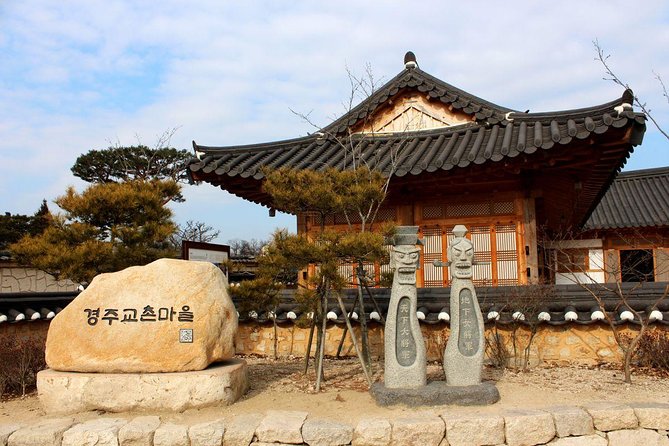
The wider Gyeongju experience also includes the Gyochon Traditional Hanok Village in the tour description. The six listed timed stops do not assign a separate duration to it, so the exact amount of time there is not clear. Still, its traditional Korean homes offer a welcome change from tombs, ruins, and temple grounds.
What the private format is really worth
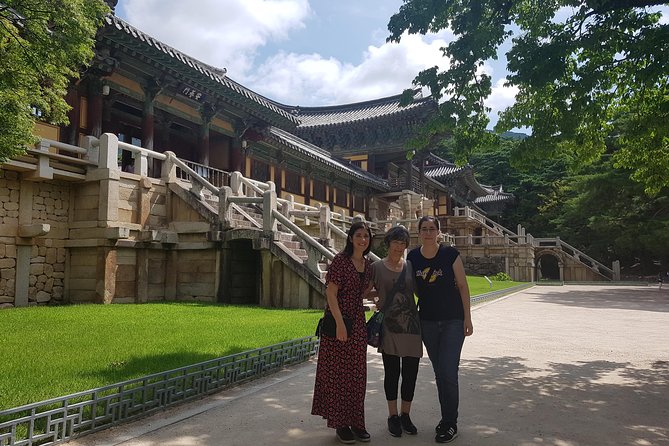
The private format is the clearest reason to consider the $340 price. Only your group participates, and the vehicle is reserved for your party. Hotel pickup and drop-off are included, which removes the need to reach a central meeting point in Busan.
That convenience is worth more if you are traveling with family, have limited time, or want to ask many questions. It also helps if your group has its own rhythm. You can focus on the stops that interest you most, within the day’s planned schedule, rather than following a large group.
The minimum is two tourists per day. At the advertised rate, two people would pay $680 before meals, bottled water, insurance, and any other personal expenses. For a couple, that is a substantial cost, but it covers private transportation, a professional English-speaking guide, and admission fees.
I would compare the price with the cost of arranging a private car, a guide, and separate entrance tickets yourself. The tour will not be the cheapest way to reach Gyeongju, but it bundles the parts that are hardest to coordinate. A solo visitor may find the per-person price difficult to justify, while a small family or group may see better value in the shared private vehicle.
Timing, meals, and what to bring
The day starts at 8:30 am and lasts approximately eight to nine hours. Since the route includes several historic sites, you should plan for a full day with regular walking and outdoor time.
Meals are not included. The supplied details do not state where or when lunch takes place, so ask the provider about the meal break before departure. You should also bring your own bottled water, since it is specifically excluded.
Admission to all visited historical sites is included, and Cheomseongdae and Wolseong Fortress do not charge admission according to the tour details. Travel insurance is not included, so you will need to arrange that separately if you want coverage.
The tour is near public transportation, but private hotel pickup and drop-off are included. Most people can participate, though the available information does not give detailed accessibility specifications. If stairs, uneven historic grounds, or mountain access are concerns, ask Tagytravelkorea for a clear answer before booking.
Guide quality can shape the whole day
This itinerary contains plenty of names and dates. Without explanation, it could become a tiring parade of tombs, stones, and palace foundations. The guide’s role is to connect the sites and show you why they matter.
Guide Jay received especially warm praise for being excellent and for helping the group learn a great deal. That specific mention is useful because it points to the kind of service that makes a private tour worthwhile: clear explanation, personal attention, and a sense that the day is more than transport between attractions.
Guide assignments can change, so I would not assume Jay will lead every departure. Still, the praise suggests that the provider has delivered a strong guiding experience at least once. If history is a major reason you are visiting Gyeongju, ask about the guide’s language ability and background when you book.
Cancellation and booking points
Confirmation is provided when you book, and free cancellation is available if you cancel at least 24 hours before the local start time. Changes or cancellations made less than 24 hours before the start are not accepted for a refund.
The tour requires at least two participants per day. If that minimum is not reached and the operator cancels, you are offered another date or experience, or a full refund. Keep this requirement in mind if you are booking alone.
Is this Busan to Gyeongju tour right for you?
Book this tour if you want to see Gyeongju’s major Silla sites in one organized day and value a private vehicle, hotel pickup, included admissions, and an English-speaking guide. It is especially suitable for couples, families, and small groups who would rather pay for convenience than manage a complicated independent route.
Think twice if $340 per person feels excessive, if you prefer slow visits, or if your main goal is to see Gyeongju after dark. The schedule is broad and efficient, not leisurely, and the famous night view of Wolji Pond is not the focus of an 8:30 am departure.
For many first-time visitors to Korea, Gyeongju is too important to skip and too spread out to tackle casually. This tour gives you a practical way to see its major sights, with the strongest value coming from the private transport and guide. If those features fit your budget, it is a solid choice for a history-focused day from Busan.
FAQ
Where does the tour begin?
The tour begins in Busan at 8:30 am.
Is hotel pickup included?
Yes. Hotel pickup and drop-off service are included.
Is transportation private?
Yes. The tour includes private round-trip transportation, and only your group participates.
How long does the tour last?
The experience lasts approximately eight to nine hours.
What sites are included?
The listed stops are Daereungwon Tomb Complex, Donggung Palace and Wolji Pond, Bulguksa Temple, Seokguram Grotto, Cheomseongdae Observatory, and Wolseong Fortress.
Are admission fees included?
Yes. Admission fees to the visited tourist sites are included. Cheomseongdae Observatory and Wolseong Fortress are listed as free admission stops.
Is a guide included?
Yes. A professional English-speaking guide is included.
Are meals included?
No. Meals are not included in the tour price.
Is bottled water included?
No. Bottled water is not included.
What is the cancellation policy?
You can cancel at least 24 hours before the experience start time for a full refund. Cancellations or changes made less than 24 hours before the start time are not accepted for a refund.
More UNESCO Sites in Busan
- Busan: Gyeongju UNESCO Legacy Tour with National Museum
★ 5.0 · 172 reviews - From Busan to Gyeongju UNESCO Legacy Tour with National Museum
★ 5.0 · 87 reviews - 3-Days 2-Nights Gyeongju UNESCO Sites & Busan City [Private Tour from Seoul]
★ 4.5 · 11 reviews - UNESCO Tongdosa Temple + Gourmet Eonyang Style Bulgogi Lunch
★ 5.0 · 7 reviews
Just added in Busan
- Small Group 7D Korea package Tour with Seoul Gyeongju Busan Jeju★ 4.5 · 13 reviews
- Private Transfer from Seoul to Busan(up to 12 passengers)★ 5.0 · 1 review
- Jinhae Cherry Blossom + Busan Sunrise from Seoul★ 4.5 · 5 reviews
- 7 days Flexible Tour for Major Cities(Seoul,Busan,Gyeongju etc)★ 5.0 · 5 reviews
- PREMIUM 5 Days Tour for Wonder of Korea(Mt. Seoraksan, Andong, Gyeongju, Busan)★ 5.0 · 1 review
- 5 Days Tour for Korea’s past and present(Mt.Seoraksan, Andong, Gyeongju, Busan)★ 5.0 · 1 review
- 7 Days Highlight Korea Tour(Seoul, Nami, DMZ, Andong, Gyeongju, Busan)★ 5.0 · 1 review
- 5-Day Korea Golden route by K-shuttle Tour from Seoul Including Busan, Yeosu★ 4.5 · 37 reviews
UNESCO World Heritage Tours, compared.
Gyeongju UNESCO World Heritage Guided Day Tour
Read our review →

East Jeju Essentials – Seongsan Ilchulbong (UNESCO) & Haenyeo
Read our review →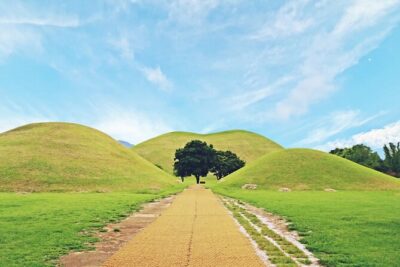
Gyeongju UNESCO World Heritage Guided Day Tour from Busan
Read our review →
Jeju Southern UNESCO Full Day Tour with Mt.Halla
Read our review →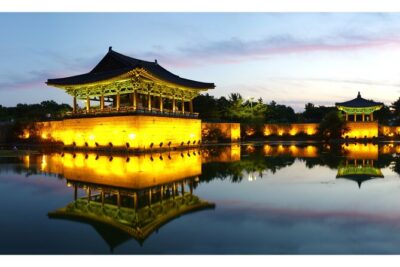
Gyeongju UNESCO sites Private tour with licensed tour guide
Read our review →
Private Gyeongju Tour – Explore Gyeongju UNESCO Sites
Read our review →Browse the lists this tour appears in